Losing someone you love is never easy. When a friend or family member experiences loss, finding the right words feels impossible. Many people struggle to write a sympathy card message that truly comforts the bereaved. Consequently, they avoid sending anything at all. However, silence often hurts more than imperfect words. This guide will help you understand what a genuine sympathy card message looks like in modern communication. Interestingly, sympathy messages have moved beyond physical cards into texts, DMs, and social media comments. Therefore, learning how to express condolences digitally matters more than ever. For instance, a thoughtful text can provide immediate comfort when someone is grieving. As a result, you will learn exactly how to craft messages that heal rather than harm. Let’s explore the art of condolence writing together. 😌
Definition & Core Meaning
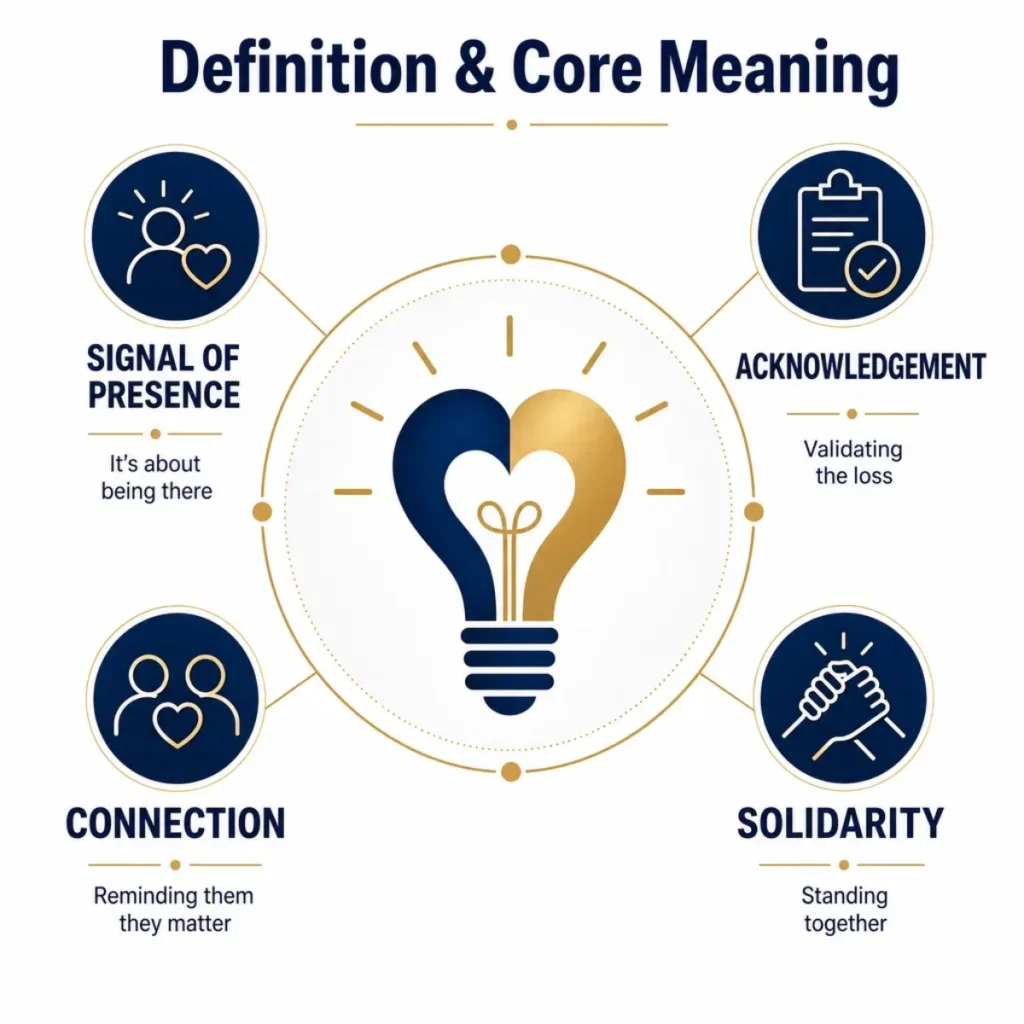
What does a sympathy card message actually mean in text-based communication? At its core, this phrase refers to written expressions of compassion sent to someone experiencing grief, loss, or hardship.
Primary Definition
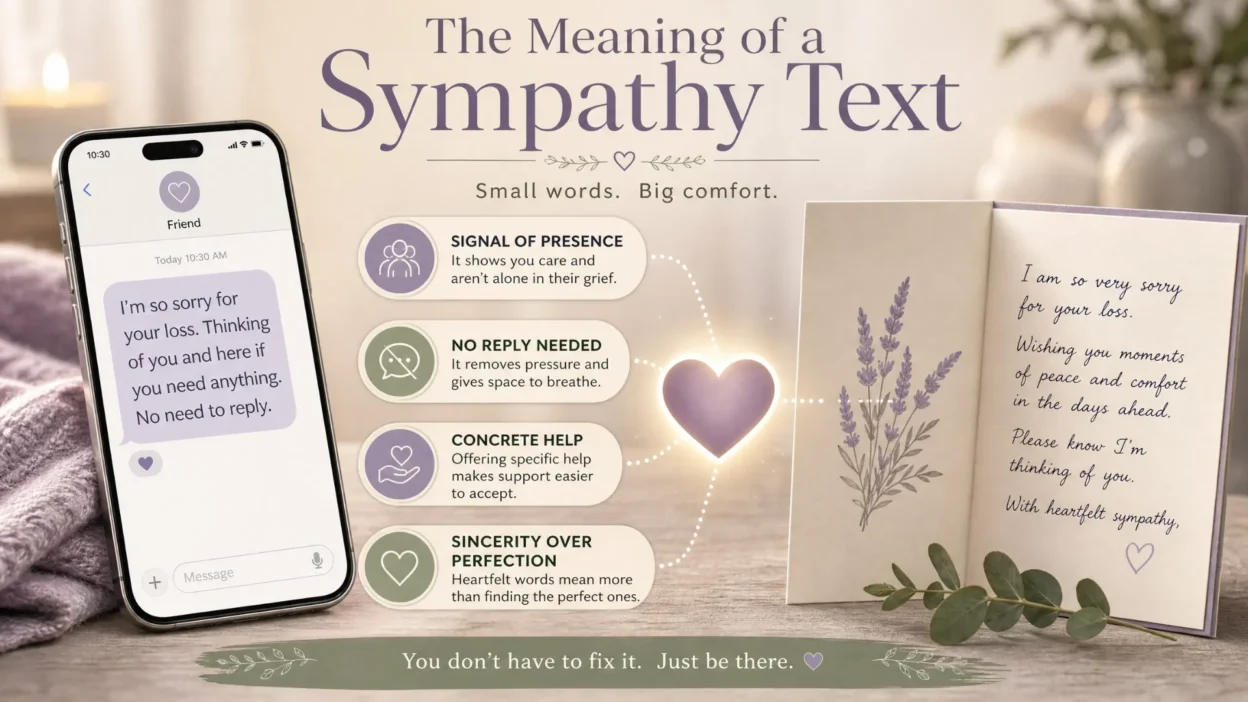
A sympathy card message is a written note expressing sorrow, support, and solidarity with a bereaved person. Specifically, these messages acknowledge the recipient’s pain without trying to fix it. For example, “I am so sorry for your loss” remains a classic opening line. Similarly, “Thinking of you during this difficult time” offers gentle support.
Core Components of an Effective Message
Every meaningful sympathy card message contains four essential elements:
- Acknowledgment of the loss (name the deceased or situation)
- Expression of sorrow (use phrases like “heartbroken” or “deeply saddened”)
- Offer of support (be specific, not vague)
- A respectful closing (with sympathy, with love, etc.)
What It Is NOT
Importantly, a sympathy card message is not a therapy session, a religious lecture, or a story about your own grief. Avoid making the message about yourself. Instead, focus entirely on the grieving person’s needs.
History & Origin of Sympathy Card Messages
Understanding the history of the sympathy card message reveals why certain phrases feel appropriate or awkward today.
Victorian Era Origins
The modern sympathy card traces back to Victorian England (1837-1901). During this period, mourning rituals became highly formalized. People sent handwritten letters on black-bordered paper to express condolences. Subsequently, the invention of the postage stamp (1840) made mailing sympathy notes accessible to the middle class.
Commercial Sympathy Cards Emerge
By the 1910s, Hallmark and other companies began producing pre-printed sympathy cards. Initially, these cards featured religious imagery and formal language. For example, “The Lord is my Shepherd” appeared on countless cards. However, by the 1960s, secular messages gained popularity as society became less religiously uniform.
Digital Age Transformation
The sympathy card message has now evolved into texts, emails, and social media comments. Interestingly, a 2022 survey found that 47% of people under 35 prefer receiving sympathy texts over physical cards. Accordingly, platforms like Facebook’s “Grief Support” features and CaringBridge websites have created new condolence formats.
Why Traditional Phrases Persist
Nevertheless, certain phrases have survived for over a century. “With deepest sympathy” first appeared in Victorian mourning cards. “You are in our thoughts and prayers” became common in 1950s America. These phrases persist because they feel safe and familiar. However, some grieving people find them hollow. Therefore, personalizing your sympathy card message is more important than ever.
Real-World Examples in Conversations
To master the sympathy card message, study these four real-world examples. Each demonstrates different relationships and situations.
Example 1: Text Message to a Close Friend (Loss of Parent)
You: “Hey Sarah. I just heard about your mom. I’m absolutely heartbroken for you. No need to reply. I’ll drop off dinner tomorrow at 5. Love you. ❤️”
Why it works: Specific offer of help (dinner), removes pressure to respond, uses loving language.
Example 2: Direct Message on Instagram (Loss of Pet)
You: “Saw your post about Max. Losing a furry family member is so hard. He was the goodest boy. Sending you a huge hug. 🐾”
Why it works: Acknowledges pet as family, uses shared memories, keeps it brief for social media.
Example 3: Email to a Coworker (Miscarriage)
You: “Dear Maria, I was so sorry to learn about your loss. Please take all the time you need. Your projects are covered. Let me know if you want me to handle anything else. With sympathy, James”
Why it works: Professional yet warm, offers concrete work support, respects privacy.
Example 4: Sympathy Card Message for a Neighbor (Sudden Death)
You: (Handwritten note) “Dear Mr. Thompson, We were devastated to hear about Mrs. Thompson’s passing. She always made our street feel like a community. We are making meals for the family this week. May we drop off a casserole on Tuesday? With deepest sympathy, The Jenkins family”
Why it works: Specific memory honors the deceased, offers tangible help, asks permission before acting.
How Context Changes Meaning of Sympathy Card Message
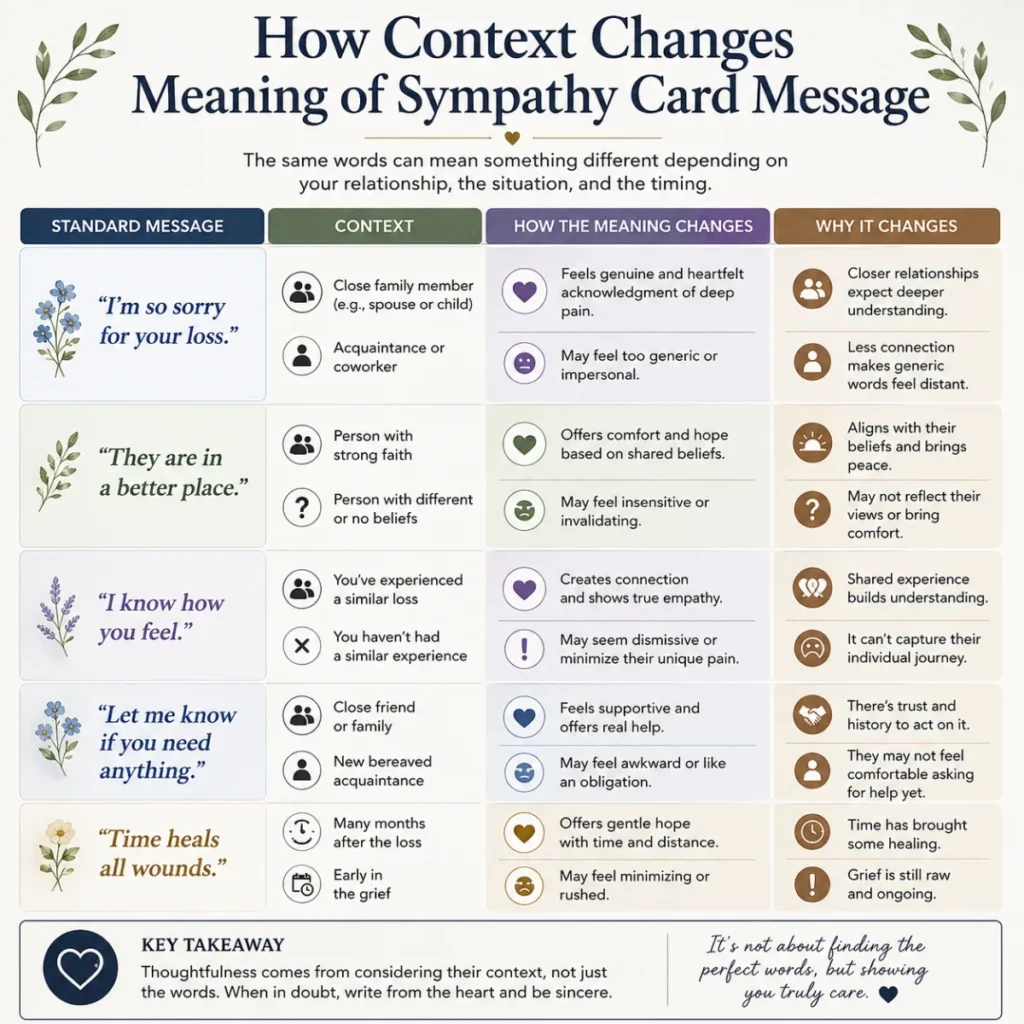
The sympathy card message changes dramatically across different platforms and relationships. Let’s break down five common contexts.
Texting (Close Friends & Family)
- Best length: 2-3 sentences
- Tone: Warm, personal, informal
- Example: “Can’t stop thinking about you. I’m here whenever you want to talk.”
- Avoid: Long paragraphs or excessive emojis
Social Media (Public Comments)
- Best length: 1-2 sentences
- Tone: Respectful, brief, non-intrusive
- Example: “So sorry for your loss. Sending love to your family.”
- Avoid: Details about the death or lengthy stories
Email (Professional Acquaintances)
- Best length: 3-5 sentences
- Tone: Formal, respectful, concise
- Example: “Please accept my sincere condolences. Your contributions to the team are valued, and we support you fully.”
- Avoid: Overly emotional language or religious references (unless you know their beliefs)
Dating Apps (If Someone Shares Loss)
- Best length: 1-2 sentences, then change subject unless they continue
- Tone: Gentle, respectful, not pushy
- Example: “I’m really sorry you’re going through that. Thanks for sharing with me.”
- Avoid: Trying to “cheer them up” or offering solutions
Sympathy Card (Physical or Digital)
- Best length: 4-8 sentences
- Tone: Thoughtful, personal, unhurried
- Example: Full note with specific memories and offers of help
- Avoid: Clichés like “Everything happens for a reason”
Key Insight: Shorter does not mean colder. In fact, grieving people often lack energy for long messages. A brief, sincere sympathy card message beats a lengthy, generic one every time.
Tone Nuances: Is a Sympathy Card Message Rude or Kind?
Many people worry: “Will my sympathy card message accidentally offend someone?” Generally, sincere efforts are appreciated. However, certain tones backfire.
When a Sympathy Message Feels Kind
- Acknowledges the loss directly (names the deceased)
- Avoids clichés like “They’re in a better place”
- Offers specific, actionable help
- Respects the person’s grief timeline
- Example: “I remember how your dad always made us laugh. That joke about the lawnmower still makes me smile. I’m so sorry.”
When a Sympathy Message Feels Rude or Hurtful
- Minimizes the loss (“At least they lived a long life”)
- Makes it about the sender (“When MY mother died…”)
- Gives unsolicited advice (“You should try grief counseling”)
- Uses toxic positivity (“Just stay positive!”)
- Example: “Everything happens for a reason. You’ll be stronger because of this.”
The “Silence is Rude” Principle
Interestingly, sending NO sympathy card message often feels ruder than sending an imperfect one. Grieving people notice who reaches out. A short, awkward message at least shows you care. Consequently, don’t let fear of saying the wrong thing stop you from saying anything.
Cultural Sensitivity Matters
Different cultures have different mourning customs. For instance:
- Jewish tradition: Avoid sending flowers. Instead, make a charitable donation or bring food.
- Muslim tradition: “Inna lillahi wa inna ilayhi raji’un” (To God we belong, to Him we return) is appropriate.
- Hindu tradition: “Om shanti” conveys peace for the departed soul.
- Mexican tradition: References to Día de los Muertos are respectful.
When unsure, stick to universal phrases like “I am so sorry for your loss.”
Sympathy Card Message vs Similar Condolence Terms
To fully understand the sympathy card message, compare it with other expressions of condolence. The table below clarifies key differences.
TermDefinitionLengthFormalityBest ForSympathy Card MessageWritten condolence for lossMedium (2-8 sentences)VariesAny bereavementCondolence TextQuick sympathy via SMSShort (1-3 sentences)CasualClose friendsEulogySpeech at funeral serviceLong (5-10 minutes)FormalPublic memorialsMemorial PostPublic tribute on social mediaMedium (3-6 sentences)Semi-formalOnline communitiesThinking of You NoteGeneral support (not just grief)Short (1-4 sentences)CasualIllness, divorce, job lossObituary CommentResponse to published death noticeVery short (1-2 sentences)FormalAcquaintancesGrief Journal EntryPersonal reflection, not sharedAny lengthPrivateSelf-processing
Key Difference: A sympathy card message is specifically for loss and can be physical or digital. Other terms like “condolence text” are simply delivery methods. Meanwhile, “memorial posts” are public, whereas sympathy cards are typically private.
How to Respond to a Sympathy Card Message
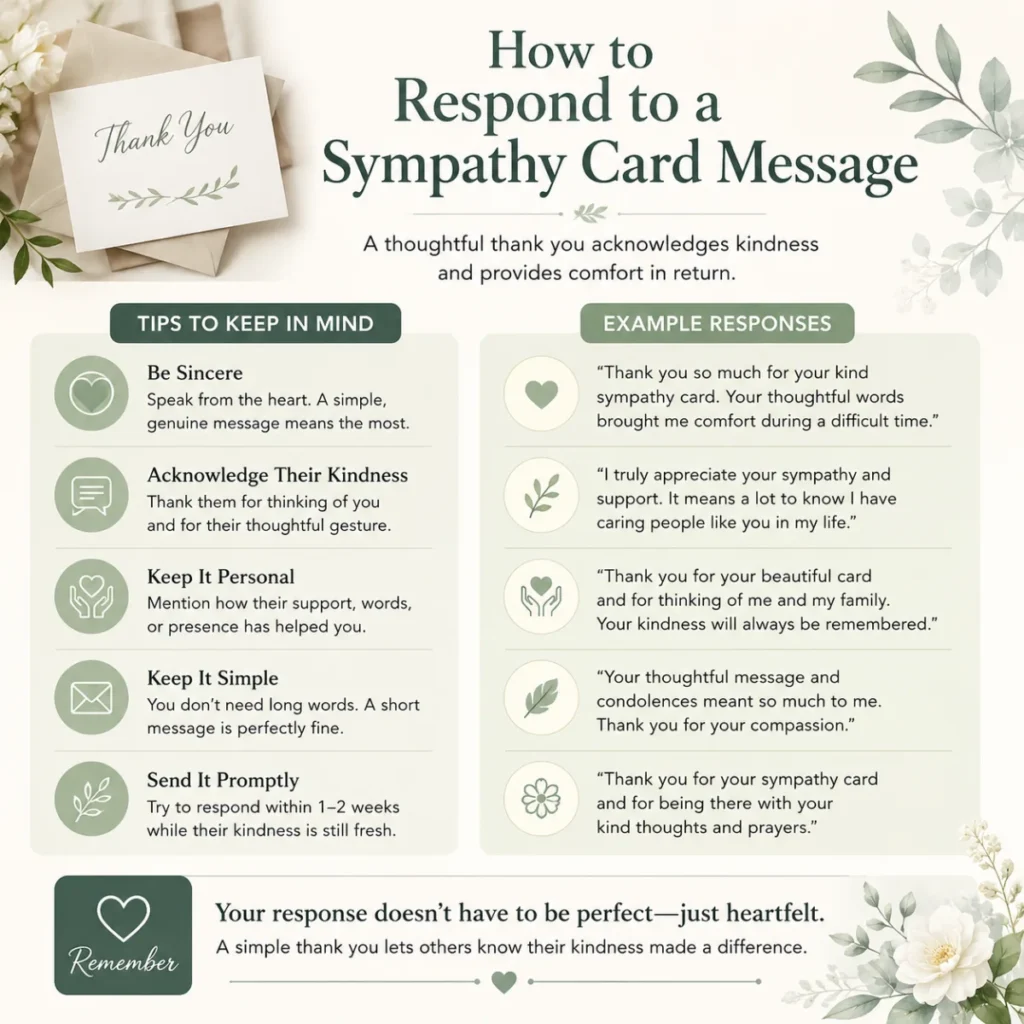
When someone sends you a sympathy card message, responding appropriately matters. However, grieving people have no obligation to reply. Here are three scenarios.
Scenario 1: You Are Grieving and Received a Message
Appropriate responses (if you have energy):
- Short reply: “Thank you for thinking of me.”
- Slightly longer: “Your message meant a lot. I’ll reply properly when I can.”
- Group response: Post on social media: “Thank you everyone for your kind messages. I’ve read them all and am grateful.”
You can also: Say nothing at all. Grieving is exhausting. Real friends will understand.
Scenario 2: You Sent a Message and the Person Replies
How to respond to their gratitude:
- Appropriate: “No need to thank me. Just take care of yourself.”
- Alternative: “I’m glad I could help a little. Let me know if you need anything specific.”
- Avoid: Asking for details about the death or pushing them to talk.
Scenario 3: You Received a Message That Hurt You
If someone’s sympathy card message offended you:
- Close friend: “I know you meant well, but that message actually hurt because…”
- Acquaintance: Say nothing or simply “Thank you” and move on.
- Toxic person: No response needed. Protect your peace.
Pro Tip: Most people genuinely try their best. Assume good intentions unless proven otherwise.
Professional Use: Can You Send a Sympathy Card Message at Work?
Workplace condolences require special care. The sympathy card message in professional settings must balance humanity with boundaries.
When to Send a Work Sympathy Message
- Coworker’s immediate family member dies (spouse, child, parent)
- Coworker experiences a miscarriage or stillbirth
- Long-term employee loses a sibling or close friend (use judgment)
Appropriate Professional Messages
To a direct report: “Please take all the time you need. The team has your projects covered. We are all thinking of you.”
To a peer: “I was so sorry to hear about your loss. Let me know if you want me to handle any meetings this week.”
To a senior executive: “Please accept my deepest sympathies. Your leadership is missed, but your family comes first.”
What to Avoid at Work
- ❌ Religious references (unless you know their faith)
- ❌ Asking for details about the death
- ❌ Sending a group email without permission
- ❌ Mentioning work deadlines or deliverables
Group Sympathy Cards at Work
Many offices circulate a group sympathy card message for a grieving colleague. Best practices include:
- One person coordinates (usually HR or an admin)
- Keep messages brief (2-3 sentences each)
- Avoid inside jokes or overly personal stories
- Deliver the card after the first week of bereavement leave
Digital Workplace Sympathy (Slack, Teams)
On platforms like Slack, send a direct message, not a public channel message. Example: “Hi Jenna. Just saw the news. I’m so sorry. No need to reply. Your tasks are on hold until you return.”
Key Takeaway: Professional sympathy messages should be warm but brief. Respect privacy above all else.
Common Misconceptions (4 Myths Debunked)
Many myths surround the sympathy card message. Let’s clear up the most harmful misunderstandings.
Myth 1: “You Must Send a Physical Card, Not a Text”
False. Research from the American Psychological Association (2021) found that grieving people value any acknowledgment of their loss. A text sent immediately often provides more comfort than a card that arrives two weeks late. However, physical cards remain appropriate for older relatives or formal relationships.
Myth 2: “Longer Messages Are More Meaningful”
False. In fact, grieving people often lack the emotional energy to read lengthy notes. A concise, heartfelt sympathy card message of 2-4 sentences typically has more impact than a rambling paragraph. Quality over quantity wins here.
Myth 3: “Never Mention the Deceased’s Name – It Will Upset Them”
False. Most grieving people want to know their loved one is remembered. Using the deceased’s name shows courage and care. For example, “I’ll never forget how Maria made everyone laugh” is healing, not hurtful. The exception is immediately after a traumatic death when the person is in shock.
Myth 4: “You Should Wait a Few Days Before Sending a Message”
False. This outdated advice leaves grieving people feeling abandoned. Send your sympathy card message as soon as you hear the news. Then, send another message one week later, one month later, and on the anniversary of the death. Grief lasts far longer than the first week.
Myth 5: “Only Send One Message – Don’t Bother Them Again”
False. Most grieving people report feeling forgotten after the first month. Continuing to check in (respectfully) is profoundly kind. For example, “Thinking of you today. No need to reply” at 30 days post-loss means everything.
5 Polite Alternatives to Standard Sympathy Card Messages
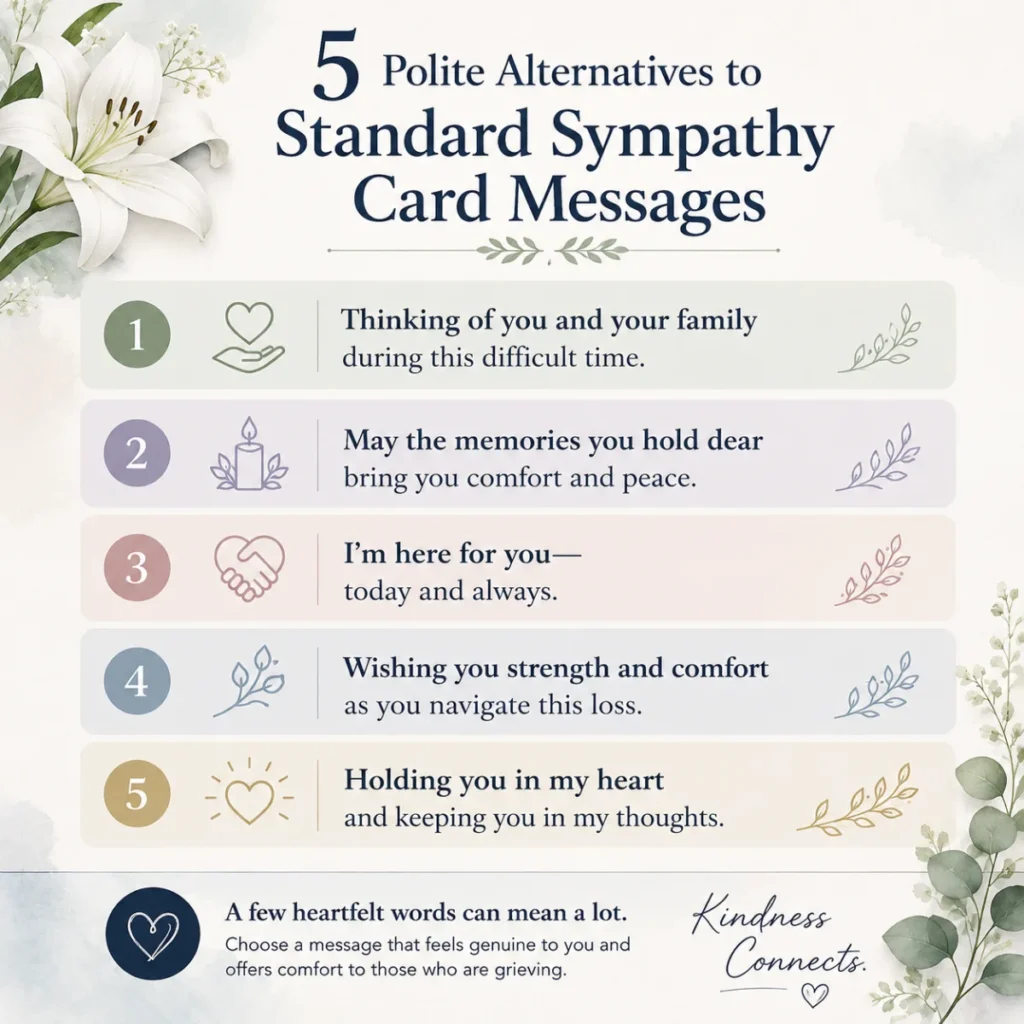
Sometimes traditional sympathy card message phrases feel stale or insincere. Here are five meaningful alternatives organized by situation.
Instead of This ClichéTry This Alternative InsteadWhy It Works“They’re in a better place”“I’m so sorry you have to carry this loss.”Avoids assumptions about the afterlife; focuses on the griever“Let me know if you need anything”“I’m dropping off dinner on Tuesday. Does 5 PM work?”Specific, actionable, removes burden from griever“Everything happens for a reason”“There’s no reason for this. It’s simply unfair.”Validates the injustice of loss; doesn’t minimize pain“Time heals all wounds”“This grief will change shape over time. I’ll be here for all of it.”Honest about ongoing nature of grief; offers long-term support“Stay strong”“You don’t have to be strong right now. It’s okay to fall apart.”Gives permission to be human; reduces pressure
Bonus Alternatives for Specific Situations
For a child’s death: “No parent should outlive their child. I am holding space for your unimaginable pain.”
For a suicide loss: “This loss is complicated and heavy. I am here to listen without judgment whenever you need.”
For a death after long illness: “You showed such incredible love through years of caregiving. Now, please care for yourself.”
For a pet loss: “They weren’t ‘just a pet.’ They were family. I’m so sorry for your loss of [pet’s name].”
Frequently Asked Questions (7 FAQs)
FAQ 1: What is the best opening line for a sympathy card message?
Answer: The safest and most effective opening is “I am so sorry for your loss.” Alternatively, use “I was heartbroken to learn about [name]’s passing.” Both acknowledge the loss directly without adding pressure. Avoid opening with “I know how you feel” because you cannot truly know another person’s grief.
FAQ 2: How long should a sympathy card message be?
Answer: For a physical card, aim for 4-8 sentences. For a text, 2-3 sentences suffice. For social media, 1-2 sentences work best. Remember: grieving people have limited emotional energy. A shorter, sincere message beats a longer, generic one every time.
FAQ 3: Can I send a sympathy card message via email?
Answer: Yes, absolutely. Email is appropriate for coworkers, acquaintances, or when you don’t have the person’s physical address. However, reserve email for less intimate relationships. For close friends or family, a text or physical card feels more personal.
FAQ 4: What should I NEVER write in a sympathy card message?
Answer: Avoid these five phrases entirely:
- “Everything happens for a reason”
- “They’re in a better place”
- “At least they’re not suffering anymore”
- “You’ll get over it”
- “I know exactly how you feel”
Additionally, never mention money, inheritance, or legal matters in a sympathy message.
FAQ 5: Is it okay to send a sympathy card message weeks after the death?
Answer: Yes, and you absolutely should. Most people receive a flood of support in week one, then silence. A sympathy card message sent at 3 weeks, 6 weeks, or 3 months stands out as exceptionally kind. Write: “I’ve been thinking of you lately. Still holding you in my heart.”
FAQ 6: How do I sign a sympathy card message?
Answer: Appropriate closings include:
- “With sympathy” (formal)
- “With love” (close family)
- “Thinking of you” (casual)
- “In caring thoughts” (neutral)
- “With deepest condolences” (traditional)
Avoid “Sincerely” (too businesslike) or “XOXO” (too casual for grief).
FAQ 7: Should I include a religious message if I’m not sure of their beliefs?
Answer: No. When unsure, stick to secular language. “You are in my thoughts” works for everyone. “You are in my prayers” only works if you know they share your faith. Imposing religious comfort can alienate or upset non-religious grievers.
Conclusion
Writing a sympathy card message feels intimidating, but your sincere effort will always be appreciated. Remember the four core components: acknowledge the loss, express sorrow, offer specific support, and close respectfully. Keep your message concise, personal, and free of clichés. Most importantly, send something rather than nothing. Silence hurts more than imperfect words.
As a result of reading this guide, you now have the tools to comfort grieving friends, family, coworkers, and acquaintances. Whether you send a text, an email, a social media DM, or a physical card, your compassion will make a difference. Grief is lonely. Your sympathy card message reminds someone that they are not alone.
So go ahead. Write that message today. Use the deceased’s name. Offer a specific meal or errand. Then, follow up again in a few weeks. That is the true art of condolence. 💙

Amelia Brooks is a passionate writer specializing in text meanings, slang, and digital communication trends. She simplifies modern messaging to help readers understand every text with ease.