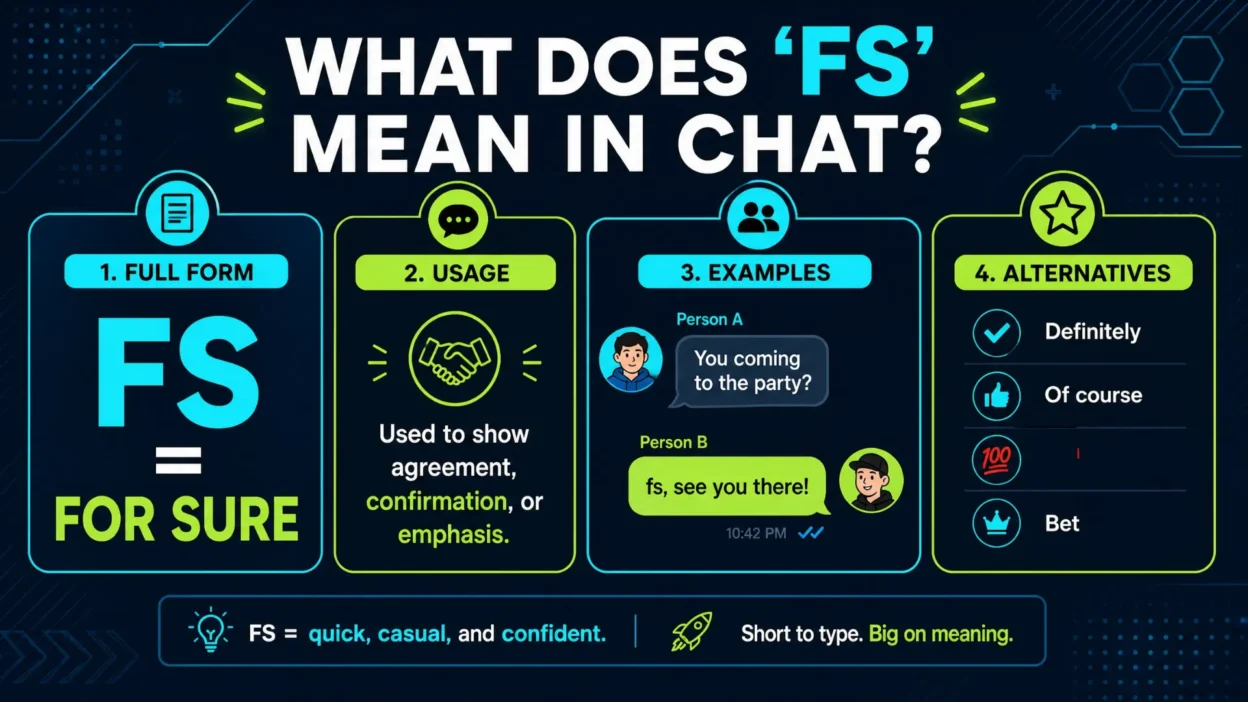
Have you ever received a text message with the letters “fs” and found yourself staring at the screen in confusion? You are certainly not alone. Many people encounter this abbreviation daily across various messaging platforms. The fs full form in chat is “For Sure.” This simple yet powerful expression has become a staple of modern digital communication. Consequently, understanding its meaning can significantly improve your texting fluency.
Interestingly, “For Sure” conveys agreement, confirmation, or enthusiasm. When someone types “fs,” they are essentially saying “definitely,” “absolutely,” or “I agree.” Typically, this abbreviation appears in casual conversations among friends, family members, or close colleagues. As a result, mastering this term will help you sound more natural in online discussions.
In this comprehensive guide, we will explore everything about the fs full form in chat. Specifically, you will learn its origins, real-world examples, contextual meanings, and polite alternatives. Moreover, we will address common misconceptions and provide practical response strategies. Therefore, keep reading to become a confident user of this popular slang term.
Definition & Core Meaning

The fs full form in chat stands for “For Sure.” This two-word phrase functions as an affirmative response or an expression of certainty. For instance, when someone asks, “Are you coming to the party?” replying with “fs” means “Yes, absolutely.” Similarly, if a friend says, “That movie was great,” responding “fs” indicates strong agreement.
Nevertheless, the abbreviation carries nuances beyond simple confirmation. Specifically, “fs” can convey enthusiasm, reassurance, or even excitement. Consider these core meanings:
- Agreement: “I think we should leave early.” → “fs” (I agree completely)
- Confirmation: “You’ll finish the report by Friday?” → “fs” (Definitely yes)
- Reassurance: “Are you sure about this plan?” → “fs” (I am absolutely certain)
- Enthusiasm: “This is the best pizza ever!” → “fs” (I strongly agree)
Additionally, the fs full form in chat rarely appears in formal writing. Therefore, you should reserve it for informal conversations. Typically, younger audiences (teens and young adults) use this abbreviation most frequently. However, people of all ages who text regularly may adopt “fs” for convenience.
For example, a parent might text their teenager: “Pick up milk on your way home?” The teen replies: “fs.” This exchange demonstrates efficiency and mutual understanding. Consequently, “fs” saves time while maintaining clarity.
History & Origin of fs full form in chat

Tracing the exact origin of the fs full form in chat reveals an interesting evolution. Specifically, the phrase “For Sure” gained popularity in spoken English during the 1980s and 1990s. Movies like “Fast Times at Ridgemont High” (1982) and “Clueless” (1995) featured characters using “for sure” as a catchphrase. Nevertheless, the abbreviated version “fs” emerged much later with the rise of SMS texting.
In the early 2000s, character limits on mobile phones encouraged users to shorten common phrases. Consequently, “fs” joined other abbreviations like “lol” (laugh out loud), “brb” (be right back), and “omw” (on my way). Interestingly, early internet chat rooms (AOL, MSN Messenger) popularized these shorthand forms.
By 2010, the fs full form in chat had become standard on platforms like Twitter, Instagram, and Snapchat. As a result, teenagers and young adults adopted “fs” for rapid-fire conversations. For instance, instead of typing “for sure,” users could simply type two letters. This efficiency proved particularly valuable on platforms with character restrictions.
Similarly, the rise of smartphone keyboards with predictive text further cemented “fs.” Nowadays, typing “fs” often auto-suggests “for sure” as the intended phrase. Therefore, the abbreviation continues to thrive in digital communication.
Real-World Examples in Conversations
Understanding the fs full form in chat becomes easier with practical examples. Below are four realistic scenarios demonstrating how people use “fs” in everyday texting.
Example 1: Making Plans with Friends
Person A: “Hey, are we still meeting at 7 PM for dinner?” Person B: “fs! I’ll be there.” Person A: “Great. Should I book a table?” Person B: “fs, do it.”
Explanation: Here, “fs” confirms plans and expresses agreement.
Example 2: Responding to a Question
Person A: “Do you think I should ask for a raise?” Person B: “fs! You’ve worked hard for two years.” Person A: “Thanks for the encouragement.” Person B: “Of course. fs, you deserve it.”
Explanation: “Fs” reinforces support and certainty about the advice given.
Example 3: Reacting to a Statement
Person A: “That concert last night was incredible.” Person B: “fs! The energy was amazing.” Person A: “Especially the final song.” Person B: “fs, that was the best part.”
Explanation: In this context, “fs” shows strong agreement with the speaker’s opinion.
Example 4: Reassuring Someone
Person A: “Are you positive you locked the front door?” Person B: “fs, I checked twice.” Person A: “Okay, just making sure.” Person B: “No worries. fs, we’re safe.”
Explanation: Here, “fs” provides reassurance and eliminates doubt.
How Context Changes Meaning (Texting, Social Media, Gaming, Dating Apps)

The fs full form in chat adapts its tone based on the platform and situation. Therefore, understanding these nuances prevents miscommunication.
Texting (iMessage, WhatsApp, SMS)
In standard texting, “fs” almost always means “for sure.” Specifically, it confirms plans, agrees with opinions, or reassures the recipient. For instance, a friend says, “Want to grab coffee?” You reply, “fs.” This exchange is casual and friendly.
Social Media (Instagram, Twitter, TikTok)
On social media, “fs” can appear in comments, captions, or direct messages. Typically, it expresses strong agreement with a post. For example, under a funny video, someone might comment, “fs this is hilarious.” Similarly, in a Twitter reply, “fs” might emphasize solidarity with a viewpoint.
Gaming (Discord, Twitch, In-Game Chat)
In gaming communities, the fs full form in chat often takes on additional urgency. Gamers use “fs” to quickly confirm strategies or respond to callouts. For instance, a teammate types, “Push the objective now?” Another replies, “fs” meaning “Absolutely, let’s do it immediately.” Consequently, speed matters more than politeness in this context.
Dating Apps (Tinder, Bumble, Hinge)
On dating apps, “fs” can signal enthusiasm or interest. However, be cautious. Using “fs” too early might seem overly eager. For example, if someone asks, “Want to meet this weekend?” Replying “fs” is positive but casual. Nevertheless, adding a bit more warmth (“fs, I’d love that 😊”) often works better.
PlatformTypical MeaningToneTextingConfirmation/AgreementCasual & FriendlySocial MediaEmphasis/SolidarityEnthusiasticGamingQuick ConfirmationUrgent & DirectDating AppsInterest/EnthusiasmWarm but Cautious
Tone Nuances: Is fs full form in chat Rude or Friendly?
Many people wonder whether the fs full form in chat comes across as rude. Generally speaking, “fs” is friendly and casual, not rude. However, tone depends entirely on context and relationship.
When “fs” Feels Friendly
- Between close friends: “fs” sounds natural and warm.
- In response to good news: “fs, congrats!” shows excitement.
- After a favor: “fs, happy to help” expresses willingness.
When “fs” Might Seem Rude
- In professional settings: Using “fs” with a boss might appear disrespectful.
- With strangers: “fs” without explanation can seem abrupt.
- After sensitive topics: If someone shares sad news, “fs” is inappropriate.
For instance, imagine a colleague asks, “Can you proofread my report?” Replying only “fs” might feel dismissive. Instead, “fs, send it over” softens the response. Similarly, a friend says, “My grandmother passed away.” Never reply “fs.” That would be deeply insensitive.
As a result, always consider your audience. Tip: When unsure, write the full “for sure” instead of abbreviating.
fs full form in chat vs Similar Slang Terms
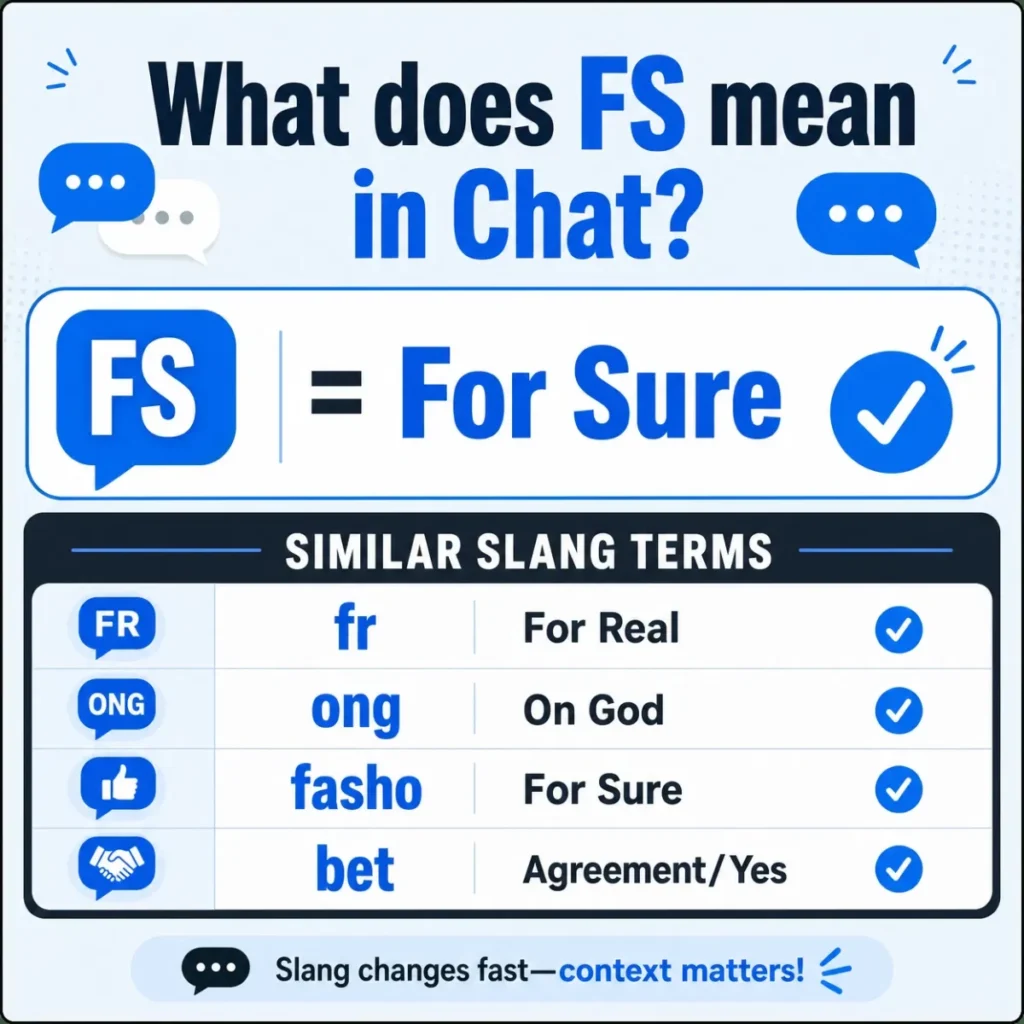
Several slang terms overlap with “fs.” Consequently, understanding the differences helps you choose the right word. Below is a comparison table.
SlangFull FormIntensityBest Used ForfsFor SureMediumCasual agreementdefDefinitelyHighStrong confirmationyeaYesLowSimple affirmativefoshoFor Sure (slang spelling)MediumInformal coolnessobviObviouslyHighStating the obvious100%One hundred percentVery HighAbsolute certaintyikrI Know, Right?MediumShared excitement
Example comparison:
- “Want pizza?” → “fs” (sure, okay)
- “Want pizza?” → “def” (absolutely yes)
- “Want pizza?” → “100%” (extremely enthusiastic)
Therefore, choose “fs” for everyday agreement. Save “def” or “100%” for stronger feelings.
What Does “If fs fs” Mean? (If Applicable)
Occasionally, users might type “if fs fs” in chat. This phrase is not standard. However, it could appear as a typo or a niche inside joke. For example, someone might write “if fs fs” meaning “if for sure, for sure” to emphasize double certainty. Nevertheless, this construction is rare.
More likely: The user intended to write “fs fs” (repeating “for sure” for emphasis). For instance: Person A: “Are you absolutely certain?” Person B: “fs fs — 100%.”
Consequently, ignore “if fs fs” as an error. Stick to standard “fs” for clarity.
How to Respond to fs full form in chat
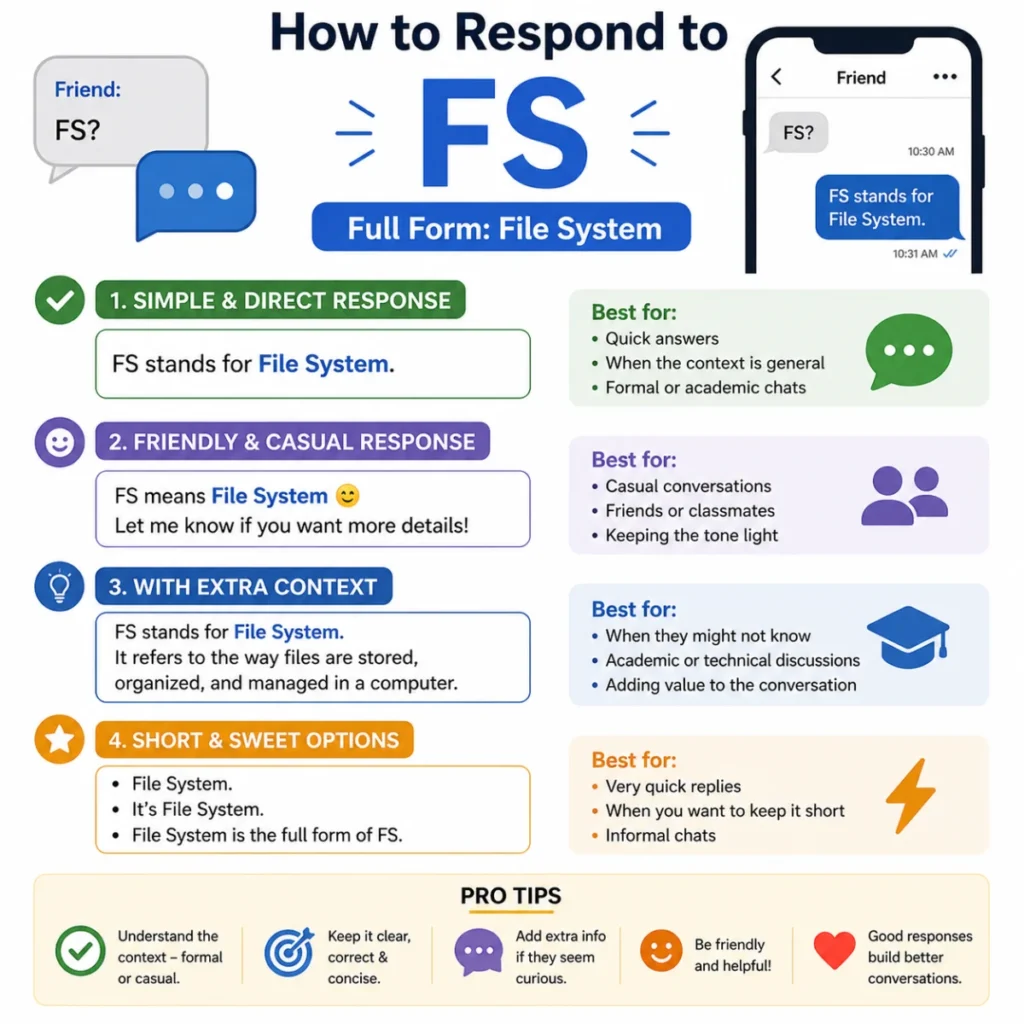
Receiving “fs” in a message requires an appropriate response. Below are three common scenarios.
Scenario 1: You Asked a Question, They Replied “fs”
You: “Can you help me move on Saturday?” Them: “fs”
Your response: “Thanks so much! I really appreciate it.” Why: Acknowledge their agreement with gratitude.
Scenario 2: You Shared an Opinion, They Replied “fs”
You: “This new coffee shop is amazing.” Them: “fs”
Your response: “Right? Their latte art is incredible.” Why: Continue the conversation by adding detail.
Scenario 3: You Requested Confirmation, They Replied “fs”
You: “You’ll send the file by 5 PM?” Them: “fs”
Your response: “Perfect. Let me know if anything changes.” Why: Show trust while leaving room for updates.
Professional Use: Can You Say fs full form in chat at Work?
Generally, avoid using the fs full form in chat at work. Professional environments expect clear, respectful language. Consequently, abbreviations like “fs” may appear lazy or unprofessional.
When It Might Be Acceptable
- Internal Slack channels with close teammates who use slang.
- Creative industries (marketing, tech startups) with casual cultures.
- After establishing a relaxed rapport with a colleague.
When to Avoid Completely
- Emails to clients or senior leadership.
- Formal reports or proposals.
- Messages to someone you don’t know well.
Better professional alternatives:
- “Certainly”
- “Absolutely”
- “Yes, I will”
- “For sure” (spelled out fully)
For example, instead of typing “fs,” write “Absolutely — I’ll handle that.” This approach maintains professionalism while still sounding friendly.
Common Misconceptions (4 Myths Debunked)
Several myths surround the fs full form in chat. Let us clarify them.
Myth 1: “fs means ‘Fingers Crossed’”
Reality: Rarely. While “fs” can mean “fingers crossed” in very specific contexts (e.g., “fs we win the game”), the overwhelming standard is “For Sure.” Therefore, assume “for sure” unless the topic involves hoping for luck.
Myth 2: “fs is outdated slang”
Reality: False. According to social media trends, “fs” remains widely used among Gen Z and millennials. In fact, platforms like TikTok and Twitter show consistent usage in 2024-2025.
Myth 3: “fs is only for teenagers”
Reality: Incorrect. Adults in casual chats also use “fs.” For instance, parents texting their adult children often adopt abbreviations for efficiency.
Myth 4: “fs is grammatically incorrect”
Reality: In formal writing, yes. In informal texting, no. Language evolves, and abbreviations serve practical purposes. Consequently, “fs” is perfectly acceptable for casual digital communication.
5 Polite Alternatives to fs full form in chat (With Table)
Sometimes you need a softer or more formal option. Below are five polite alternatives to the fs full form in chat.
AlternativeFormality LevelExample SentenceFor sure (spelled out)Casual but clear“For sure, I’ll be there.”AbsolutelyProfessional“Absolutely, I agree with your plan.”CertainlyFormal“Certainly, I can assist with that.”DefinitelyEnthusiastic“Definitely, that sounds great.”Of courseWarm & Polite“Of course, happy to help.”
Usage tip: When messaging a boss or client, choose “certainly” or “absolutely.” When texting a friend, “for sure” works perfectly. Consequently, matching your word choice to the relationship prevents misunderstandings.
Frequently Asked Questions (FAQs)
1. What does fs mean in chat from a guy?
From a guy, fs typically means “For Sure.” It shows agreement, confirmation, or reassurance. For instance, if you ask, “Are you coming to the game?” and he replies “fs,” he is saying yes enthusiastically. Context rarely changes this meaning.
2. What does fs mean in chat from a girl?
Similarly, from a girl, fs stands for “For Sure.” It expresses certainty or strong agreement. For example, “Do you like this dress?” “fs” means “Yes, definitely.” Therefore, gender does not alter the abbreviation’s core meaning.
3. Is fs rude in text messages?
Generally, no. The fs full form in chat is casual and friendly. However, using it in formal situations or with strangers might seem abrupt. Consequently, always consider your relationship with the recipient.
4. Can I use fs in professional emails?
No. Avoid using any slang abbreviations in professional emails. Instead, write “for sure,” “absolutely,” or “certainly.” This maintains professionalism while still sounding helpful.
5. What is the difference between fs and fosho?
“Fs” is the standard abbreviation for “For Sure.” “Fosho” (or “fo sho”) is a phonetic, slang-heavy spelling. Both mean the same thing. However, “fosho” sounds more casual and hip-hop influenced. For most situations, “fs” works fine.
Conclusion
Understanding the fs full form in chat transforms confusing texts into clear communication. As we have learned, fs stands for “For Sure,” expressing agreement, confirmation, or enthusiasm. This abbreviation thrives across texting, social media, gaming, and dating apps. Nevertheless, context matters significantly. While friendly among peers, “fs” has no place in professional emails.
Remember the key takeaways: Use “fs” casually with friends. Avoid it with bosses or strangers. When in doubt, spell out “for sure.” Additionally, polite alternatives like “absolutely” or “certainly” work better in formal settings.
Consequently, mastering “fs” will make you a more efficient and natural texter. Therefore, next time you see “fs,” you will respond confidently. And when you use it yourself, you will know exactly what tone you are projecting. Happy texting! 😉

Amelia Brooks is a passionate writer specializing in text meanings, slang, and digital communication trends. She simplifies modern messaging to help readers understand every text with ease.