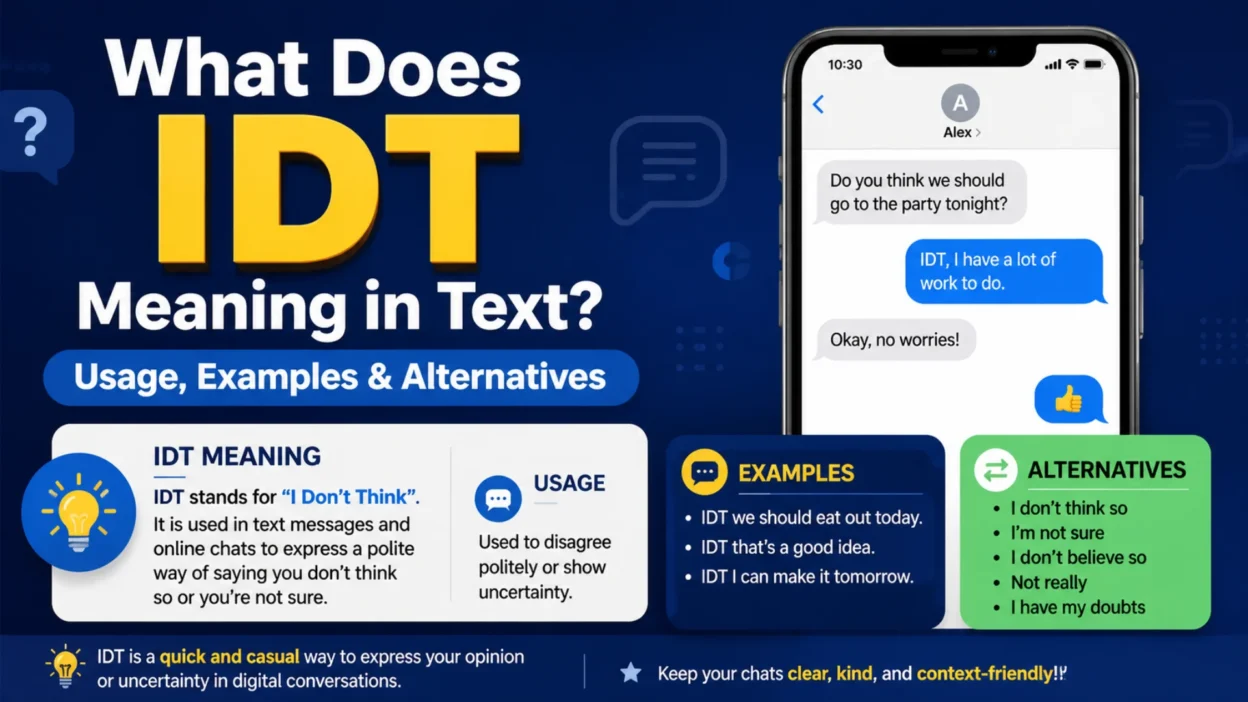
Have you ever received a text that simply said “IDT” and found yourself staring at the screen in confusion? You are not alone. In today’s fast-paced digital world, new acronyms appear almost daily. Consequently, keeping up with text slang can feel like learning a second language. Fortunately, understanding IDT meaning in text is actually quite straightforward once you know the basics. This article will break down everything you need to know about this popular abbreviation. We will explore its origins, real-world usage, and even polite alternatives. By the end, you will feel confident using and responding to IDT in any conversation. Let’s dive right in. 😉
Definition & Core Meaning: What Does IDT Stand For?
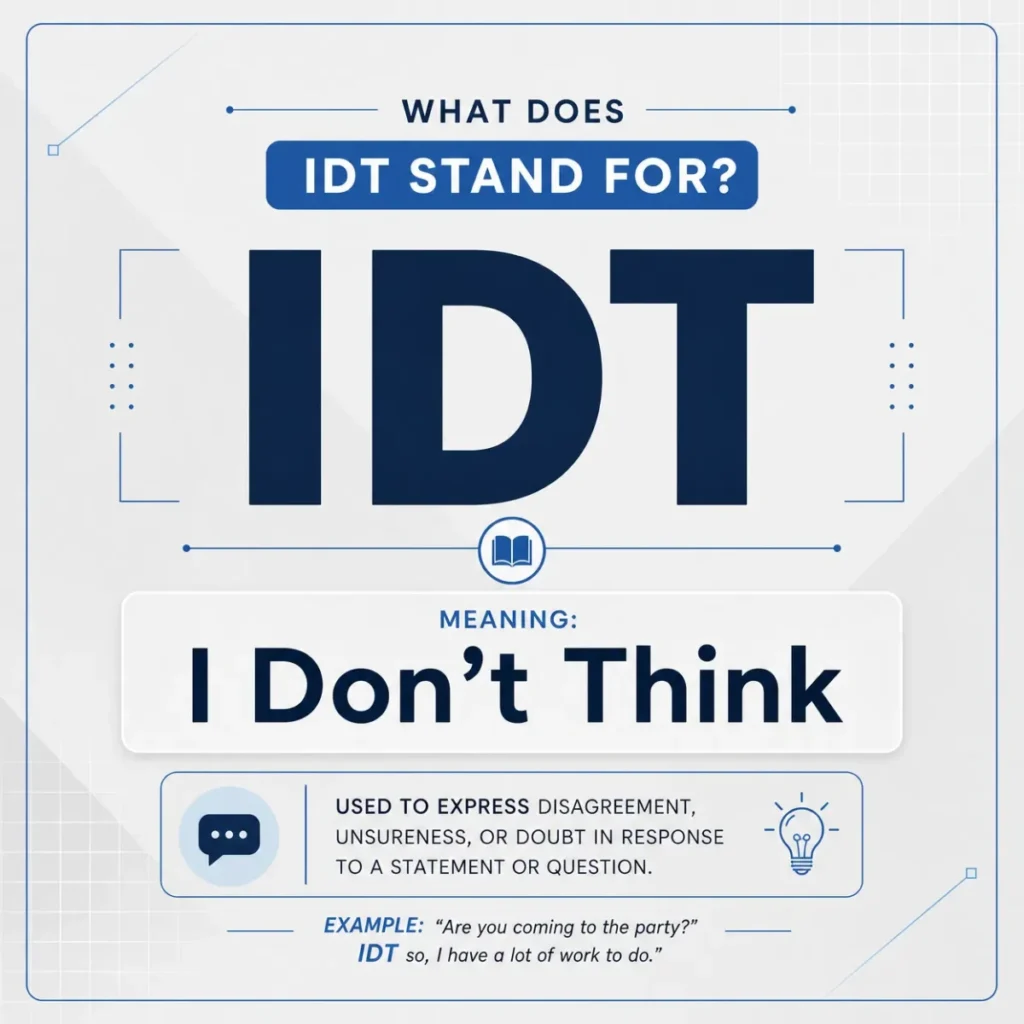
IDT meaning in text is simply “I Don’t Think.” Specifically, people use it to express doubt, uncertainty, or a gentle disagreement. For instance, instead of typing out the full phrase “I don’t think so,” a texter can save time by writing “IDT.” Typically, this abbreviation appears in informal settings like text messages, Snapchat chats, Instagram DMs, or Discord servers.
Interestingly, IDT meaning in text does not change much across different platforms. Whether on WhatsApp, Twitter, or Reddit, IDT almost always signals a lack of certainty. Nevertheless, the tone can shift slightly depending on context. For example, “IDT that’s a good idea” sounds softer than saying “That’s a bad idea.” As a result, many people use IDT to avoid sounding overly harsh or confrontational.
To summarize the core definition:
- IDT = “I Don’t Think”
- Purpose = Express doubt or mild disagreement
- Formality = Very informal (best for friends and peers)
- Emotion = Usually neutral to cautious
History & Origin of IDT in Digital Communication
Where did IDT meaning in text first appear? The abbreviation likely emerged during the early 2000s SMS era. Specifically, when mobile phones had character limits and T9 predictive text, users needed shorter ways to communicate. Accordingly, acronyms like IDT, IDK (I Don’t Know), and IMO (In My Opinion) gained popularity.
Subsequently, the rise of instant messaging platforms like AOL Instant Messenger (AIM) and MSN Messenger accelerated the use of such shortcuts. Teenagers and young adults, who wanted to type faster, adopted IDT as a standard abbreviation. For instance, a 2005 forum post might have read: “IDT he’s coming to the party tonight.”
Moreover, the spread of smartphones and QWERTY keyboards did not kill these acronyms. On the contrary, they became even more entrenched in digital culture. Why? Because speed and convenience remain highly valued. Interestingly, IDT meaning in text has remained remarkably stable for nearly two decades. Unlike slang terms that fade quickly (e.g., “on fleek”), IDT continues to thrive due to its clarity and utility.
Today, IDT appears across generations, from Gen Z to Millennials. However, older users might still find it confusing. Therefore, we recommend using IDT only with people who are familiar with common text abbreviations.
Real-World Examples of IDT in Conversations
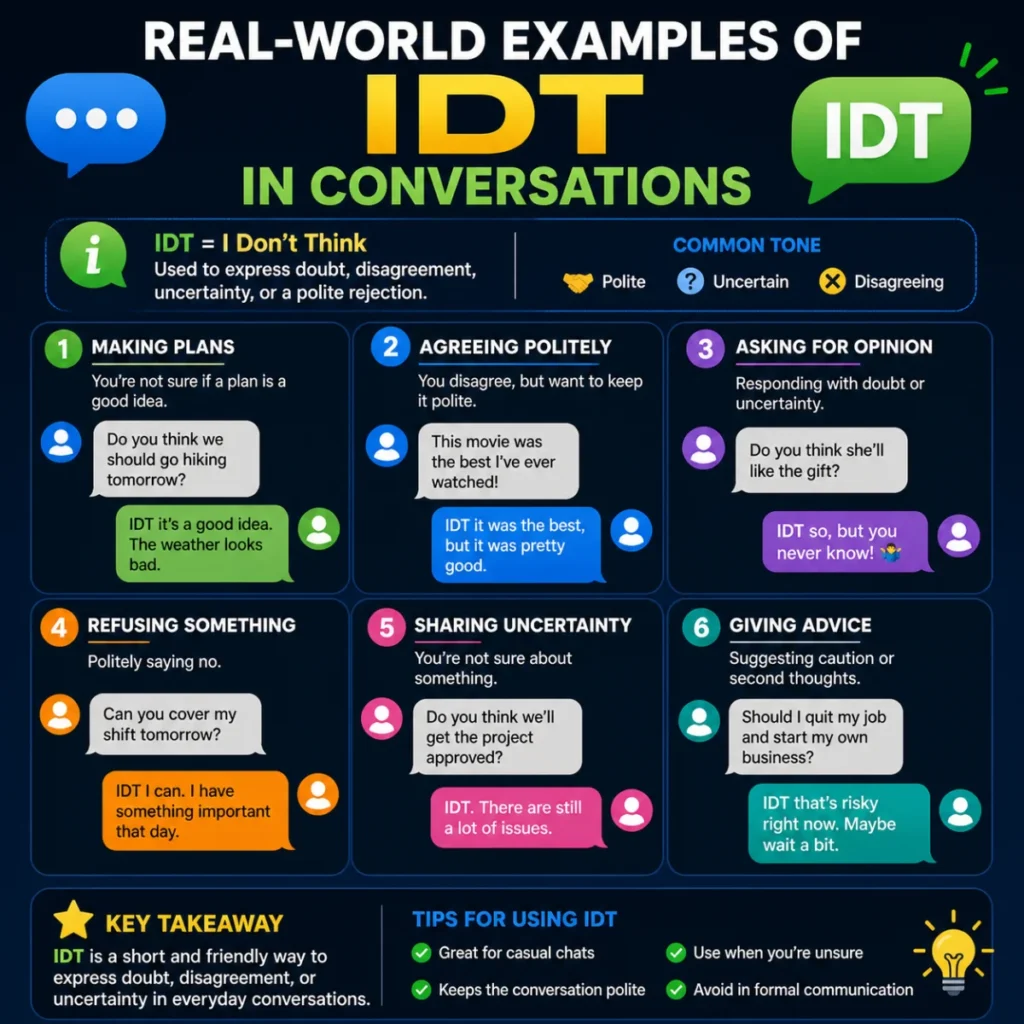
To fully grasp IDT meaning in text, nothing beats real examples. Below are four realistic scenarios showing how people use IDT in daily chats.
Example 1: Making Plans with Friends
Friend A: “Should we go to the beach tomorrow? The forecast says sunny.” Friend B: “IDT that’s a good idea. I just checked, and it says 90% chance of rain.” Friend A: “Oh really? Thanks for checking!”
Example 2: Discussing a Movie
Person 1: “That new sci-fi movie was amazing, right?” Person 2: “IDT so. The special effects were cool, but the plot made no sense.” Person 1: “Fair point. The ending was confusing.”
Example 3: Work-Related Group Chat (Casual Setting)
Coworker: “Anyone think we can finish this project by Friday?” You: “IDT we have enough time. We still need client approval.” Coworker: “Yeah, you’re probably right. Monday is more realistic.”
Example 4: Dating App Conversation
Match: “Do you believe in love at first sight?” You: “Hmm, IDT that’s a real thing. Attraction at first sight? Sure. But love takes time.” Match: “That’s a mature answer actually. I respect that.”
Notice how each example uses IDT to soften disagreement. Instead of directly saying “You’re wrong,” the speaker offers a gentler alternative. This makes IDT meaning in text particularly useful for maintaining harmony in conversations.
How Context Changes the Meaning of IDT
While the literal definition stays constant, context can shift how IDT is perceived. Below we break down four common digital environments.
Texting (Between Friends)
In casual texts, IDT meaning in text remains light and friendly. Friends use it to disagree without drama. For example: “IDT I can make it to dinner. Rain check?” This sounds much softer than “I’m not coming.”
Social Media (Comments & Replies)
On platforms like Twitter, Instagram, or TikTok, IDT often signals polite debate. For instance, someone might comment: “IDT this take is accurate. Here’s why…” Accordingly, IDT helps avoid aggressive arguments. However, some users might still perceive it as dismissive if overused.
Gaming (Voice Chat & Text Chat)
In gaming communities, IDT meaning in text typically relates to strategy. A player might type: “IDT we should push mid. They have an advantage.” Here, the abbreviation is purely tactical and rarely emotional. Gamers value efficiency, so IDT fits perfectly.
Dating Apps (Tinder, Bumble, Hinge)
On dating apps, IDT carries more weight because impressions matter. Using IDT can show you are thoughtful and non-confrontational. For example: “IDT we’re a romantic match, but you seem like a cool person.” This soft rejection is far kinder than ghosting.
Thus, while the letters remain the same, the emotional stakes change with each setting. Always consider your audience before using IDT.
Tone Nuances: Is IDT Rude or Friendly?
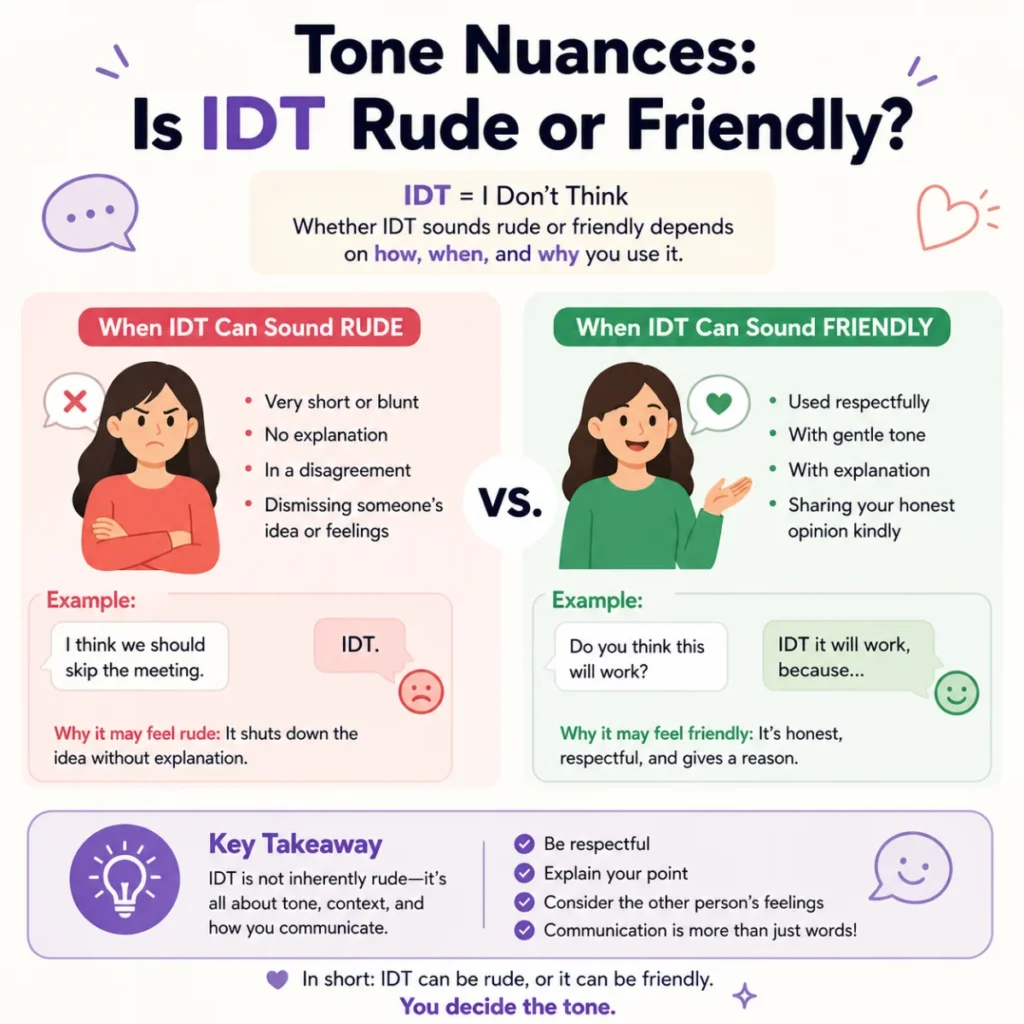
This is a common concern. Is IDT meaning in text inherently rude? Generally, no. Most people perceive IDT as neutral or slightly cautious. Nevertheless, tone depends heavily on what comes after it.
For instance:
- Friendly: “IDT I’ll have time today, but let’s try tomorrow!”
- Neutral: “IDT that’s correct based on the data.”
- Potentially rude: “IDT anyone cares about your opinion.” (This is clearly harsh because of the follow-up words.)
Additionally, overusing IDT can make you seem indecisive or passive. Imagine saying “IDT” before every opinion. Eventually, others might find you wishy-washy. Therefore, balance IDT with confident statements when appropriate.
Interestingly, research on digital communication suggests that acronyms like IDT actually reduce perceived aggression. Why? Because the abbreviation feels less direct than spelling out “I don’t think.” The shorter form softens the blow. As a result, many people prefer IDT for sensitive topics.
IDT vs Similar Slang Terms (Comparison Table)
To fully understand IDT meaning in text, compare it with similar abbreviations. Below is a helpful table.
AcronymMeaningToneWhen to UseIDTI Don’t ThinkSoft disagreement, doubtExpressing uncertainty gentlyIDKI Don’t KnowNeutral ignoranceGenuinely lacking informationIMOIn My OpinionSubjective assertionSharing a personal viewIMHOIn My Humble OpinionPolite, modestSoftening strong opinionsTBHTo Be HonestFrank, sometimes bluntEmphasizing honesty over politenessNGLNot Gonna LieCandid, vulnerablePrefacing an honest confession
Key takeaway: IDT is unique because it specifically questions a statement or idea without completely dismissing it. Meanwhile, IDK admits lack of knowledge, and IMO claims a subjective belief. Choose the right tool for the right job.
What Does “If IDT IDT” Mean? (Exploring Repetition)
You might occasionally see a strange construction like “If IDT IDT, then what?” This is rare, but it appears in niche online communities (e.g., Reddit or Twitter debates). So what does IDT meaning in text become when repeated?
Typically, “If IDT IDT” is a shorthand for “If I don’t think I don’t think…” which emphasizes extreme uncertainty or confusion. For instance: “If IDT IDT the movie was good, does that mean I secretly liked it?” This is non-standard and mostly humorous. In everyday texting, you can safely ignore this format. Stick to single “IDT” for clarity.
How to Respond to IDT (3 Common Scenarios)
Receiving an IDT message leaves some people unsure how to reply. Fortunately, we have three practical scripts.
Scenario 1: Agreeing with IDT
They say: “IDT we should go out tonight. I’m tired.” You respond: “Yeah, I agree. Let’s reschedule for the weekend.”
Scenario 2: Disagreeing with IDT (Politely)
They say: “IDT this restaurant is good. The reviews are mixed.” You respond: “I see your point, but I’ve eaten there twice and loved it. Want to check it out together?”
Scenario 3: Seeking Clarification
They say: “IDT that’s the right answer.” You respond: “What makes you think that? I’d love to understand your perspective.”
Notice that each response respects the other person’s doubt while moving the conversation forward. Never dismiss someone’s IDT with “You’re wrong.” Instead, acknowledge their uncertainty first.
Professional Use: Can You Say IDT at Work?
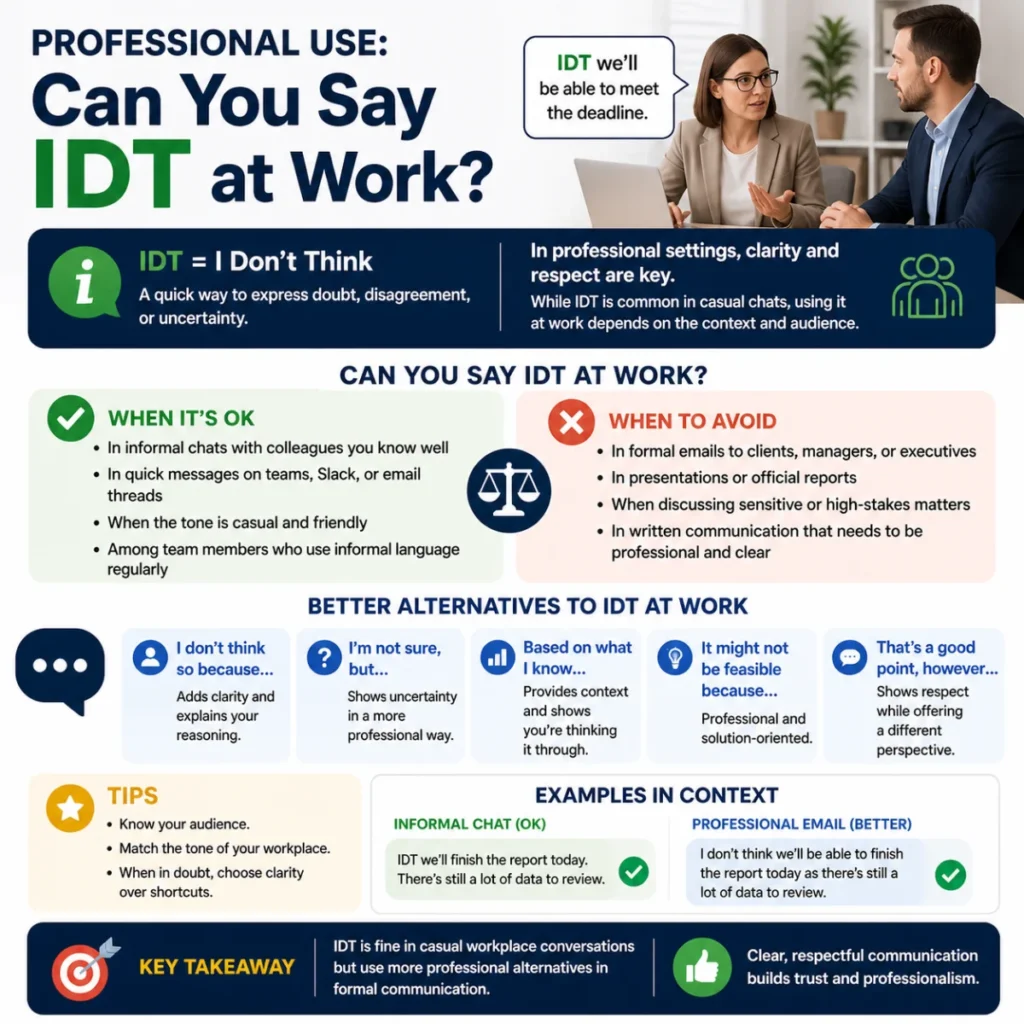
Now for a critical question: Is IDT meaning in text appropriate for professional settings? Generally, no. In formal work environments (emails, Slack channels with managers, client meetings), avoid IDT entirely. Specifically, spell out “I don’t think” instead.
Why? Because acronyms like IDT can appear lazy or unprofessional in corporate culture. For example, writing “IDT we’ll meet the deadline” in an email to your boss might seem flippant. Conversely, “I don’t think we’ll meet the deadline unless we reprioritize” sounds more serious and thoughtful.
That said, there are exceptions. In very casual team chats (e.g., a Slack channel called #watercooler or #random), IDT might be acceptable among colleagues who are also friends. Nevertheless, when in doubt, spell it out. Professionalism rarely hurts, but informality can.
Common Misconceptions About IDT (4 Myths Debunked)
Let’s clear up confusion around IDT meaning in text by tackling popular myths.
Myth 1: IDT means “I Don’t Trust”
Reality: No. IDT almost always means “I Don’t Think.” While “I Don’t Trust” exists in some contexts, it is rarely used. If someone means distrust, they typically write “IDT” (I Don’t Trust) with context clues, but this is non-standard.
Myth 2: IDT is aggressive or argumentative
Reality: As explained earlier, IDT actually softens disagreement. Compare “I don’t think you’re right” vs “You’re wrong.” The former is milder.
Myth 3: Only teenagers use IDT
Reality: Adults in their 20s, 30s, and even 40s use IDT, especially in fast-paced texting. The abbreviation transcends age groups.
Myth 4: IDT is the same as IDC (I Don’t Care)
Reality: These are very different. IDT expresses thoughtful doubt. IDC expresses apathy. Saying “IDT it will rain” is not the same as “IDC if it rains.” One shows engagement; the other shows disinterest.
5 Polite Alternatives to IDT (With Table)
Sometimes you want to express doubt without using any acronym. Below are five polished alternatives to IDT meaning in text that work in both casual and professional settings.
Alternative PhraseBest ForTone Level“I’m not entirely convinced that…”Formal debatesHigh politeness“That doesn’t quite align with…”Work emailsProfessional“I have some reservations about…”Sensitive topicsCareful, respectful“From my perspective, it seems…”Neutral discussionsBalanced“I respectfully disagree because…”DisagreementsPolite but direct
Using these alternatives shows emotional intelligence and vocabulary range. For instance, instead of texting “IDT that’s fair,” try “I’m not entirely convinced that’s fair.” The latter sounds more thoughtful.
Frequently Asked Questions (FAQs) About IDT
1. What does IDT mean in text from a guy?
IDT meaning in text from a guy is the same as anyone else: “I Don’t Think.” Guys typically use it to express doubt without sounding aggressive. For example, “IDT I can make it to the game” is just a polite decline.
2. Is IDT the same as IDK?
No. IDK means “I Don’t Know” (lack of information). IDT means “I Don’t Think” (doubt or opinion). For instance, “IDK the answer” vs “IDT your answer is correct.”
3. Can IDT be used sarcastically?
Yes, absolutely. For example: “The sky is green.” Reply: “IDT so, genius.” Here, the sarcasm comes from tone and the added “genius,” not from IDT itself.
4. Should I use IDT in formal writing (essays, reports)?
Never. Formal writing requires complete phrases. Write “I do not think” or “It seems unlikely that” instead.
5. How do I pronounce IDT when reading aloud?
Most people say each letter: “I-D-T.” Alternatively, some say the full phrase “I don’t think.” There is no standard pronunciation as a single word.
6. Is IDT used in British English or other English dialects?
Yes, IDT appears in all digital English dialects. However, British users might prefer “I reckon not” or “I doubt it” in spoken conversation. In text, IDT remains common.
Conclusion: Mastering IDT for Better Digital Conversations
Understanding IDT meaning in text is a small but powerful step toward becoming a more effective digital communicator. As we have explored, IDT stands for “I Don’t Think” and helps express doubt or gentle disagreement without causing offense. Its history dates back to early SMS and instant messaging, proving that some acronyms have real staying power.
Importantly, using IDT correctly requires attention to context. What works in a group chat with friends might fail in a professional email. Similarly, pairing IDT with kind follow-up words keeps conversations positive. On the other hand, overusing IDT or combining it with harsh language can backfire.
We also learned that IDT differs significantly from similar terms like IDK, IMO, and TBH. Each has its own unique job. Additionally, polite alternatives exist for times when acronyms feel too casual. Ultimately, the best communicators know when to use shortcuts and when to slow down.
So next time you see IDT pop up on your phone, you will know exactly what it means – and exactly how to respond. Keep texting smartly, stay curious about language, and remember: IDT meaning in text will likely stay relevant for years to come. Happy texting! ✅

Amelia Brooks is a passionate writer specializing in text meanings, slang, and digital communication trends. She simplifies modern messaging to help readers understand every text with ease.