Every relationship reaches a moment when words matter most. Maybe you want to tell your partner how deeply you feel. Perhaps you’ve been through a difficult patch and need to rebuild what was broken. Or maybe you simply want to put into words what your heart has been trying to say for months. Finding the right love and trust message isn’t always easy. Many people struggle to express these profound emotions without sounding cliché or inauthentic. You want to say something meaningful, something that truly captures the depth of your feelings, but the words don’t always come naturally. This guide explores everything you need to know about crafting genuine love and trust messages. From understanding what makes these messages powerful to practical examples you can adapt, you’ll learn how to express your heart with confidence and authenticity. Whether you’re writing a love letter, sending a text, or speaking face-to-face, the principles here will help you communicate what truly matters.
What Makes a Love and Trust Message Powerful?
Before we dive into examples and templates, it’s worth understanding what elevates a simple message into something genuinely meaningful. A powerful love and trust message doesn’t rely on fancy vocabulary or poetic flourishes. Instead, it draws on something more fundamental: authenticity.
Specificity is the secret ingredient. Generic messages like “I love you” or “I trust you” are important, but they lack the detail that makes the feeling real. Adding specific details transforms a simple statement into something unforgettable. For instance, instead of saying “I trust you,” you might say, “I trust you because you’ve always been there when I needed you most, like the time you dropped everything to help me through that tough week at work.” Specificity shows you’ve thought about the person and your relationship deeply.
Emotional honesty matters tremendously. Many people hold back in their messages because they fear vulnerability. However, it’s the willingness to be vulnerable that makes a love and trust message truly powerful. When you share your genuine fears, hopes, and feelings, you invite the other person to do the same. This mutual openness forms the bedrock of deep connection.
Timing also plays a crucial role. The same words delivered at the right moment can have significantly more impact. A love and trust message sent after a difficult conversation, during a quiet moment together, or in response to a meaningful gesture carries added weight. Pay attention to these moments rather than relying on a calendar.
The Connection Between Love and Trust in Relationships
Love and trust are often discussed as separate concepts, but they’re deeply intertwined in practice. Understanding how they relate helps you craft more meaningful messages that address both.
Trust is the foundation on which love is built. Without trust, love tends to feel unstable and insecure. When you trust someone, you feel safe being vulnerable with them. This safety allows love to grow deeper and more resilient. Consequently, love and trust messages should acknowledge this connection. When you express love without acknowledging trust, the message can feel incomplete. Similarly, expressing trust without love can feel transactional.
Love, in turn, strengthens trust. When someone feels genuinely loved, they’re more likely to trust the person expressing that love. Genuine love demonstrates commitment, care, and consistency—qualities that naturally build trust. A love and trust message that acknowledges this cycle reinforces both emotions simultaneously.
Real-world example: Imagine you’re messaging your partner after a disagreement. A simple “I love you” might feel insufficient. However, a message that says, “I love you, and I trust that we can work through this together” acknowledges both the love that’s already there and the trust needed to move forward. This kind of message feels more complete and more reassuring.
Key Elements Every Love and Trust Message Should Include
While every relationship is different, effective love and trust messages typically share several key elements. Incorporating these into your messages will make them more impactful and meaningful.
Authenticity Over Perfection
Many people get hung up on finding the perfect words. They worry about sounding cliché, awkward, or insufficient. The result? They either say nothing at all or borrow someone else’s words that don’t feel genuine. Authenticity is far more important than perfection. Your partner loves you for who you are, not for your ability to craft flawless prose. A messy, heartfelt message from you will always mean more than a perfectly polished message that doesn’t sound like you.
Example: Instead of trying to sound like a poet, you might write, “I’m not great with words, but I need you to know how much you mean to me. When I think of my life without you, it doesn’t make sense. That’s how I know I love you.”
Specificity and Detail
As mentioned earlier, specifics bring messages to life. Vague declarations of love feel nice, but specific references to shared experiences, qualities you admire, or moments that matter create a much deeper impact. Mention a particular memory, a quality you admire, or a moment that strengthened your trust.
Example: “Remember that time we got caught in the rain and ended up laughing about it for hours? That’s when I knew I wanted to spend my life with someone who could make even a disaster feel like an adventure. I love you, and I trust that every unexpected moment with you will be something we face together.”
Vulnerability and Honesty
Don’t be afraid to share your fears, hopes, and deeper feelings. Vulnerability shows emotional courage and invites the other person to be vulnerable in return. If you’re scared of losing the relationship, say so. If you’re hopeful about the future, express that. Honest vulnerability creates a space for genuine connection.
Example: “I’m scared to say this because it makes me feel exposed. But I need you to know that I love you more than I’ve ever loved anyone. And I trust you completely, even when it’s hard for me to be that open.”
Action-Oriented Language
Love isn’t just a feeling—it’s a verb. Including action-oriented language in your message shows that your love and trust aren’t just words but commitments. Use phrases like “I choose you,” “I’m here for you,” “I’ll always have your back,” or “I’m committed to us.”
Example: “I love you, and I trust you. But more than that, I choose you every single day. I choose to show up, to listen, to grow with you, and to build a future together.”
Types of Love and Trust Messages for Different Situations
The best love and trust message depends on your situation. Here are examples tailored to different contexts.
Messages for a Romantic Partner
When expressing love and trust to a romantic partner, your message should reflect the depth and intimacy of your relationship. These messages often work well in love letters, anniversary cards, or quiet moments shared together.
Example 1: “Every day with you reminds me what real love feels like. It’s not just the big moments—it’s the way you make coffee in the morning, the way you laugh at my terrible jokes, and the way you look at me when you think I’m not paying attention. I love you in ways I didn’t know were possible. And I trust you with my heart, my fears, and my future.”
Example 2: “I used to think I understood love until I met you. You showed me that love isn’t a feeling you have—it’s a choice you make every day.
Example 3: “Sometimes I still can’t believe I get to wake up next to you. You’ve given me so much—not just love, but safety, comfort, and the courage to be myself completely. I love you with everything I have, and I trust you more than I trust anyone.”
Messages for Rebuilding Trust After a Difficult Time
When trust has been broken, messages need to acknowledge the pain while expressing commitment to rebuilding. These messages should include accountability, remorse, and a forward-looking commitment.
Example 1: “I know I’ve hurt you, and I carry that weight every single day. I can’t undo what happened, but I can promise you this: I will spend every day earning back your trust. I love you, and I’m committed to showing you through my actions, not just my words.”
Example 2: “Trust isn’t something I’m asking you to give me overnight. I understand that it takes time, patience, and consistent effort. But I want you to know that I love you deeply, and I’m here to do the work. Whatever it takes, I’m willing.”
Example 3: “The hardest part of losing your trust was realizing what I had risked. You are the most important person in my life, and I was reckless with something so precious. I’m sorry from the bottom of my heart. I love you, and I will keep showing up until you feel safe with me again.”
Messages for Expressing Trust in a Partner
Sometimes, you need to specifically express your trust without making the message solely about love. These messages focus on confidence in your partner’s character and decisions.
Example 1: “I trust you. Not because I have to, but because you’ve earned it. I trust your judgment, your heart, and your intentions. And I want you to know that you never have to prove yourself to me—you’ve already shown me who you are.”
Example 2: “There’s something incredibly freeing about trusting someone completely. I can be myself with you—the messy, imperfect, overthinking version of me—and I don’t worry about being judged or abandoned. That’s rare. That’s you. I love you, and I trust you.”
Example 3: “You might not always feel confident in yourself, but let me tell you something: I have absolute faith in you. I trust your decisions, your instincts, and your heart. Whatever comes our way, I know you’ll handle it with grace. I love you, and I trust you completely.”
Short Love and Trust Messages for Texting
Text messages are quick, but they can still carry profound meaning. These shorter messages are perfect for sending throughout the day to remind your partner of your love and trust.
Example 1: “Just wanted to remind you that I love you and I trust you completely. That’s all. Have a great day ❤️”
Example 2: “Thinking of you this morning. I’m grateful for your love and for the trust we’ve built. You mean everything to me.”
Example 3: “Whatever happens today, I believe in you. I love you, and I trust you. Now go be amazing.”
Example 4: “You’re my safe place. I love you, and I trust you with everything. Always.”
Example 5: “Sometimes I forget to say this, but I trust you more than anyone in the world. And I love you even more than that.”
Common Mistakes People Make When Sending Love and Trust Messages
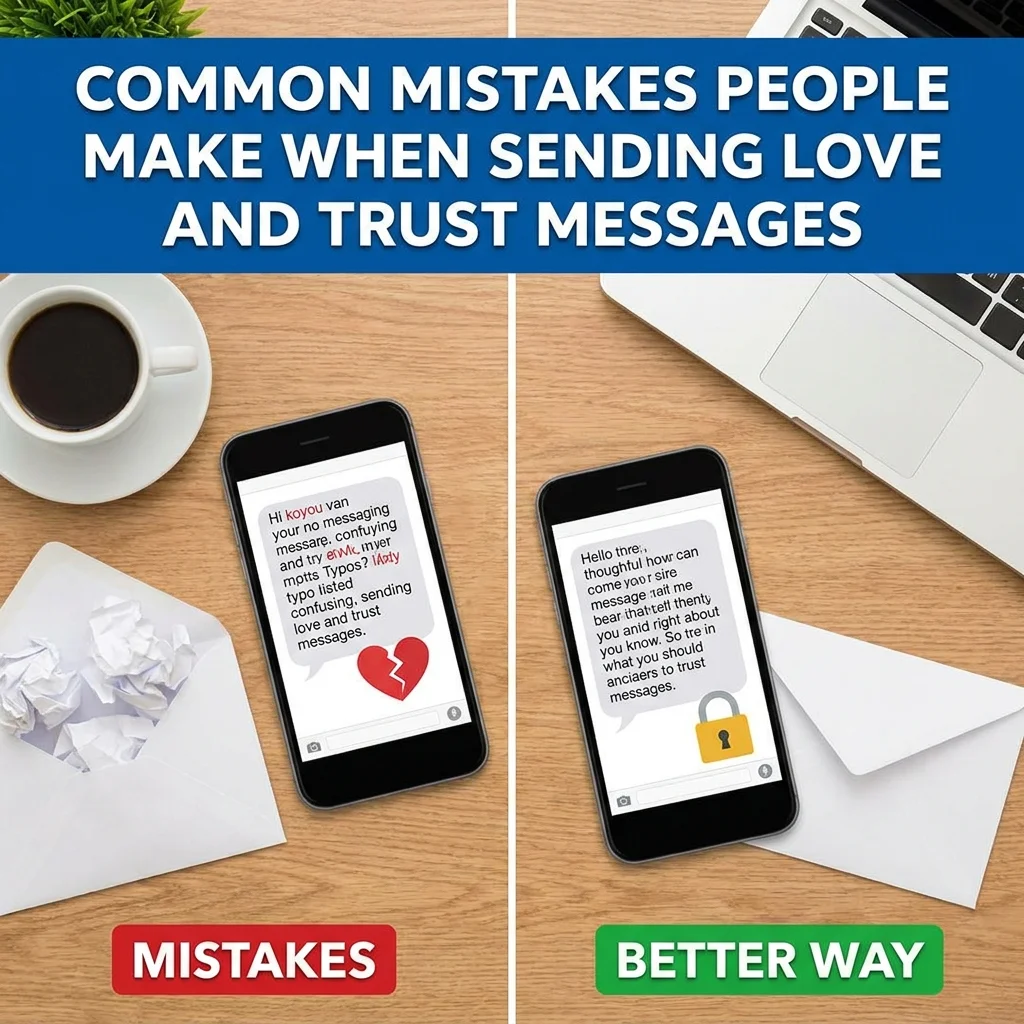
Even with good intentions, people often make mistakes that undermine their messages. Being aware of these helps you avoid them.
Mistake #1: Overpromising. In the heat of the moment, people sometimes make promises they can’t realistically keep. Saying “I will never hurt you” sounds beautiful, but it’s impossible. Instead, say something honest like “I will always try my best to avoid hurting you, and when I do, I’ll take responsibility.”
Mistake #2: Expecting a specific response. When you send a love and trust message, the goal should be expressing yourself, not controlling the other person’s reaction. If you’re sending a message to manipulate someone into feeling a certain way, it will feel inauthentic and might backfire.
Mistake #3: Using overly generic language. “You mean everything to me” is a nice sentiment, but it’s been said a million times. Adding specifics makes it your own.
Mistake #4: Sending love and trust messages when angry. Emotions can run high during arguments, and words said in anger often don’t reflect your true feelings. Take time to calm down before expressing love and trust. If you need to address an issue, separate the repair of love and trust from the discussion of the problem.
Mistake #5: Forgetting that actions matter more. Words are meaningful, but they’re only one part of the equation. A love and trust message that isn’t backed by consistent, trustworthy behavior will eventually feel hollow.
Mistake #6: Using guilt or obligation. Messages like “After everything I’ve done for you, you should trust me” aren’t expressions of love—they’re manipulation. Genuine love and trust messages never use guilt as a tool. They come from a place of security and generosity.
When NOT to Send a Love and Trust Message
Sometimes, silence is more appropriate than a message. Here are situations where you might want to hold back:
When you’re not feeling it. Sending an insincere love and trust message because you feel you “should” does more harm than good. People can sense inauthenticity. Wait until you genuinely feel the emotions you want to express.
When trust has been severely broken without resolution. If you’ve deeply betrayed someone’s trust and haven’t yet addressed the root cause, a love and trust message might feel like a manipulation tactic rather than a genuine expression.
When the other person has asked for space. Respecting boundaries is a form of trust. If someone has requested space, sending unsolicited love and trust messages might feel intrusive. Allow them to come back to you on their terms.
When you’re drunk. Alcohol lowers inhibitions and often leads to over-the-top messages that people regret later. Save your love and trust expressions for when you’re clear-headed.
When you’re not ready to follow through. If you say “I trust you completely” but still check their phone or demand constant reassurance, your words and actions don’t align. Only say what you’re genuinely ready to back up with behavior.
Myths vs. Facts About Love and Trust Messages
Myth #1: “Love and trust messages need to be long and poetic to be meaningful.”
Fact: Brevity and authenticity often matter more than length. A short, genuine message can be far more powerful than a long, forced one. Some of the most impactful love and trust messages are just a few lines long.
Myth #2: “Once trust is broken, love messages are pointless.”
Fact: While broken trust is difficult, love and trust messages can play a crucial role in rebuilding. They communicate commitment and create a starting point for repair. However, they must be backed by consistent actions.
Myth #3: “Men don’t need love and trust messages as much as women.”
Fact: Everyone benefits from expressions of love and trust, regardless of gender. Men often feel pressure to appear emotionally strong, but research shows they appreciate and need these messages just as much.
Myth #4: “Love and trust messages should only be sent when everything is perfect.”
Fact: Some of the most meaningful messages come during challenges. Expressing love and trust during difficult times shows commitment and deepens the relationship.
Myth #5: “If you truly love someone, you shouldn’t have to say it.”
Fact: People aren’t mind readers. Verbal and written expressions of love and trust are important for reinforcing bonds and creating emotional security. Assuming someone knows how you feel without ever saying it risks leaving them feeling uncertain.
How to Write Your Own Personalized Love and Trust Message
No matter how many examples you read, the most powerful message will be one you write yourself. Here’s a simple framework to create your own personalized love and trust message:
Step 1: Start with a specific memory or quality. “I was thinking about the time when…” or “One thing I’ve always admired about you is…”
Step 2: Connect that memory or quality to love and trust. “That moment showed me I could trust you with anything” or “That’s when I realized how deeply I love you.”
Step 3: Express what they mean to you. “I can’t imagine my life without you” or “You make me want to be the best version of myself.”
Step 4: Make a commitment or express hope for the future. “I’m committed to building a future with you” or “I trust we can face anything together.”
Step 5: Keep it authentic. Read it back to yourself. Does it sound like you? If not, rewrite it in your own words.
Love and Trust Messages for Special Occasions
Certain occasions call for more thoughtful expressions. Here are some tailored examples.
Anniversary Messages
“Another year with you, and I’m still amazed. It’s not just that I love you—it’s that I trust you more than I trust myself sometimes. You’ve seen me at my worst and still chose to stay. You’ve believed in me when I couldn’t believe in myself.
Birthday Messages
“On your birthday, I want to celebrate not just the day you were born, but the person you’ve become. I love you for your kindness, your strength, and your unwavering honesty. And I trust you with my heart, my secrets, and my future. Happy birthday, my love.”
Messages for Hard Times
“I know things are difficult right now. And I know it’s easy to feel uncertain about the future. But I want you to hear me when I say this: I love you, and I trust us. We’ve faced challenges before, and we’ve come through stronger. We’ll do it again. Together.”
Messages of Gratitude
“I don’t say it enough, so let me say it now: Thank you for trusting me. It’s not something I take for granted. I love you for the grace you show me and the faith you have in our relationship.”
Expert Tips for Delivering Your Message

Be genuine. The most important tip is simply to be yourself. Your unique voice and authentic expression will resonate far more than borrowed phrases or forced eloquence.
Choose the right medium. Consider whether this message works best as a letter, a text, a card, or an in-person conversation. Some messages benefit from a written format where they can be re-read, while others feel more powerful spoken aloud.
Time it well. A love and trust message delivered during a calm, quiet moment often has the most impact. Avoid delivering emotionally heavy messages during busy or stressful times.
Follow up with actions. One message doesn’t build a relationship. Consistent, loving, trustworthy actions over time do. Use the message as a starting point, not a conclusion.
Re-read before sending. Especially with written messages, it’s worth proofreading to make sure you haven’t included anything you might regret. But remember: perfection isn’t the goal. Authenticity is.
Frequently Asked Questions About Love and Trust Messages
1. What should I write in a love and trust message to my partner?
Focus on specific qualities you admire, shared memories that solidified your trust, and your commitment to the future. Be honest about your feelings, and avoid generic clichés.
2. How do I express trust in a relationship through words?
Be specific about why you trust them. Mention actions they’ve taken that earned your trust, express confidence in their judgment, and use phrases like “I believe in you” or “I know you’ll make the right decision.”
3. Can a love and trust message help rebuild a broken relationship?
Yes, but it’s only one step. A genuine message that acknowledges the hurt, expresses remorse, and commits to change can start the rebuilding process. However, trust is rebuilt through consistent actions over time, not just words.
4. What if I’m not good with words?
That’s okay. Authenticity matters more than eloquence. You can write something simple like, “I’m not great at expressing myself, but I want you to know I love you and I trust you completely.” That honesty is often more powerful than polished prose.
5. How often should I send love and trust messages?
Quality matters more than quantity. A heartfelt message sent regularly—perhaps weekly or monthly—is more meaningful than daily messages that feel forced.
6. Is it okay to send a love and trust message over text?
Absolutely. A text message can be a lovely way to brighten someone’s day. However, for particularly deep or serious expressions, consider a handwritten letter or an in-person conversation.
7. What should I avoid saying in a love and trust message?
Avoid overpromising, using guilt or obligation, making it about yourself, and using generic clichés. Also avoid sending messages when you’re angry or under the influence.
8. How do I know if my love and trust message was received well?
Look for genuine reactions—a warm response, changed behavior, or a reciprocal expression of feelings. Avoid monitoring their reaction anxiously; trust that the message did its job simply by being sent.
Conclusion: The Power of Saying What’s in Your Heart
Love and trust messages are more than just words on a page. They’re bridges that connect hearts, assurances that soothe fears, and commitments that build futures. When you express love and trust to someone, you’re doing something profound.
The messages that stick with us aren’t necessarily the most poetic or the longest. They’re the ones that feel real. The ones that came from a genuine place. The ones that said something we needed to hear but didn’t know how to ask for.
So don’t overthink it. Don’t wait for the perfect moment or the perfect words. Your authentic self, expressing genuine love and trust, is exactly what the person you love needs to hear. Send that message. Say what’s in your heart. You’ll never regret telling someone you love them and that you trust them.
Whether you write a long letter, a short text, or say it in person, the act of expressing these feelings strengthens your bond and creates a foundation for deeper connection. Love and trust aren’t just felt—they’re shared. And when you share them through words, you build something beautiful that can weather any storm.

Amelia Brooks is a passionate writer specializing in text meanings, slang, and digital communication trends. She simplifies modern messaging to help readers understand every text with ease.