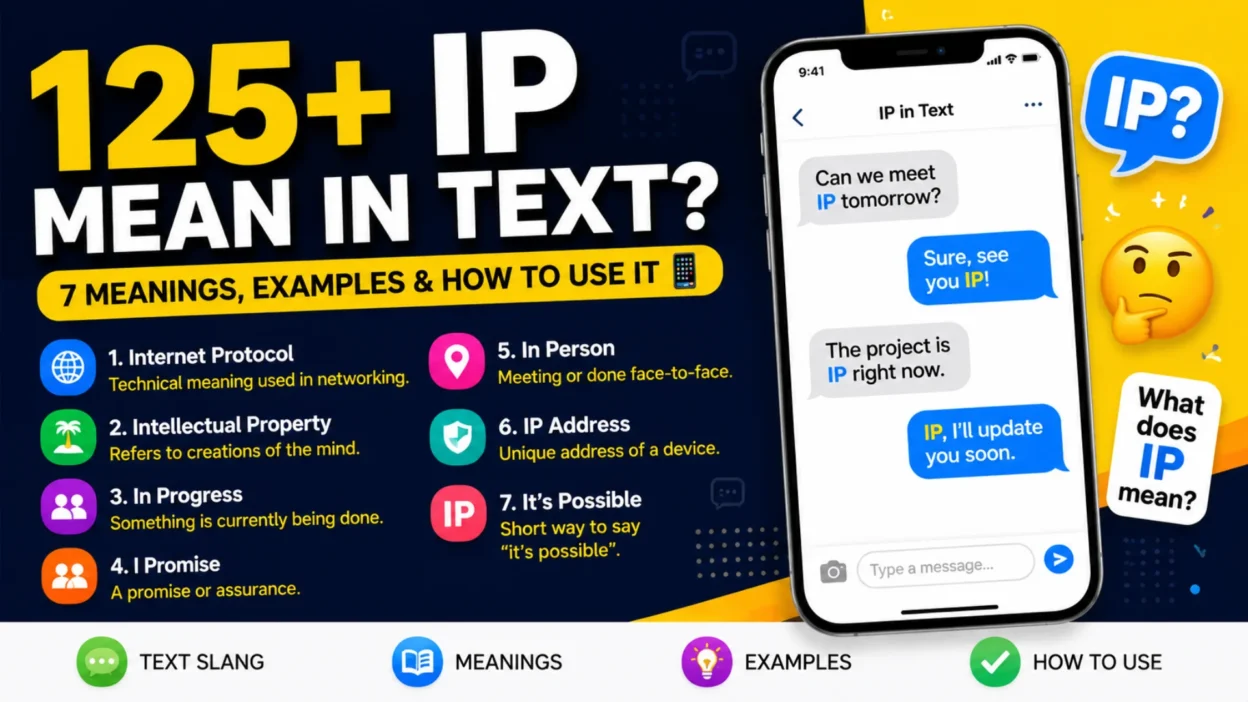
You’re reading a text message or scrolling through social media, and suddenly you spot it: “IP.” Two simple letters, but what do they actually mean? Depending on who you’re talking to and where you’re chatting, IP could refer to your internet connection, someone’s creative work, a baseball statistic, or even a gaming currency. It’s one of those abbreviations that seems straightforward but carries surprisingly diverse meanings across different contexts.
Unlike more niche slang terms that have a single definition, IP has multiple established meanings that span technology, law, gaming, and even professional sports. This guide breaks down all the common meanings of IP in text so you can confidently understand what people mean when they use it. Whether you’re trying to decode a tech-savvy friend’s message, figure out what your gamer buddy is talking about, or just stay current with digital communication, you’ll find everything you need here.
What Does IP Mean in Text? The Core Definition 📖
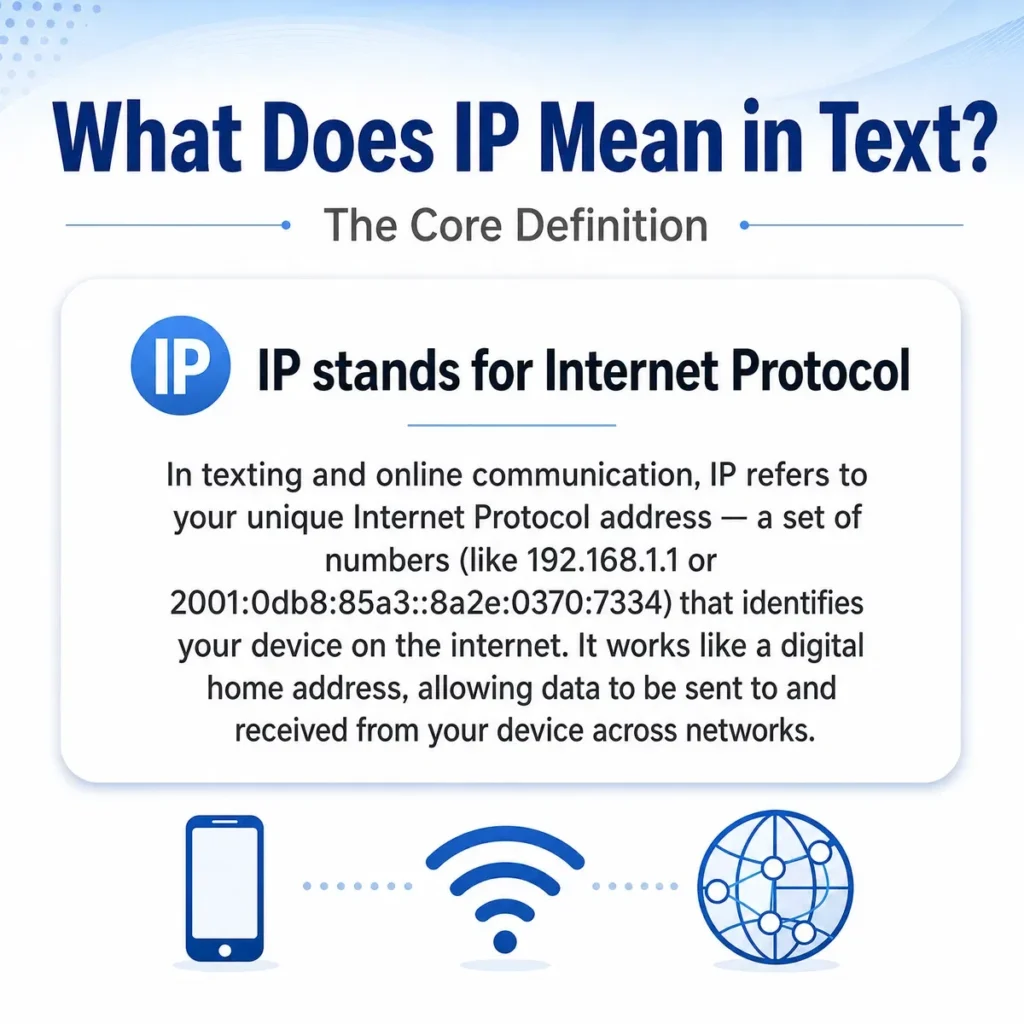
In most texting and digital communication contexts, IP stands for “Internet Protocol.” This is the technical term for the set of rules that governs how data travels across the internet. When people refer to an “IP address,” they’re talking about the unique numerical label assigned to each device connected to a computer network.
However, IP has several other common meanings depending on the context. In legal and business conversations, it typically stands for “Intellectual Property” —creative works, inventions, and designs protected by law. In gaming, it can mean “Influence Points” (a currency in League of Legends) or “Intellectual Property” in the context of game development. And in baseball, it’s a stat abbreviation for “Innings Pitched.” Because its meaning varies so widely, understanding IP always starts with checking the context of the conversation.
“Internet Protocol”: The Tech Meaning 💻
The most widely recognized meaning of IP is “Internet Protocol.” This is the foundational technology that makes the internet work—it’s the system that ensures data packets find their way from one device to another across networks.
People use this meaning when discussing:
- IP addresses (the unique number assigned to devices online)
- Network connections
- Internet privacy and security
Examples from real conversations:
- “What’s your IP address? I need to troubleshoot the connection.” 🌐
- “I think my IP was blocked—I can’t access the site.” 🚫
- “Use a VPN to hide your IP for privacy.” 🛡️
- “My IP keeps changing—is that normal?” 🤔
- “The server logged every IP that accessed the file.” 📋
- “I need to find my IP for the network setup.” 🔧
- “Someone hacked my IP address!” 😱
This meaning is especially common in IT and tech-related discussions. When someone mentions their “IP” or asks about “IP settings,” they’re usually referring to Internet Protocol.
“Intellectual Property”: The Legal and Business Meaning ⚖️
Another extremely common meaning of IP is “Intellectual Property.” This refers to creations of the mind—inventions, literary and artistic works, designs, symbols, names, and images used in commerce.
Intellectual property includes:
- Copyright – protects books, music, and art
- Patents – protects inventions
- Trademarks – protects brand names and logos
- Trade secrets – protects confidential business information
Examples from conversations:
- “That company is suing for IP infringement.” ⚖️
- “We need to protect our IP before launching the product.” 🛡️
- “She licensed her IP to a major studio for a film adaptation.” 🎬
- “The patent protects their IP from copycats.” 💡
- “We filed for IP protection internationally.” 🌍
- “The startup’s value is in its IP portfolio.” 📊
- “AI-generated content raises complex IP questions.” 🤖
In business and creative industries, IP is a critical term. It’s also used in social media when people discuss content ownership or originality. Interestingly, in China, “IP” has evolved to mean cultural assets or characters that can be adapted across different media—like a famous book or a beloved cartoon character that becomes a franchise.
“Innings Pitched”: The Baseball Stat ⚾
In baseball contexts, IP stands for “Innings Pitched.” This is a standard pitching statistic that tracks how many innings a pitcher has thrown.
Key points about this usage:
- Each out counts as one-third of an inning pitched.
- It’s used for both starting pitchers and relief pitchers.
- It’s a key metric for measuring pitcher performance and endurance.
Examples from conversations:
- “He has 6 IP with only 1 earned run.” ⚾
- “The starter went 7 strong IP tonight.” 🔥
- “She leads the league in IP this season.” 🏆
- “The bullpen covered 4 IP combined.” 💪
- “His IP total is down this year due to injury.” 😞
- “That’s 200 career IP—impressive!” 🎉
- “The rookie had 5 IP in his debut.” 🌟
If you’re chatting with a baseball fan or talking about the sport, this is likely what IP means.
“Influence Points”: The Gaming Currency 🎮
In the gaming community, particularly among players of the popular game League of Legends, IP stands for “Influence Points.” This is a currency that players earn by playing matches, which they can then spend to unlock new characters (champions), runes, and other in-game items.
Important details about IP in gaming:
- Players earn IP after each match.
- IP can be used to unlock champions without spending real money.
- In some newer versions of the game, this currency has been renamed or replaced, but many players still use the term.
Examples from conversations:
- “I need 200 more IP to buy the new champion.” 🎮
- “Save your IP for the weekly sale.” 💰
- “How much IP do you have saved up?” 📊
- “I spent all my IP on runes yesterday.” 💸
- “Double IP weekend is coming!” 🎉
- “IP farming is the only way to get champions fast.” 🏃
- “I’m saving IP for the 6300 champion.” 🏆
If you’re in a gaming chat or discord, this is a likely meaning.
“Internet Provider”: Another Tech Variation 📡
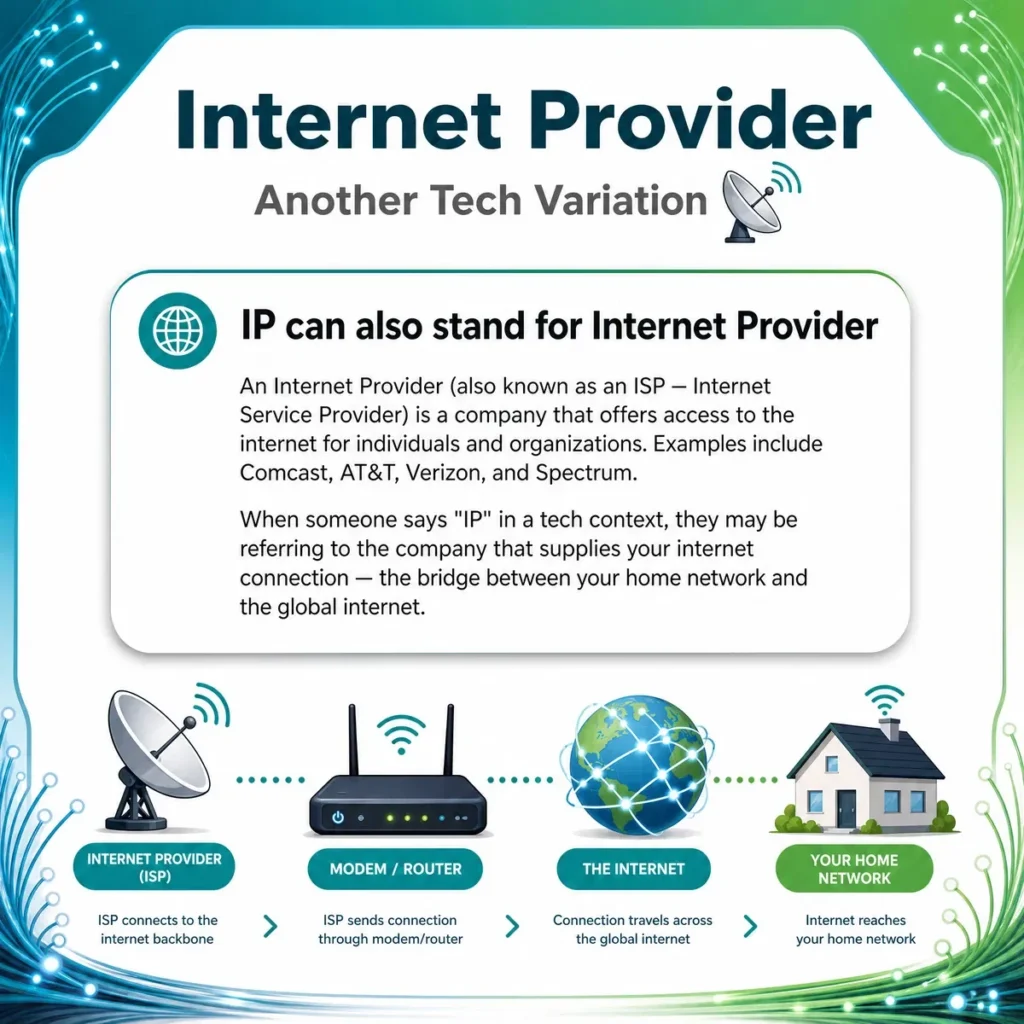
In some contexts, IP can stand for “Internet Provider” (often shortened from ISP—Internet Service Provider). This is less common than “Internet Protocol” but still appears in casual conversations.
Examples include:
- “My IP is down again.” 📶
- “Which IP do you use at home?” 🏠
- “The IP is raising prices next month.” 💰
- “IP service in my area is terrible.” 😤
- “We switched to a new IP for better speeds.” ⚡
This usage is generally informal and less precise than saying “ISP,” but you might encounter it in quick texts or chats.
Less Common Meanings of IP You Might Encounter 🔍
Depending on the platform, community, or conversation, IP can carry several more specialized meanings:
“In Progress”
Used to indicate that a task or project is still being worked on.
Example: “The report is IP—I’ll send it by 5 PM.” 📋
“In Person”
Often used when arranging meetups.
Example: “Let’s discuss this IP rather than over text.” 🤝
“In Particular”
Used to single out a specific point.
Example: “I loved the food, IP the pasta.” 🍝
“Instruction Pointer”
A computing term referring to a register in a processor.
Example: “The IP is pointing to the next instruction.” 💻
“Induced Polarization”
A geophysical method used in mineral exploration.
Example: “The IP survey showed promising results.” ⛏️
“Immunoprecipitation”
A biological technique used in research.
Example: “We used IP to isolate the protein.” 🧬
“Intraperitoneal”
A medical term referring to the area inside the abdominal cavity.
Example: “The medication was administered via IP injection.” 💉
“I’ll Pimp Slap You”
An informal, often humorous slang abbreviation used in online chats.
Example: “Are you serious? IP!” 😂
“Idea Pitch”
Used in creative or business settings.
Example: “I have an IP for the new campaign.” 💡
“International Paper”
A company name abbreviation.
Example: “IP stock is up today.” 📈
“Isopropyl”
Commonly used as a shorthand for isopropyl alcohol.
Example: “Use IP to clean the surface.” 🧴
How to Determine the Correct IP Meaning in Any Conversation 🤔
Because IP has so many possible meanings, figuring out which one applies requires paying attention to the conversation. Here’s a quick way to approach it:
- Look at the platform: Tech forums and IT discussions almost always mean “Internet Protocol.” Gaming chats likely mean “Influence Points” or “Intellectual Property.” Baseball conversations mean “Innings Pitched.”
- Check the tone: Serious business discussions point to “Intellectual Property.” Casual gaming chats point to “Influence Points.”
- Consider the topic: If you’re talking about the internet, it’s probably “Internet Protocol.” If you’re talking about creative works, it’s “Intellectual Property.”
- Ask for clarification: When in doubt, asking “What does IP mean here?” is always okay and prevents misunderstandings.
When to Use IP in Your Own Messages ✍️
Using IP yourself depends on the context and your audience. Here’s when it works best:
Good times to use IP:
- In tech discussions where “Internet Protocol” is understood
- In legal or business contexts where “Intellectual Property” is relevant
- In gaming communities where “Influence Points” is common
- In baseball conversations where “Innings Pitched” is appropriate
Times to avoid IP:
- When the meaning isn’t obvious from context
- With people who might not understand the specific abbreviation
- In formal writing where clarity is essential
If you’re unsure whether your audience will understand IP, spelling out the full term is usually safer.
Where IP Appears Most Often 🌐
IP shows up across multiple digital platforms, though its meaning can shift depending on where you encounter it:
📱 Text Messaging and WhatsApp
In personal texts, IP most commonly means “Internet Protocol” or “Intellectual Property.” However, it can also appear as a shorthand for “In Person” or “In Progress” depending on the conversation.
💻 Professional and Business Communication
In workplace contexts, IP almost always means “Intellectual Property.” It’s frequently used in discussions about patents, copyrights, and creative assets.
🎮 Gaming Communities
In gaming chats and Discord servers, IP typically means “Influence Points” (in League of Legends) or “Intellectual Property” (in game development).
⚾ Sports Forums
Baseball fans and sports commentators use IP to refer to “Innings Pitched.”
📲 Social Media
On platforms like Twitter, Instagram, and TikTok, IP can refer to “Intellectual Property” when discussing content ownership, or “Internet Protocol” in tech-related posts.
Common Mistakes When Using IP 📝
People often misunderstand IP because of its multiple meanings. Here are some common pitfalls:
- Assuming everyone knows the tech meaning: Not everyone thinks of “Internet Protocol” when they see IP. In many casual chats, the gaming or baseball meaning might be more relevant.
- Using IP in formal writing without explanation: In professional documents, it’s usually better to write “Intellectual Property” or “Internet Protocol” fully the first time, then abbreviate.
- Confusing IP with ISP: “IP” and “ISP” are different. ISP means “Internet Service Provider” (the company providing internet). IP means “Internet Protocol” (the technology).
- Using IP in mixed company: If your audience includes people from different backgrounds, the abbreviation might cause confusion.
Frequently Asked Questions About IP Meaning in Text ❓
🤔 What does IP mean in text messages?
In most text messages, IP means either “Internet Protocol” (technical internet term) or “Intellectual Property” (legal/business term). However, the exact meaning depends on the conversation’s context and topic. In gaming, it can also mean “Influence Points.”
💡 What does IP stand for on social media?
On social media, IP commonly stands for “Intellectual Property” when discussing content ownership or originality. It can also mean “Internet Protocol” in tech-related posts.
👀 Does IP mean the same thing everywhere?
No. Unlike some acronyms with fixed definitions, IP has multiple meanings that depend heavily on context. The most widely used meanings are “Internet Protocol,” “Intellectual Property,” “Innings Pitched” (baseball), and “Influence Points” (gaming).
📱 How do I respond to IP in a text?
When uncertain, asking “What did you mean by IP?” works perfectly.
👨💼 Can I use IP in professional communication?
Yes, but only when it’s clear from context that you mean “Intellectual Property” or “Internet Protocol.” In formal documents, it’s often best to spell out the full term first and establish the abbreviation.
🎮 What does IP mean in League of Legends?
In League of Legends, IP means “Influence Points,” an in-game currency players earn to unlock champions and items. However, this system has been modified in some versions, so the term is less common than it used to be.
⚾ What does IP mean in baseball?
In baseball, IP stands for “Innings Pitched.” It’s a standard stat used to track how many innings a pitcher has thrown.
🔄 Is IP a typo or misspelling?
No, “IP” is not typically a typo. It’s a widely recognized abbreviation with multiple valid meanings depending on context.
🧬 What does IP mean in medical contexts?
In medicine, IP can stand for “Intraperitoneal” (referring to the abdominal cavity) or “Immunoprecipitation” (a laboratory technique). It’s also used as shorthand for “Inpatient” in some healthcare settings.
📡 What’s the difference between IP and ISP?
IP stands for “Internet Protocol” (the technology), while ISP stands for “Internet Service Provider” (the company that provides internet access). They’re related but entirely different concepts.
🎯 Conclusion: Understanding IP in the Digital Age
The abbreviation “IP” has proven itself to be one of the most versatile and widely-used acronyms in modern communication. Unlike many slang terms that have a single, fixed meaning, IP adapts to its environment—shifting from a technical term in IT discussions to a legal concept in business settings, from a baseball statistic in sports conversations to a gaming currency in online communities. This flexibility is precisely what makes it both useful and, at times, confusing for users who encounter it unexpectedly.
As we’ve explored throughout this guide, the most common meanings of IP in text are “Internet Protocol” and “Intellectual Property.” The first is foundational to how the internet works—it’s the system that ensures data travels from one device to another. The second protects creative works, inventions, and brand identities, making it essential in business and creative industries. Both meanings carry significant weight in their respective contexts, and understanding which one applies requires careful attention to the conversation’s tone, topic, and platform.

Amelia Brooks is a passionate writer specializing in text meanings, slang, and digital communication trends. She simplifies modern messaging to help readers understand every text with ease.