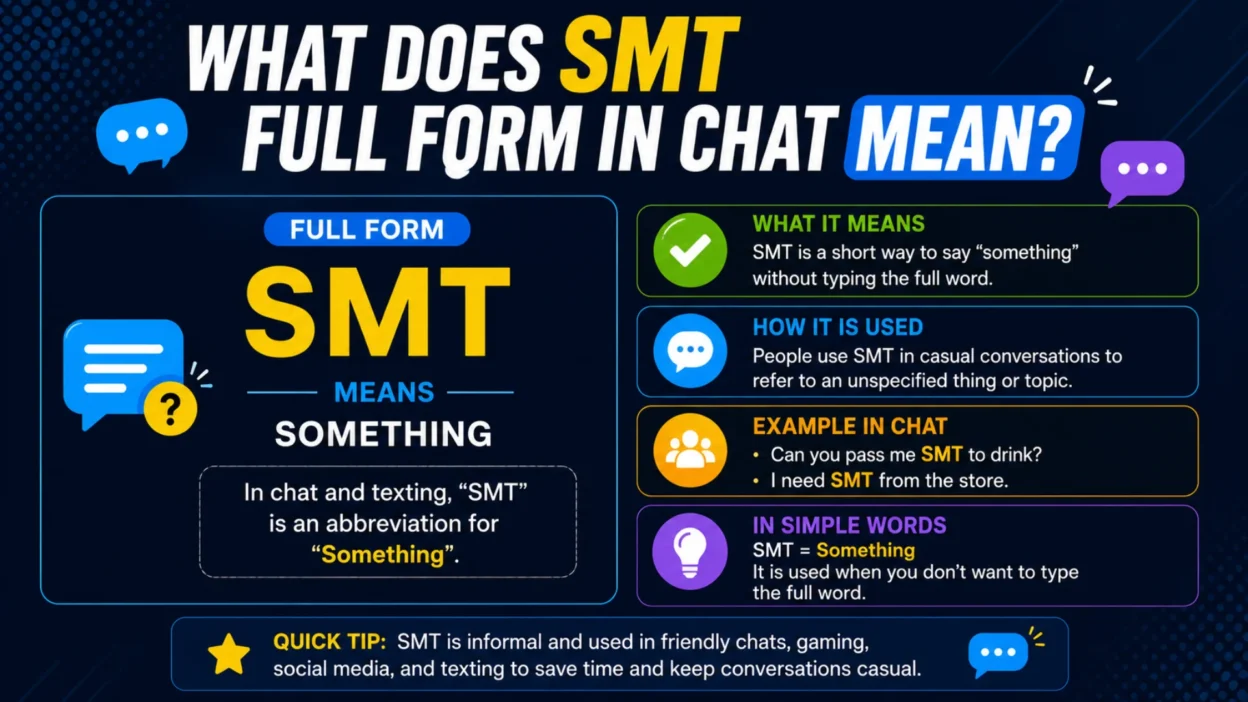
Have you ever been in the middle of a heated group chat and suddenly seen “SMT” pop up on your screen? Your first reaction was probably confusion mixed with curiosity. Interestingly, smt full form in chat is one of the most searched abbreviations across texting platforms. You are definitely not alone in wondering what these three letters actually stand for. Consequently, understanding this term will completely change how you read reactions from younger texters. Moreover, using it correctly can help you express frustration or sarcasm like a true digital native. Let us decode this popular piece of internet slang once and for all. 😅
Definition & Core Meaning of smt full form in chat
So, what does smt full form in chat actually stand for? The most common definition is “Sucking My Teeth.” This phrase represents the physical action of making a “tsk” sound by sucking air through your teeth. Specifically, people use SMT to express annoyance, disappointment, or frustration without typing full sentences. For instance, someone might text “SMT” after hearing bad news. Alternatively, a friend could say “SMT, not again” when something frustrating happens repeatedly.
Nevertheless, smt full form in chat has a secondary meaning as “Something” in some texting contexts. This usage is less common but appears occasionally. For example, “Let me tell you smt” means “Let me tell you something.” However, the “Sucking My Teeth” meaning dominates online conversations by a wide margin. Consider that the teeth-sucking sound is a universal expression of “That’s annoying” across many cultures.
Importantly, smt full form in chat is distinct from “SMD” (Suck My D***) which is highly offensive. SMT is much milder and generally acceptable among friends. The abbreviation serves as a quick emotional reaction without swearing. As a result, SMT has become a favorite among teenagers and young adults who want to express negativity without crossing into vulgarity.
The table below summarizes the main meanings:
AbbreviationFull FormEmotional ToneBest Used ForSMTSucking My TeethAnnoyed, frustrated, disappointedReacting to bad news or repeated failuresSMTSomethingNeutral, informativeShortening “something” in casual texts
History & Origin of smt full form in chat
Where did smt full form in chat originally come from? The expression “sucking teeth” has existed in spoken language for centuries across Caribbean, African, and African American communities. Specifically, the “tsk” sound made by sucking air through your teeth conveys disapproval or annoyance. This non-verbal gesture crossed over into written internet slang naturally.
Subsequently, smt full form in chat appeared in early online forums and chat rooms during the 2000s. Texters needed a way to represent the teeth-sucking sound in writing. “SMT” emerged as the standard abbreviation for this purpose. Interestingly, Urban Dictionary first recorded “SMT” as “Sucking My Teeth” back in 2009. Meanwhile, the abbreviation gained traction on Black Twitter and in AAVE (African American Vernacular English) online spaces.
As social media evolved, smt full form in chat spread to mainstream texting culture. Teenagers adopted SMT for group chats and private messages. Millennials used the term to react to frustrating news without swearing. Gen Z expanded its usage into meme culture and ironic contexts. For example, “SMT” under a video of someone failing repeatedly became a common reaction. Today, SMT appears millions of times daily across every major messaging platform.
Real-World Examples of smt full form in chat in Conversations
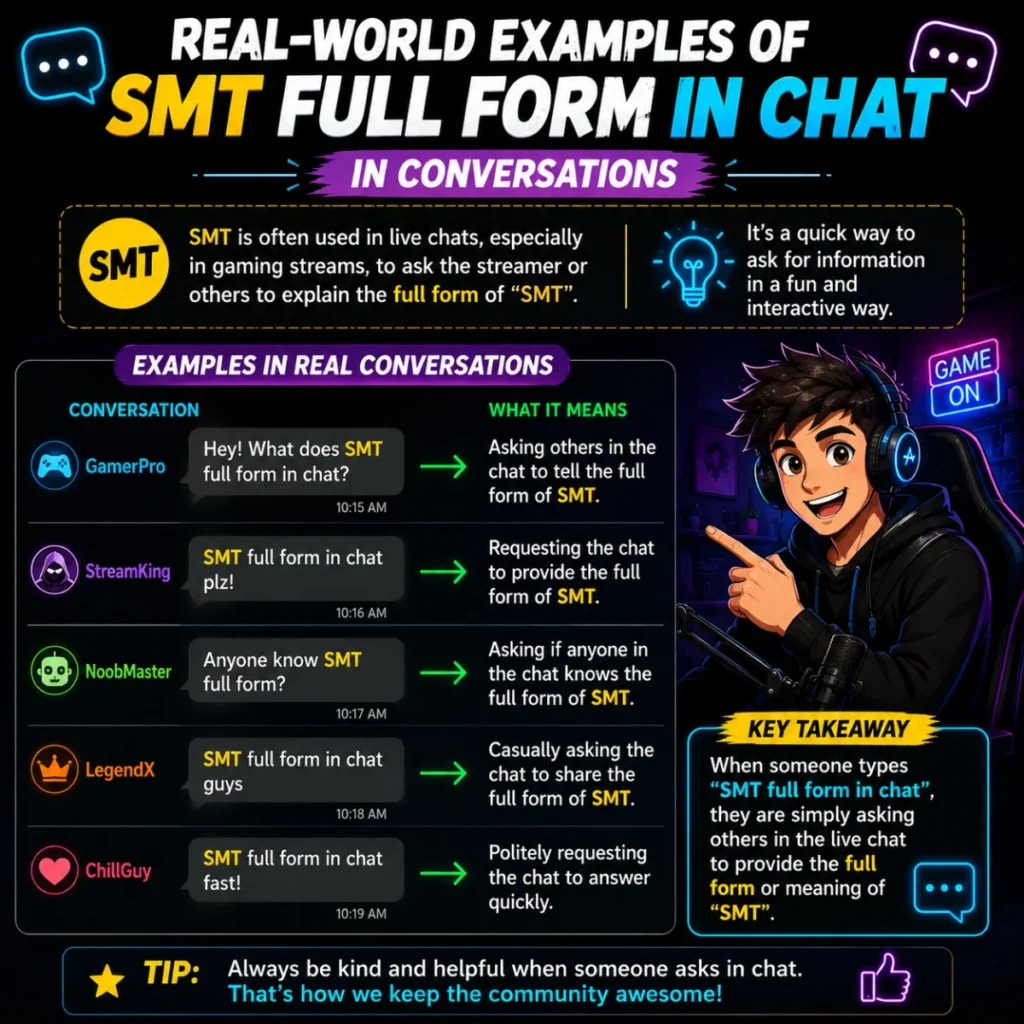
To fully grasp smt full form in chat, let us explore authentic conversation examples. Each scenario below demonstrates how people naturally use this abbreviation.
Example 1: Reacting to Bad News
Person A: “I just missed my bus by ten seconds.” Person B: “SMT. That is the worst feeling.” Person A: “Right? Now I will be late for work.” Person B: “SMT, I hate when that happens.”
Example 2: Expressing Disappointment
Person A: “The restaurant forgot my order again.” Person B: “SMT. Third time this month?” Person A: “Yes! I am so done with that place.” Person B: “SMT, I would be furious too.”
Example 3: Reacting to Repeated Failures
Person A: “I tried to fix my phone screen and made it worse.” Person B: “SMT. Why did you not take it to a professional?” Person A: “I thought I could save money.” Person B: “SMT. Now it will cost double.”
Example 4: Group Chat Frustration
Person A: “The WiFi went out during my online exam.” Person B: “SMT! Did you get to finish?” Person A: “No, I have to retake it next week.” Person C: “SMT, that is so unfair.”
Notice how smt full form in chat always signals negative emotions like frustration, annoyance, or disappointment. For instance, people use SMT to react to bad news. Similarly, SMT expresses empathy when someone else shares a frustrating experience. The abbreviation never appears in positive contexts.
How Context Changes smt full form in chat Meaning
The smt full form in chat can shift slightly depending on where and how you use it. Let us break down four major communication contexts below.
Texting (SMS, iMessage, WhatsApp)
In standard one-on-one texting, SMT expresses genuine frustration. Close friends use SMT freely to react to each other’s bad news. For example, “SMT, that sucks” shows empathy and shared annoyance. However, using SMT with acquaintances might seem overly familiar. Therefore, reserve SMT for people you know reasonably well. Adding a sad emoji like 😞 softens the tone considerably.
Social Media (Twitter, Instagram, TikTok)
On public social media platforms, smt full form in chat often appears in comments and captions. For instance, users comment “SMT” under videos of people failing or making bad decisions. Influencers use SMT in reaction videos to show authentic frustration. Nevertheless, brands rarely use SMT due to its negative connotations. Twitter remains the most SMT-friendly platform for quick reactions to annoying news.
Gaming (Discord, Twitch, Xbox Live)
Gamers use SMT constantly during matches after frustrating deaths or losses. For example, “SMT, I was one shot away from winning” expresses disappointment. “SMT, my teammate left mid-game” shows frustration with others. Interestingly, smt full form in chat in gaming contexts is extremely common. The abbreviation captures the exact feeling of a close loss perfectly. Consequently, SMT appears in nearly every gaming session.
Dating Apps (Tinder, Bumble, Hinge)
Using SMT on dating apps is risky. The abbreviation expresses negativity, which is not attractive in early conversations. For instance, responding “SMT” to a match’s message seems dismissive and rude. Similarly, using SMT to complain about your day creates a negative first impression. Therefore, avoid SMT entirely on dating platforms. Save it for friends who already understand your communication style.
Tone Nuances: Is smt full form in chat Rude or Friendly?
Many people genuinely wonder whether smt full form in chat comes across as rude. The honest answer is that it depends entirely on your relationship with the person. Generally speaking, SMT is neutral to mildly negative. For example, texting “SMT, that is annoying” to a close friend is perfectly fine. That is friendly empathy.
However, smt full form in chat can become rude in specific situations. For instance, using SMT to respond to someone sharing good news is definitely rude. “I got a promotion! SMT” makes no sense and insults the other person. Similarly, using SMT with a boss, teacher, or elder relative is disrespectful. The abbreviation implies annoyance, which is inappropriate with authority figures.
Nevertheless, most people under 35 perceive SMT as a normal, casual expression of frustration. Close friends appreciate when you share their annoyance with “SMT.” Similarly, SMT works well in group chats where everyone commiserates together. The key is matching the abbreviation to the emotional tone of the conversation. When used correctly, SMT builds bonds through shared negativity. When used poorly, it seems dismissive or rude.
smt full form in chat vs Similar Slang Terms (Comparison Table)
Understanding smt full form in chat becomes much easier when comparing it to alternative slang terms. Here is a detailed breakdown.
Slang TermFull MeaningEmotional ToneBest Used ForWorst Used ForSMTSucking My TeethAnnoyed, frustratedReacting to bad news or failuresResponding to good newsSMHShaking My HeadDisappointed, judgmentalExpressing disapproval of someone’s actionsExpressing empathySMDSuck My D***Highly offensive, angryNever (highly vulgar)Any situationFMLF*** My LifeSelf-pitying, dramaticComplaining about your own bad luckResponding to others’ problemsUGHUgh (exclamation)Frustrated, disgustedQuick reaction to something gross or annoyingFormal conversationsTSKTsk (sound)Mild disappointmentPolite disapprovalExpressing strong frustrationSighSigh (exclamation)Exhausted, resignedLong-term frustration or hopelessnessQuick reactions
Notice that smt full form in chat is most similar to SMH (Shaking My Head) but with a key difference. SMH expresses disappointment in someone’s poor decision. SMT expresses frustration about a situation outside anyone’s control. For instance, “SMH at you for forgetting” versus “SMT at this traffic.” One judges; the other commiserates.
What Does “If smt full form in chat smt full form in chat” Mean?
Sometimes people repeat the phrase as “if SMT SMT” in online conversations or forum posts. This unusual pattern typically expresses conditional frustration or hypothetical annoyance. For example: “If SMT means sucking my teeth, then why do people use it for everything?” Alternatively, this repetition can indicate a stutter or typing error in casual messages.
Specifically, smt full form in chat in this repeated form emphasizes uncertainty about the abbreviation’s meaning. The speaker questions whether they understand the slang correctly. This usage remains relatively rare and mostly appears in meta-discussions about internet slang. For most practical purposes, you can safely ignore this variation without losing any meaning. When you do encounter it, simply read it as “if ‘sucking my teeth’ truly means what I think it means.”
How to Respond to smt full form in chat (3 Scenarios)
Knowing smt full form in chat is only half of the battle. You also need appropriate responses for different situations. Here are three common scenarios with example replies.
Scenario 1: Someone Uses SMT to Empathize with You
They text: “SMT, that is so frustrating about your car breaking down.” You reply: “Right? I am so annoyed right now.” Alternative reply: “Thanks for understanding. SMT to this whole situation.”
Scenario 2: Someone Uses SMT to Complain About Their Own Problem
They text: “SMT, I forgot my lunch at home again.” You reply: “SMT, that is the worst. Can you buy something near work?” Alternative reply: “Oh no! SMT. Want me to bring you something?”
Scenario 3: You Do Not Understand Why They Used SMT
They text: “SMT. I cannot believe this.” You reply: “What happened? You seem frustrated.” Alternative reply: “SMT about what? Did something go wrong?”
Pro tip: When someone uses SMT, they are inviting you to share their frustration. Respond with empathy, not solutions. Unless they ask for advice, simply acknowledge their annoyance. A shared “SMT” back builds connection through mutual understanding.
Professional Use: Can You Say smt full form in chat at Work?
Is smt full form in chat appropriate for professional environments? Absolutely not. Work communication demands professionalism and clarity. SMT is casual slang that expresses frustration. Using it in a work email, Slack channel, or team meeting would be highly unprofessional. For instance, responding “SMT” to a client’s request is unthinkable.
There are no exceptions for using SMT in professional contexts. Unlike some milder abbreviations like “FYI” or “ASAP,” SMT expresses negative emotion. Workplaces value solutions and positivity. Expressing frustration through slang damages your professional reputation. Consequently, never type SMT at work. Not in Slack, not in emails, not in team chats.
Safe professional alternatives include “That is frustrating,” “I understand your disappointment,” or simply “Noted.” For example, instead of “SMT, this deadline is too tight,” say “I am concerned about this deadline. Can we discuss extending it?” The meaning remains clear without the casual slang. When in doubt at work, keep all abbreviations professional or avoid them entirely.
Common Misconceptions About smt full form in chat
Let us debunk four persistent myths about smt full form in chat once and for all.
Myth 1: SMT Means “Something” in Most Contexts
Reality: While “something” is a possible meaning, it is not the common one. “Sucking My Teeth” dominates online usage by a wide margin. If someone means “something,” they will usually write “smth” or “sth” instead . Therefore, assume SMT means “Sucking My Teeth” unless context clearly indicates otherwise.
Myth 2: SMT Is the Same as SMH
Reality: SMT and SMH express different emotions. SMH (Shaking My Head) expresses disappointment in someone’s poor decision. SMT expresses frustration about a situation. For example, “SMH at you for forgetting your keys” judges the person. “SMT about this traffic” complains about the situation . They are not interchangeable.
Myth 3: SMT Is Rude in All Contexts
Reality: SMT is perfectly fine among close friends and in casual chats. The rudeness depends entirely on your relationship with the person. Using SMT with a stranger is rude. Using SMT with your best friend is normal. Therefore, know your audience before using this abbreviation.
Myth 4: SMT Is New Slang
Reality: SMT has been around since at least 2009, when Urban Dictionary first recorded it. The teeth-sucking gesture itself is centuries old. While SMT may feel new to some people, it is well-established internet slang. Consequently, SMT is not going away anytime soon.
5 Polite Alternatives to smt full form in chat (With Table)
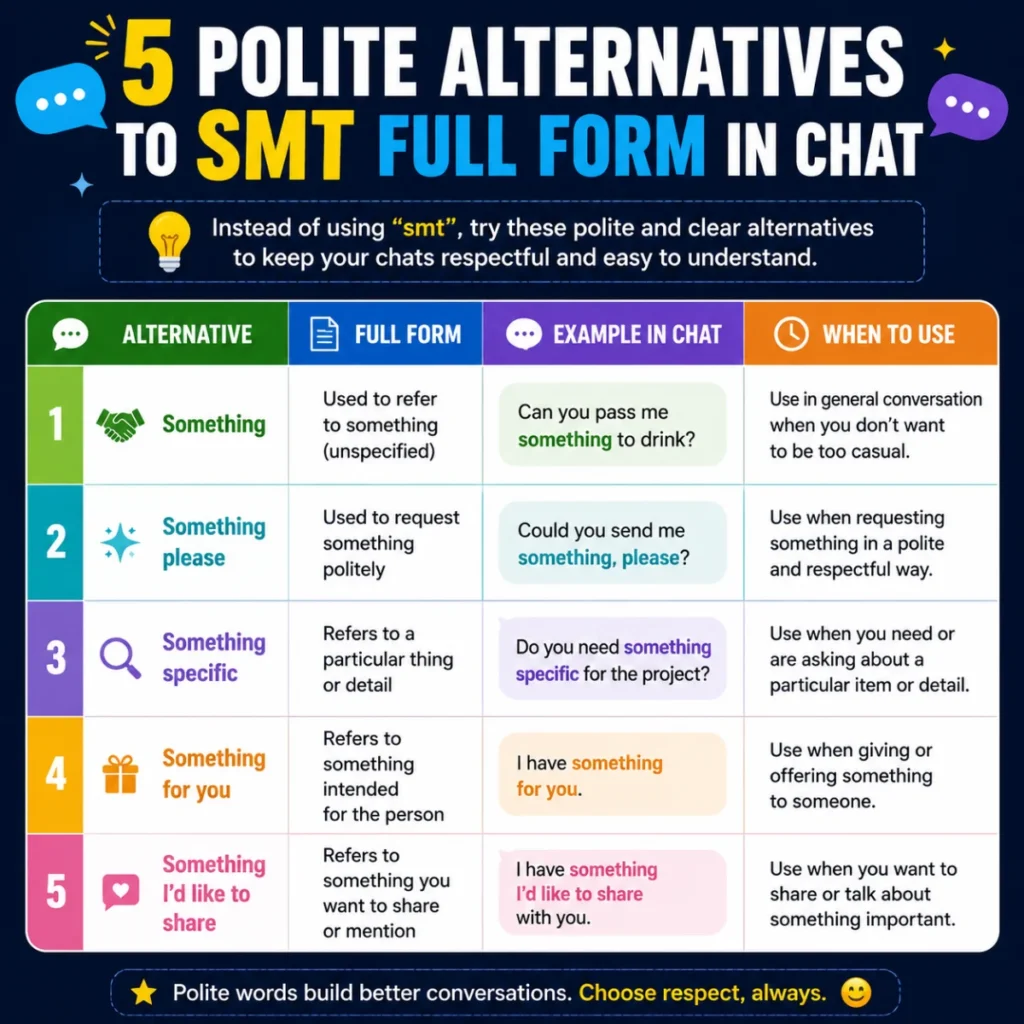
If smt full form in chat feels too casual or negative for your situation, try these alternatives instead. Each one expresses frustration politely.
Alternative PhraseFormality LevelBest ForWhy It WorksThat is frustratingMediumProfessional emails, conversationsClear and universally understoodWhat a shameMediumExpressing sympathyPolite and gentleThat is too badLow to mediumCasual conversationsFriendly but not slangyHow annoyingLowClose friendsDirect but not vulgarI understand your disappointmentHighProfessional supportValidates feelings professionally
Specifically, “that is frustrating” works beautifully as an smt full form in chat replacement for professional situations. Similarly, “what a shame” fits perfectly when you want to express sympathy without negativity. For casual contexts with friends, “how annoying” is clear and natural. When in doubt, simply say “That sucks” which is slightly more polite than SMT but still casual.
Frequently Asked Questions About smt full form in chat
Q1: What does SMT stand for in chat?
SMT most commonly stands for “Sucking My Teeth.” People use this abbreviation to express annoyance, frustration, or disappointment. For example, “SMT, I missed the bus again” shows frustration. In rare cases, SMT can mean “Something,” but this usage is much less common. Consequently, smt full form in chat is almost always the teeth-sucking expression.
Q2: Is SMT the same as SMH?
No, they are different. SMH stands for “Shaking My Head” and expresses disappointment in someone’s actions or decisions. SMT expresses frustration about a situation, not necessarily someone’s fault. For instance, “SMH at you for being late” judges the person. “SMT about this traffic” complains about the situation. Therefore, they are not interchangeable.
Q3: Is SMT rude to use in texts?
It depends on who you are texting. Among close friends, SMT is perfectly fine and even expected. With acquaintances, coworkers, or family elders, SMT may seem rude or dismissive. The abbreviation implies frustration, which can come across as negative. Therefore, know your audience before using SMT. When in doubt, spell out “That is frustrating” instead.
Q4: What is the difference between SMT and “tsk”?
“Tsk” is the onomatopoeia for the teeth-sucking sound. SMT is the abbreviation representing the action. They mean the same thing. However, “tsk” is older and less common in texting. SMT has become the standard written form for the teeth-sucking expression. Consequently, most younger texters use SMT rather than “tsk.”
Q5: Can I use SMT in a professional email?
No, absolutely not. SMT is casual internet slang that expresses frustration. Professional communication requires neutral, positive, or solution-focused language. Using SMT in a work email would damage your professional reputation. Use “That is frustrating” or “I am disappointed to hear that” instead. Save SMT for personal texts with friends only.
Q6: What does SMT mean on Snapchat or Instagram?
On Snapchat and Instagram, SMT functions exactly the same way as regular texting. Users write SMT in direct messages or comments to express frustration. The meaning does not change across different social media platforms. Smt full form in chat remains consistent everywhere. You will also see SMT in reaction videos where creators make the teeth-sucking sound.
Q7: Is there a positive meaning for SMT?
No, SMT is exclusively negative or frustrated in tone. The teeth-sucking gesture never expresses happiness, excitement, or approval. If someone uses SMT, they are annoyed about something. Therefore, do not use SMT to respond to good news. That would confuse the other person completely. Save SMT for situations where frustration is the appropriate response.
Conclusion
Understanding smt full form in chat transforms how you express frustration in digital conversations. As we have thoroughly explored, SMT stands for “Sucking My Teeth” and represents the “tsk” sound people make when annoyed. The abbreviation emerged from spoken language centuries ago and entered internet slang around 2009. Consequently, millions of people use SMT daily to react to bad news, repeated failures, and general annoyances.
Nevertheless, context remains critically important for proper usage. While SMT works beautifully among close friends, professional environments demand more formal alternatives. Similarly, dating app users should avoid this abbreviation entirely. For instance, “that is frustrating” or “what a shame” might serve you better in uncertain situations. Empathy matters more than efficiency.
The key takeaway from all of this? Smt full form in chat reflects how physical gestures translate into written internet slang. Embracing this abbreviation helps you connect with younger audiences and express authentic reactions. However, always consider your audience before typing those three letters. When used correctly, SMT adds emotional depth and shared frustration to your messages. When used poorly, it seems rude or dismissive. Use it wisely, empathize genuinely, and enjoy more connected conversations. 😊

Amelia Brooks is a passionate writer specializing in text meanings, slang, and digital communication trends. She simplifies modern messaging to help readers understand every text with ease.