Have you ever seen “Message 5e” pop up in a gaming conversation and felt completely lost? You are definitely not alone in this confusion. Interestingly, message 5e is not a texting abbreviation or slang term at all. Instead, it refers to a specific spell in the fifth edition of the world’s most popular tabletop role-playing game, Dungeons & Dragons. Consequently, understanding this term will help you participate in D&D discussions with confidence. Moreover, this spell offers fascinating tactical possibilities for both players and Dungeon Masters. Let us dive into everything you need to know about this magical communication tool. 😊
Definition & Core Meaning of message 5e
So, what does message 5e actually mean? This term refers to a cantrip spell in Dungeons & Dragons 5th Edition that allows magical communication. Specifically, the spell enables you to send a whispered message to a creature up to 120 feet away. The target, and only the target, hears your message clearly. For instance, you could point your finger at an ally across a crowded room and whisper “The guard is coming” without anyone else overhearing.
Nevertheless, message 5e is not pure telepathy. You must actually whisper the words you wish to convey. The spell simply ensures that only your intended recipient hears those whispered words. On the other hand, the spell does allow two-way communication. The target can reply in a whisper that only you can hear as well. Consider a scenario where you are scouting ahead and need to report back to your party without alerting enemies.
Importantly, message 5e has some notable limitations. The spell requires verbal, somatic, and material components. You need a short piece of copper wire as the material component. Additionally, you must be able to whisper and point your finger at the target. Magical silence blocks the spell completely. As a result, you cannot use this spell if silenced or if your hands are bound.
History & Origin of message 5e
Where did message 5e originally come from? The spell has existed in Dungeons & Dragons for multiple editions. Specifically, earlier versions of D&D included similar communication spells with different mechanics. The 5th Edition version standardized the spell as a cantrip available to multiple classes.
Subsequently, message 5e became one of the most popular utility cantrips in the game. Bards, Sorcerers, Wizards, and Artificers can all learn this spell naturally. Interestingly, other classes can access it through feats like Magic Initiate or racial traits. For instance, High Elves can take this cantrip regardless of their class. Meanwhile, the spell’s school of magic is Transmutation, meaning it manipulates sound rather than affecting minds directly.
The spell is often compared to its more powerful cousin, “Sending,” which is a 3rd-level spell. Think of message 5e as a magical walkie-talkie you can use constantly. Sending is more like a long-distance telephone call for important messages. Today, Message remains a staple choice for players who value stealth, strategy, and creative problem-solving.
Real-World Examples of message 5e in Conversations
To fully understand message 5e, let us explore authentic conversation examples from D&D players. Each scenario demonstrates how people discuss this spell.
Example 1: Character Building
Player 1: “What cantrip should I take for my new Wizard?” Player 2: “Definitely grab message 5e. It is so useful for stealth.” Player 1: “Really? I was thinking about taking Fire Bolt instead.” Player 2: “Take both if you can. Message saves parties constantly.”
Example 2: In-Game Strategy
DM: “The guards are patrolling the hallway ahead.” Player: “I cast message 5e to tell the rogue they are coming.” DM: “Roll to see if you can whisper quietly enough.” Player: “Natural 20! The rogue hears you perfectly.”
Example 3: Spell Debate
Player 1: “Can I use message 5e to intimidate an enemy?” Player 2: “Rules as written, the target must be willing to reply.” Player 1: “The spell does not say they have to be willing to hear it.” Player 2: “True, but the reply only works if they choose to whisper back.”
Example 4: New Player Question
New Player: “What does message 5e actually do?” Experienced Player: “It lets you send a secret whisper to someone 120 feet away.” New Player: “That sounds super useful for heists.” Experienced Player: “Exactly. It is basically a magical radio.”
Notice how message 5e appears in discussions about character optimization, tactical planning, and rules clarification. For instance, players debate whether the target must be willing. Similarly, Dungeon Masters interpret how the spell interacts with stealth mechanics.
How Context Changes message 5e Meaning
The message 5e spell functions consistently, but player strategies change dramatically across different scenarios. Let us break down four major gameplay contexts.
Dungeon Exploration
In dungeon crawling contexts, message 5e enables the party to split up safely. The scout can move ahead and report back without shouting. For example, “I see three goblins around the corner” whispers through the spell. Consequently, the party can prepare before entering combat. However, walls block the spell beyond certain thicknesses.
Social Encounters
In ballrooms, courts, or negotiation scenes, message 5e allows secret communication. The party face can receive advice from allies while talking to an NPC. For instance, “Ask about the stolen jewels” comes through discreetly. This prevents the NPC from realizing the party is coordinating against them. Nevertheless, perceptive NPCs might notice you pointing and whispering.
Combat Situations
In battle, message 5e uses your action to cast. That means you cannot attack or cast most other spells in the same turn. Therefore, using Message in combat requires sacrificing offensive potential. However, coordinating a complex strategy might be worth the trade-off. For example, “I will cast Darkness, you run left” could save the party.
Stealth Missions
In heists or infiltration scenarios, message 5e is absolutely invaluable. Multiple party members can coordinate silently from different positions. The spell travels around corners and through openings. As a result, you do not need line of sight to your target. Just knowing their direction and distance is sufficient.
Tone Nuances: Is message 5e Rude or Friendly?
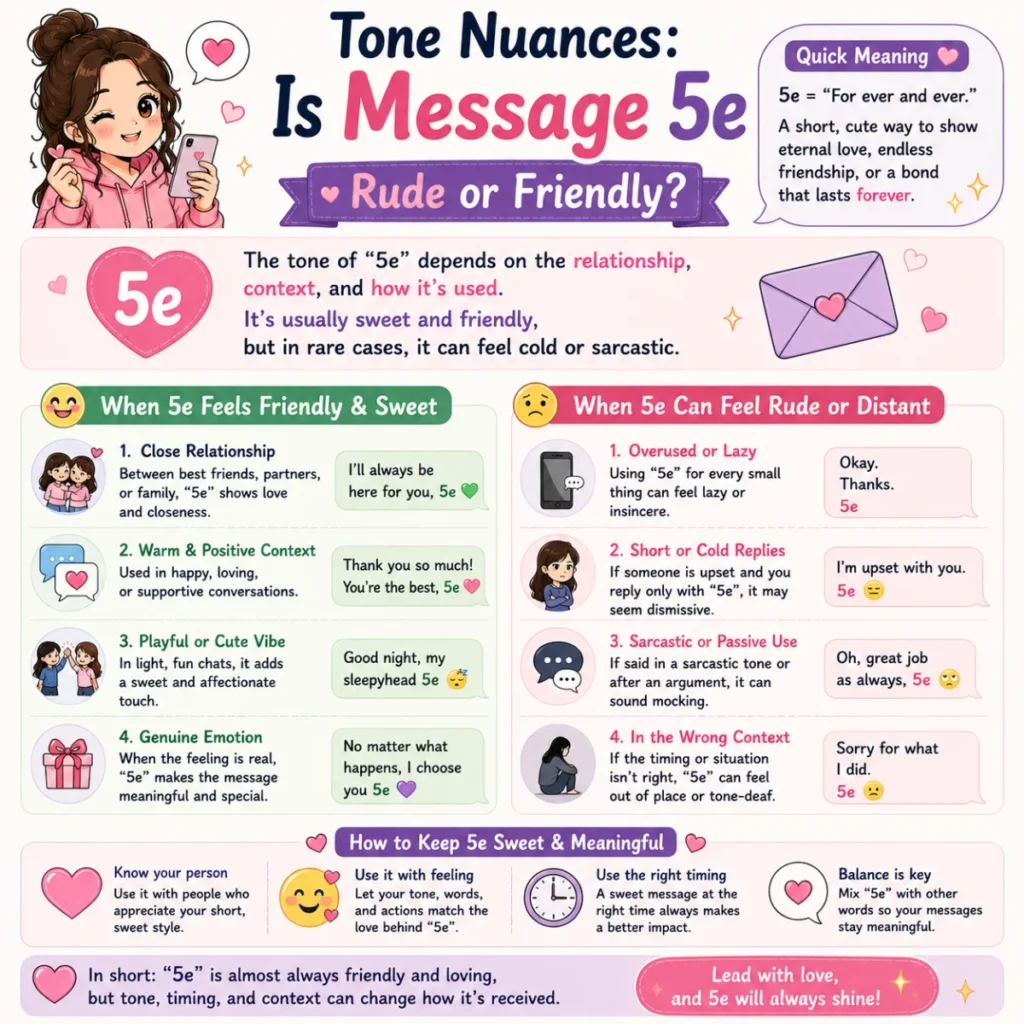
The message 5e spell itself has no inherent rudeness. It is simply a tool for communication. However, how you use it determines whether NPCs perceive it as rude. For example, using Message to eavesdrop on someone without their knowledge could be considered rude or sneaky. Similarly, sending annoying whispers to an enemy during combat might be seen as taunting.
Nevertheless, most players and Dungeon Masters view message 5e as a friendly utility spell. It enables teamwork and coordination. Close party members use it constantly to share information. Consequently, the spell strengthens party bonds rather than harming them. The key is using the spell respectfully toward NPCs and other players. When used correctly, Message is one of the most beloved cantrips in the game.
message 5e vs Similar Spells (Comparison Table)
Understanding message 5e becomes easier when comparing it to alternative communication spells. Here is a detailed breakdown.
Spell NameLevelRangeDurationBest Used ForLimitationsMessageCantrip120 feet1 roundQuick, secret whispers in the same areaBlocks by walls, requires whisperingSending3rdUnlimited1 roundLong-distance messages across planes25-word limit, 5% failure chance across planesTelepathic Bond5th30 feet1 hourGroup telepathy for complex planningRequires ritual casting, higher levelComprehend Languages1stSelf1 hourUnderstanding unknown languagesDoes not allow speaking backTongues3rdTouch1 hourSpeaking any language fluentlyHigher level spell slot required
Notice that message 5e is the only cantrip-level communication spell. Unlike Sending which costs a 3rd-level spell slot, Message costs nothing. Consequently, you can cast Message unlimited times per day. However, Sending works across any distance and even to other planes of existence.
What Does “If message 5e message 5e” Mean?
Sometimes players repeat the phrase as “if Message Message” in online discussions or forum posts. This unusual pattern typically expresses conditional hypotheticals about the spell. For example: “If Message worked on objects instead of creatures, that would change everything.” Alternatively, this repetition can emphasize the spell’s name in casual conversation.
Specifically, message 5e in this repeated form appears in rules debates. The speaker questions how the spell interacts with itself or with other effects. This usage remains relatively rare and mostly appears in dedicated D&D forums. For most practical purposes, you can safely ignore this variation without losing any meaning. When you do encounter it, simply read it as “if the Message spell works in this specific way.”
How to Respond to message 5e (3 Scenarios)
Knowing about message 5e is one thing. Knowing how to respond when it comes up in conversation is another. Here are three common scenarios with example replies.
Scenario 1: A Player Asks About Taking the Spell
They ask: “Should I take Message as one of my cantrips?” You reply: “Yes, especially if your party does stealth missions or social encounters.” Alternative reply: “It depends on your campaign. Combat-heavy games might prefer damage cantrips.”
Scenario 2: A DM Rules Against Your Use of Message
They say: “You cannot cast Message because you are in a zone of magical silence.” You reply: “That is correct. The spell requires verbal components, so I understand.” Alternative reply: “Can I use Subtle Spell metamagic to bypass that restriction?”
Scenario 3: A New Player Does Not Understand the Spell
They ask: “Wait, does Message let me read minds?” You reply: “No, it just lets you send a whispered message. The target still has free will.” Alternative reply: “Think of it as a magical walkie-talkie, not telepathy.”
Pro tip: When explaining message 5e to new players, emphasize that it is not mind control. The target hears your message but can choose to ignore it. Clarifying this early prevents disappointment later.
Professional Use: Can You Discuss message 5e at Work?

Is discussing message 5e appropriate for professional environments? Generally no, unless your job involves gaming. Tabletop role-playing games are recreational activities. Discussing D&D spells during work hours might be seen as unprofessional. However, there are specific exceptions.
For instance, game designers, writers, or content creators covering D&D must discuss spells like Message as part of their jobs. Similarly, teachers using D&D in educational settings might reference the spell. For these professionals, message 5e is directly relevant work content.
Nevertheless, in most office settings, save D&D discussions for lunch breaks or after work. Safe alternatives include simply saying “I play D&D on weekends” without diving into spell mechanics. When in doubt at work, keep recreational gaming conversations brief and appropriate.
Common Misconceptions About message 5e
Let us debunk four persistent myths about message 5e once and for all.
Myth 1: Message 5e Is Telepathy
Reality: Message is explicitly not telepathy. The caster literally whispers words that the target hears magically. Telepathy involves direct mind-to-mind communication without sound. Consequently, anything that blocks sound (like magical silence) also blocks Message.
Myth 2: You Can Message Any Creature Anywhere
Reality: Message has a range of only 120 feet. You cannot send messages across continents or to other planes. For long-distance communication, you need the 3rd-level spell Sending. Therefore, Message is for close-range coordination only.
Myth 3: The Target Must Be Willing to Receive the Message
Reality: The spell does not specify that the target must be willing to hear the message. However, the target can choose whether to reply. You can send an unwanted whisper to an enemy. Whether that is a good idea tactically is another question.
Myth 4: You Can Message Objects or Constructs
Reality: The spell specifically targets a “creature”. Objects, constructs that are not creatures, and undead may not qualify depending on your Dungeon Master’s interpretation. Always check with your DM before assuming Message works on non-standard targets.
5 Creative Uses for message 5e (With Table)
If you are looking for creative applications of message 5e, try these ideas instead of standard communication.
Creative UseBest ForWhy It WorksExampleCheating at cardsRogues, BardsSecret information sharing”The dealer’s hand is three queens”Coordinating a heistAny stealth partySilent teamwork across distance”You take left guard, I take right”Intimidating enemiesWarlocks, SorcerersPsychological warfare”We are watching you. Leave now.”Testing for mimicsCautious explorersSee if objects respondWhisper “Hello?” to a suspicious chestLong-distance ventriloquismEntertainers, TrickstersMisdirection and confusionMake a guard think their captain is calling them
Specifically, using message 5e to cheat at cards is a classic trick. Similarly, intimidating enemies from the shadows can break their morale without combat. The spell’s ability to travel around corners makes these creative uses possible.
Frequently Asked Questions About message 5e
Q1: What does message 5e mean in D&D?
Message 5e refers to a cantrip spell in Dungeons & Dragons 5th Edition. The spell allows you to whisper a message that only one target creature within 120 feet can hear. The target can reply in a whisper that only you can hear. Consequently, it is invaluable for stealth and coordination.
Q2: Which classes can learn message 5e?
The Message cantrip is available to Artificers, Bards, Sorcerers, and Wizards. Other classes can access it through the Magic Initiate feat or racial traits like the High Elf’s bonus cantrip. Warlocks with Pact of the Tome can also learn it. Therefore, many characters have access to this useful spell.
Q3: Can message 5e go through walls?
Yes, but with limitations. Message can travel through solid objects if you are familiar with the target and know they are beyond the barrier. However, 3 feet of wood, 1 foot of stone, 1 inch of common metal, or a thin sheet of lead blocks the spell. Magical silence also blocks Message completely.
Q4: Is message 5e a good spell?
Yes, Message is widely considered one of the best utility cantrips in the game. It enables silent coordination, stealth communication, and creative problem-solving. However, it is not essential for combat-heavy campaigns where damage cantrips might serve you better. Therefore, evaluate your campaign style before choosing it.
Q5: Does message 5e require the target to reply?
No, the target can choose whether to reply. The spell states the target “can reply in a whisper,” not that they must reply. Consequently, you might send a message and receive no response. This is important to remember when using Message on hostile creatures or NPCs.
Q6: Can you cast message 5e on yourself?
No, the spell targets “a creature within range” other than yourself. You cannot send a Message to yourself. For self-reminders, use a different method. The spell is designed for communication between two different creatures.
Q7: What is the difference between message 5e and sending 5e?
Message is a cantrip with 120-foot range and 1-round duration. Sending is a 3rd-level spell with unlimited range that can reach other planes of existence. Sending also allows the target to recognize you as the sender. Think of Message as a walkie-talkie and Sending as an international phone call.
Conclusion
Understanding message 5e opens up countless tactical possibilities in your D&D games. As we have thoroughly explored, this cantrip allows silent, secret communication with allies up to 120 feet away. The spell is available to Bards, Sorcerers, Wizards, and Artificers. Consequently, many parties have access to this invaluable utility tool.
Nevertheless, Message has important limitations. Walls can block the spell beyond certain thicknesses. Magical silence makes casting impossible. The spell requires verbal, somatic, and material components. Therefore, always check your surroundings before relying on Message in critical moments.
The key takeaway from all of this? Message 5e is one of the most versatile cantrips in Dungeons & Dragons 5th Edition. Whether you are planning a heist, navigating a social encounter, or coordinating a stealth mission, this spell delivers. Add it to your spell list, practice creative applications, and watch how it transforms your party’s coordination. Now go forth and communicate magically! 😊

Amelia Brooks is a passionate writer specializing in text meanings, slang, and digital communication trends. She simplifies modern messaging to help readers understand every text with ease.