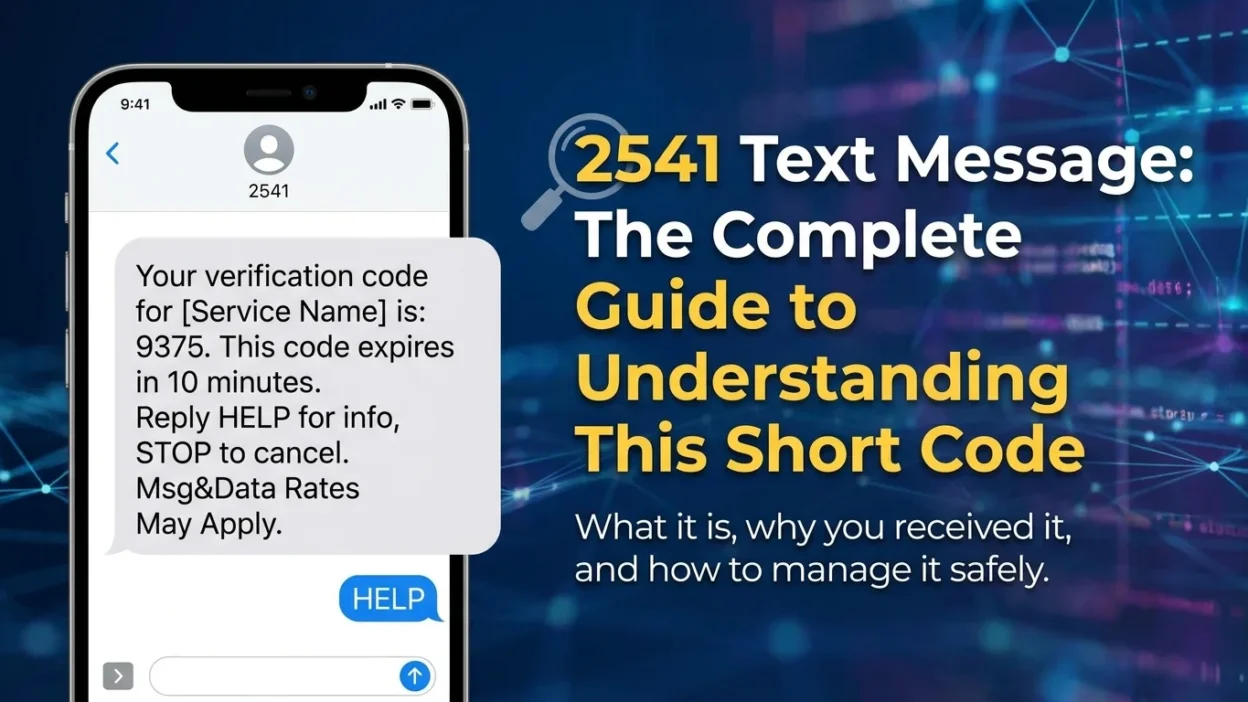
If you’ve received a text from the short code 2541, you might be wondering who sent it and why. The number 2541 serves several legitimate purposes depending on your location and mobile carrier. This comprehensive guide explains everything you need to know about the 2541 short code and what to do if you receive a message from it.
What Is a Short Code?
Before diving into the specifics of 2541, it helps to understand what a short code actually is. A short code is a 3- to 6-digit number used by organizations to send text messages in bulk, often for alerts, marketing, or verification purposes. Unlike standard 10-digit phone numbers, short codes are designed specifically for high-volume business messaging and are regulated by mobile carriers.
These numbers make it easier for companies to send appointment reminders, two-factor authentication codes, promotional offers, and alert notifications. Because short codes are registered and monitored, they provide a layer of accountability that helps prevent spam and fraud—though scammers can still find ways to exploit them.
Primary Uses of 2541

The 2541 short code is primarily used in two different contexts depending on your location.
2541 on T-Mobile: A Service Alert Code
If you’re a T-Mobile customer in the United States, 2541 is an official T-Mobile short code used for service alerts and notifications. T-Mobile uses this number as part of a family of short codes for various campaigns and alerts, helping customers stay informed about their accounts.
According to T-Mobile’s official support documentation, short codes including 2535, 2536, 2537, 2538, 2539, 2540, 2541, 2542, 2543, 2544, 2545, and 2546 are T-Mobile campaigns . These codes are used for different types of notifications and service-related communications.
Common alerts from 2541 may include:
- Service notifications about your account status
- Information about plan changes or updates
- Network maintenance announcements
- Account-related updates and reminders
- Promotional notifications (if you’ve opted in)
Important Note: Official carrier alerts like those from 2541 never ask for your password, full credit card number, or other sensitive personal details. They are informational notifications only. If a message from 2541 asks for this information, it is likely a scam.
2541 in New Zealand: Bulletin Messaging Service
In New Zealand, 2541 is operated by Bulletin Messaging for various notification services . The shortcode is listed in the public premium-text directories of all major New Zealand mobile carriers including Spark, One NZ, 2degrees, and Skinny .
Service Details:
- Cost to send: NZ$0.09–0.20 depending on your carrier
- Cost to receive: Free
- Category: Listed as “Other” in carrier directories
- Contact: 0800 586 453 (listed by 2degrees)
How to stop messages from 2541 in New Zealand: Reply STOP to the number 2541 . Under the NZ TCF Mobile Messaging Services Code, commercial and premium senders are required to honour STOP requests within two business days.
Note: Transactional notifications (delivery updates, appointment reminders, OTP codes) are generally exempt from STOP obligations — you need to unsubscribe via the service itself .
Other Meanings of the Number 2541
Beyond its use as a short code, the number 2541 appears in several other contexts around the world:
ContextWhat 2541 RepresentsArea Code (Greece)Telephone area code for Xanthi, GreeceError CodeSMS gateway “Mail loop prevention” errorSwedish StandardSMS 2541:1975 – Technical drawings gear representationISO StandardSS-ISO 2541:2017 – Center drills for center holesFinancialTrading price/stock ticker reference
2541 as a Telephone Area Code in Greece
In Greece, 2541 is a telephone area code for the Xanthi region in Thrace . The area code serves landline numbers in the city of Xanthi and surrounding areas.
Dialing instructions:
- Within Greece: Dial 2541 [local number]
- International callers: Dial +30 2541 [local number]
The area is served by providers including FORTHNET S.A. and CYTA HELLAS S.A. .
2541 as an SMS Gateway Error Code
In technical contexts, Error 2541 indicates “Mail loop prevention” in SMS gateway systems. This error occurs when setting up an email to SMS gateway. The system prevents sending messages that could create an infinite loop of email-to-SMS-to-email communication .
2541 as a Swedish Standard
SMS 2541:1975 is a Swedish standard for “Technical Drawings – Conventional Representation of Gears” . This standard was published in 1975 and has been superseded by ISO 2203:1973 .
2541 as an ISO Standard
SS-ISO 2541:2017 specifies dimensions for center drills for center holes with radius form – Type R . This standard covers metric dimensions and includes recommendations for R-type center holes.
How to Identify a Legitimate 2541 Message
To determine if a text from 2541 is legitimate, follow these guidelines:
Check the Message Content
- Official T-Mobile alerts provide information but typically don’t ask you to reply with personal information
- Look for the carrier or company name identifying itself in the message
- If the message references New Zealand content or services, it’s from Bulletin Messaging
- Legitimate messages usually have professional grammar and spelling
Look for Red Flags
- Unsolicited offers – If it claims you’ve won a prize or gift, it’s likely a scam
- Suspicious links – Official carrier alerts generally don’t contain links
- Requests for personal info – Any message asking for passwords, credit card numbers, or verification codes is almost certainly a scam
- Urgent language – Messages that pressure you to act immediately are often scams
- Too good to be true – If it sounds too good to be true, it probably is
Verify Independently
- If the text claims to be from T-Mobile, contact them directly through their official app or website
- If the message is from Bulletin Messaging in New Zealand, call their support at 0800 586 453
- Never call the number that texted you—look up official contact information separately
How to Stop Messages from 2541
For T-Mobile Customers
For T-Mobile alerts, messages from 2541 are typically considered “transactional” or “informational” alerts, not optional marketing messages. Replying with “STOP” may not have any effect, as these are essential service notifications.
If you want to stop receiving messages from 2541:
- Contact T-Mobile customer service directly
- Ask about the specific messages you’re receiving
- Inquire about opting out of non-essential notifications
- You may need to adjust your notification preferences in your account settings
Important: Some alerts are legally required (like data usage warnings) and cannot be opted out of.
For Bulletin Messaging in New Zealand
Reply STOP to 2541. Commercial senders must honour STOP requests within two business days under the NZ TCF Mobile Messaging Services Code .
For Transactional Messages
Messages like delivery updates, appointment reminders, and OTP codes are generally exempt from STOP obligations. You need to unsubscribe via the service itself .
How to Report Suspicious 2541 Messages
If you believe you’ve received a scam message from a spoofed 2541 number:
- Don’t reply – Responding confirms your number is active
- Don’t click any links – They may lead to malicious websites
- Block the number on your phone
- Forward the message to 7726 (SPAM) to help carriers identify spam
- Report to your carrier – They can investigate spoofed numbers
What to Do If You Accidentally Responded
If you’ve replied to a suspicious message or clicked a suspicious link:
- Contact your bank or credit card company immediately if you provided financial information
- Change your passwords for all important accounts
- Place a fraud alert on your credit report
- Run a security scan on your device
- Monitor your accounts for suspicious activity
Comparison Table: 2541 Uses by Region
Location/ProviderWhat 2541 RepresentsPurposeAction RequiredT-Mobile (USA)Official short codeService alerts and notificationsNone – informational onlyNew ZealandBulletin Messaging short codeVarious notification servicesReply STOP to unsubscribeGreeceArea code (Xanthi)Geographic telephone codeUsed for phone callsSMS GatewayError 2541Mail loop preventionRemove SMS/REPORT tags
Frequently Asked Questions About 2541
Is 2541 a scam number?
No, 2541 is a legitimate short code used by T-Mobile for service alerts in the US and by Bulletin Messaging for notifications in New Zealand. However, scammers can spoof numbers, so always check the content of any message you receive.
What does 2541 mean on T-Mobile?
2541 is a T-Mobile short code used for service alerts and notifications, part of their self-service campaign system .
Is 2541 from a US carrier?
Yes, 2541 is used by T-Mobile in the United States for service alerts and account notifications .
What is 2541 in New Zealand?
In New Zealand, 2541 is operated by Bulletin Messaging for various notification services. Sending a text costs NZ$0.09-0.20 depending on your carrier, and receiving is free .
How do I stop text messages from 2541 in New Zealand?
Reply STOP to 2541 . Under the NZ TCF Mobile Messaging Services Code, commercial senders must honour STOP requests within two business days .
What is the contact for 2541 in New Zealand?
The contact number for Bulletin Messaging is 0800 586 453 (listed by 2degrees) .
What is the 2541 area code?
2541 is a telephone area code for Xanthi, Greece . It’s used for landline numbers in the Xanthi region of Thrace.
Can scammers use 2541?
Scammers can “spoof” any number to appear legitimate, making it look like they’re texting from 2541 when they’re actually not. This is why it’s important to check message content, not just the sender.
What is Error 2541 in SMS?
Error 2541 is a “Mail loop prevention” error that occurs in SMS gateway systems when the [SMS] or [REPORT] tag is in the subject line of an email being processed for SMS delivery .
Is 2541 an international standard?
Yes, SS-ISO 2541:2017 is an international standard for center drills for center holes with radius form – Type R .
The Evolution of Short Codes
Short codes like 2541 have evolved significantly over the past two decades. Originally designed for simple marketing campaigns and voting systems, they now serve a wide range of purposes.
Early 2000s: SMS voting for TV shows, simple marketing campaigns
Late 2000s: Two-factor authentication, appointment reminders, charity donations
2010s: Mobile banking alerts, customer service interactions, emergency alerts
2020s: AI-powered chatbots, personalized notifications, integrated customer experiences
The 2541 short code represents this evolution—from simple notification services in New Zealand to sophisticated carrier notifications in the US.
Protecting Yourself from SMS Scams
Best Practices for SMS Safety
- Never share personal information via text message
- Don’t click links in unsolicited messages
- Verify sender identity through official channels
- Block and report suspicious numbers
- Keep your phone updated with the latest security patches
- Use a spam blocker app for additional protection
- Be skeptical of any message that creates urgency
How Carriers Protect You
Mobile carriers like T-Mobile have robust systems in place to protect customers from SMS scams:
- Spam detection algorithms that identify suspicious patterns
- Machine learning that adapts to new scam tactics
- Reporting systems like 7726 that help identify new threats
- Number verification to confirm legitimate short codes
- Collaboration with regulatory bodies and other carriers
Conclusion
The 2541 text message can mean very different things depending on your location and context. If you’re a T-Mobile customer in the US, it’s an official service alert from your carrier . If you’re in New Zealand, it’s a notification from Bulletin Messaging . And in Greece, 2541 is a telephone area code for Xanthi .
Understanding these various uses helps you determine whether a message from 2541 is legitimate. Always check the message content for red flags, verify through official channels if unsure, and never share personal information in response to unsolicited texts.
By staying informed about what numbers like 2541 represent and following basic SMS safety practices, you can confidently handle any message you receive—knowing whether to read, ignore, or report it.

Amelia Brooks is a passionate writer specializing in text meanings, slang, and digital communication trends. She simplifies modern messaging to help readers understand every text with ease.