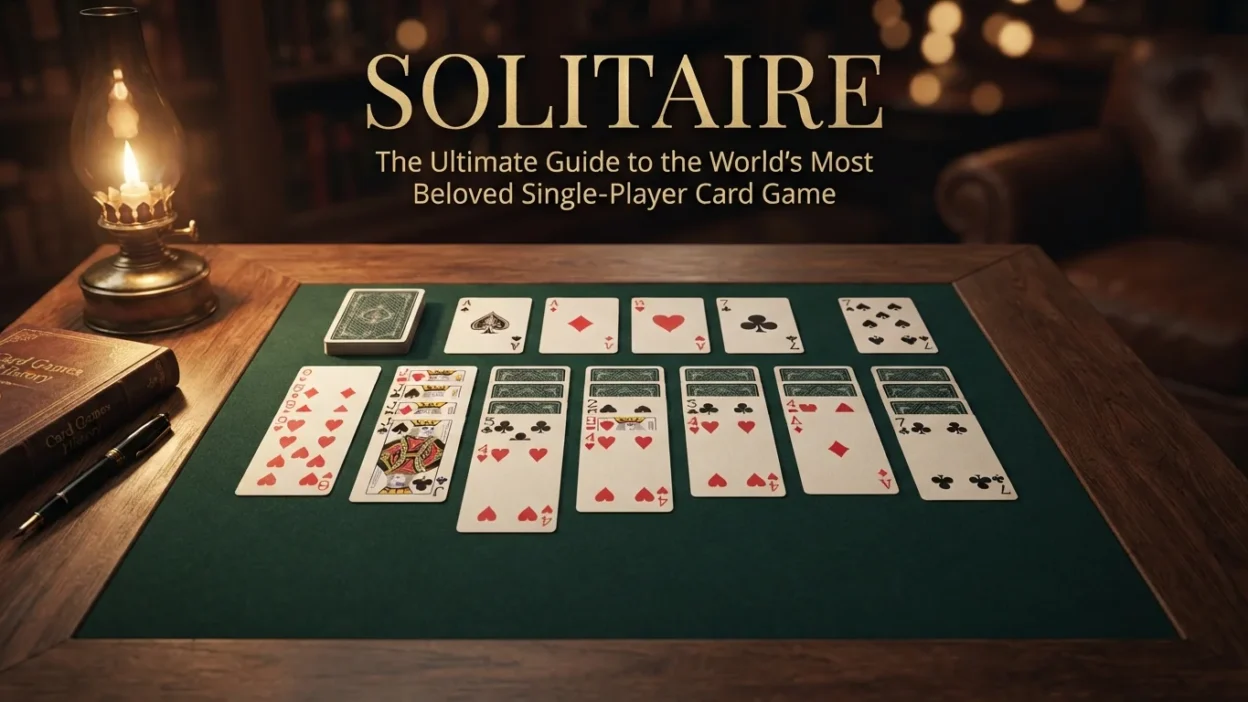
Solitaire is a single-player card game where you arrange cards into ordered piles. The most common version, Klondike, uses one 52-card deck and challenges you to build four foundation piles from Ace to King. The game has been played for centuries, but Microsoft’s version made it a global phenomenon in the 1990s.
If you have ever killed time on a computer by flipping cards and stacking them in neat rows, you already know the quiet joy of Solitaire. It is a game of patience, strategy, and luck. Moreover, it has a rich history that stretches back hundreds of years. Let’s explore everything you need to know about this timeless classic.
H2: What Is Solitaire?
Solitaire is a genre of card games designed for one player. The term comes from the French word solitaire, meaning “alone” or “solitary” . In many parts of the world, especially the UK and Europe, the game is called Patience .
The most popular version is Klondike Solitaire. When people say “Solitaire,” they almost always mean Klondike. The game’s goal is simple: sort a standard 52-card deck into four foundation piles, each organized by suit from Ace to King .
However, Solitaire is not just one game. There are over 500 documented variants . Some use one deck. Others use two. Some use pegs or tiles instead of cards. The common thread is that they are all designed for solo play.
H2: A Brief History of Solitaire
The exact origins of Solitaire are unknown. However, the first written references appeared in a German gaming book published in 1783 . At that time, the game was called “Patience.” The name likely reflected the mental quality needed to succeed .
H3: The Early Years
Solitaire spread across Europe and Scandinavia in the 1700s. Interestingly, cards were sometimes used for fortune-telling. A successful game represented a favorable answer to a wish. This is why the French still call the game réussite, which means “success” .
The first formal rules for Solitaire appeared in 1870. Lady Adelaide Cadogan published Illustrated Games of Patience, a book that shaped the game into what it is today . Her book reached America in 1914, which helped popularize the game across the Atlantic .
H3: The Napoleon Myth
A popular legend says Napoleon played Solitaire while exiled on Saint Helena. However, historians have found no evidence for this. Most records show he played Whist and Piquet instead . Nevertheless, a variant called “Napoleon” was named after him.
H3: The Digital Revolution
Solitaire remained a niche pastime for adults until 1990. That year, Microsoft included Solitaire with Windows 3.0. The game was designed to teach users how to use a mouse—dragging and dropping cards . It became a massive hit. Millions of office workers played it to pass the time.
Today, Solitaire is available on virtually every platform. Microsoft Solitaire Collection offers five games in one: Klondike, Spider, FreeCell, Pyramid, and TriPeaks . Mobile apps bring the game to smartphones and tablets. And countless websites offer free online versions .
H2: How to Play Classic Solitaire (Klondike)
Klondike is the version most people know. Here is how it works.
H3: The Setup
You start with a standard 52-card deck. Shuffle the cards and deal them into seven tableau columns:
- Column 1: 1 card, face up
- Column 2: 2 cards, 1 face up and 1 face down
- Column 3: 3 cards, 1 face up and 2 face down
- And so on, until Column 7: 7 cards, 1 face up and 6 face down
The remaining 24 cards form the stock pile. You flip cards from here during the game .
H3: The Goal
Your goal is to move all cards to four foundation piles, one for each suit. Foundations build up from Ace to King .
H3: The Rules
- Tableau building: You build columns in descending order, alternating colors. For example, a red 6 can go on a black 7. A black 5 can go on a red 6 .
- Moving sequences: You can move multiple cards at once if they form a valid descending, alternating-color sequence.
- Empty columns: Only a King can fill an empty tableau column .
- Stock and waste: Flip cards from the stock. If a card is playable, move it. If not, place it face-up in the waste pile. When the stock runs out, flip the waste pile back over .
- Winning: You win when all 52 cards are in the foundation piles.
H2: Popular Solitaire Variants
Klondike is just the beginning. Here are the most popular variants and what makes each one unique.
VariantDecksDifficultyWin RateKey MechanicKlondike1Medium~80%Build descending, alternating colors FreeCell1Medium~99.99%All cards visible; four free cells Spider2Hard33–99%Build same-suit sequences Pyramid1Easy–Medium~2%Pair cards that sum to 13 TriPeaks1Easy~90%Clear cards by ±1 rank Golf1Easy~30%Clear by ±1 rank, any suit
H3: FreeCell
FreeCell is the thinking player’s Solitaire. All 52 cards are dealt face-up across eight columns. There is no hidden information. Moreover, four “free cells” provide temporary storage for individual cards .
Because everything is visible, nearly every deal is winnable. Of roughly 8 billion possible deals, only a tiny handful are unsolvable . FreeCell rewards planning and patience, not luck.
H3: Spider
Spider uses two decks (104 cards) dealt into 10 columns. The goal is to build complete King-to-Ace sequences in the same suit. When you complete a sequence, it is removed from the board .
You can choose the difficulty by selecting one, two, or four suits. One-suit Spider is easy. Four-suit Spider is brutally hard, with a win rate around 33% .
H3: Pyramid
Pyramid Solitaire uses a completely different mechanic. Instead of building sequences, you remove pairs of cards that sum to 13. For example, a 6 pairs with a 7. A Queen pairs with an Ace. Kings are removed alone because they equal 13 .
This variant is quick and approachable. However, it is statistically very hard to win. Only about 2% of deals are winnable .
H2: Why Play Solitaire?
Solitaire is more than just a way to pass time. Research and player experience suggest several benefits.
H3: It Relaxes the Mind
Solitaire engages the brain in a soft, meditative way. It does not demand intense concentration like a fast-paced video game. Instead, it provides a gentle mental activity that can reduce stress and promote calm .
H3: It Improves Problem-Solving Skills
Every move in Solitaire is a small puzzle. You must decide which card to play, which column to build, and when to flip the stock. Over time, this practice can sharpen strategic thinking and pattern recognition .
H3: It Teaches Patience
The game’s original name says it all. Solitaire rewards careful planning over impulsive moves. Rushing often leads to dead ends. Patience leads to victory .
H3: It Is Pure, Simple Fun
Solitaire has a low barrier to entry. You can learn the rules in minutes. You can play for five minutes or five hours. And you can play it anywhere—on a computer, a phone, or with a physical deck of cards .
H2: Solitaire Tips and Strategies
Want to improve your win rate? These tips will help.
H3: Prioritize Aces and Twos
Move Aces and Twos to the foundation piles as soon as possible. They unlock other moves and clear space on the tableau .
H3: Expose Face-Down Cards
Your top priority should be revealing hidden cards. The more cards you can see, the more options you have. Move cards strategically to uncover what is underneath .
H3: Keep Foundations Balanced
Do not build one foundation pile far ahead of the others. Balanced foundations make it easier to build sequences in the tableau. If one pile is too high, you may block yourself from moving other cards .
H3: Do Not Empty Columns Without a King
Empty columns are valuable. Only a King can fill them. If you empty a column without a King ready, you lose that space. Sometimes it is better to leave a column occupied than to create an unusable gap .
H3: Think Ahead
Do not just make the first move you see. Look for sequences. Plan several moves ahead. Good Solitaire players think like chess players—always considering the next step .
H2: FAQ
What is solitaire?
Solitaire is a single-player card game. The most common version is Klondike, where you arrange cards into foundation piles by suit from Ace to King .
Is solitaire and patience the same thing?
Yes. “Solitaire” is the term used in North America. “Patience” is used in the UK and Europe. They refer to the same genre of single-player card games .
Are all solitaire games winnable?
No. The win rate varies by variant. FreeCell is winnable about 99.99% of the time. Klondike is winnable about 80% of the time. Pyramid is winnable only about 2% of the time .
What is the easiest solitaire game for beginners?
FreeCell is often recommended for beginners who enjoy strategy. TriPeaks is ideal for casual players who want fast, easy gameplay .
How many cards are used in solitaire?
Klondike, FreeCell, TriPeaks, Pyramid, Golf, and Yukon use one deck (52 cards). Spider uses two decks (104 cards) .
Where can I play solitaire for free?
Many websites offer free solitaire games, including Solitaired, Solitaire Bliss, and World of Solitaire. Most variants are also available as free mobile apps .
H2: Conclusion
Solitaire is more than a game. It is a piece of history, a mental exercise, and a quiet companion for moments of solitude. From its mysterious origins in 18th-century Europe to its digital rebirth on Microsoft Windows, Solitaire has endured for centuries.
Whether you play Klondike, FreeCell, Spider, or Pyramid, the appeal is universal. It is a game of skill and chance. It rewards patience and punishes haste. And it offers a simple pleasure that never gets old.
So next time you have a few minutes to spare, deal yourself a hand. You might just discover why Solitaire has remained one of the world’s most beloved games.

Amelia Brooks is a passionate writer specializing in text meanings, slang, and digital communication trends. She simplifies modern messaging to help readers understand every text with ease.