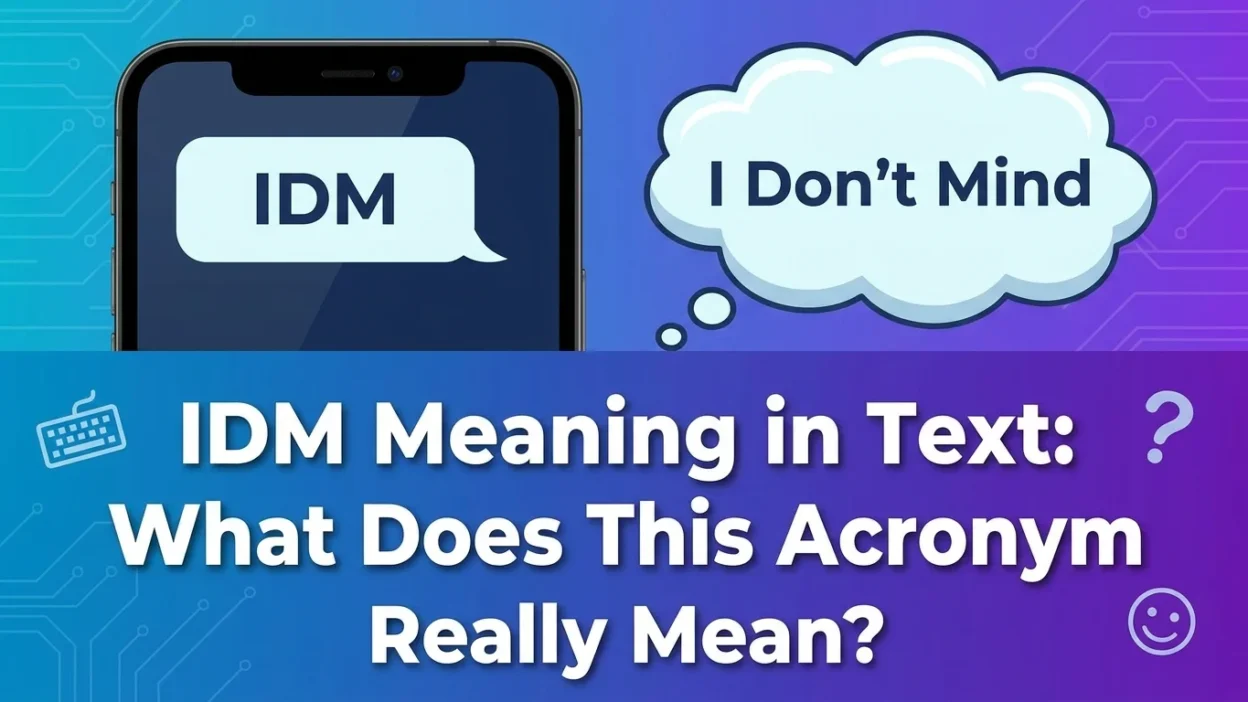
You’re texting a friend about dinner plans, and they reply with “IDM.” Or maybe you’re on Snapchat, and someone sends idm meaning in text in response to a question about what to do. If you’re staring at those three letters wondering what they mean, you’re not alone. This compact acronym has become increasingly common in digital conversations, but its meaning isn’t always immediately obvious.
The good news is that IDM is simple to understand once you know what it stands for. This comprehensive guide covers everything you need to know about what IDM means in text, how to use it properly, when to avoid it, and how it differs from similar acronyms like IDC. By the end, you’ll be able to decode IDM confidently and use it like a pro.
What Does IDM Stand For?
In texting, social media, and casual digital communication, IDM most commonly stands for “I Don’t Mind” . It’s a quick, casual way to say you’re flexible, okay with a suggestion, or don’t have a strong preference about something.
A Close Second: “It Doesn’t Matter”
IDM can also mean “It Doesn’t Matter” in some contexts. The meaning is very similar—both express that you’re indifferent or that the choice doesn’t make a difference to you. In most everyday conversations, you can use the two meanings interchangeably without causing confusion.
When someone sends IDM, they’re essentially saying:
- “I’m okay with either option”
- “I don’t have a strong preference”
- “Whatever you decide is fine with me”
- “That doesn’t bother me”
- “It’s not a big deal”
How IDM Is Used in Texting
Using IDM is straightforward. It works best when someone asks for your opinion, preference, or permission, and you want to show you’re easygoing and flexible.
Responding to Questions About Preferences
This is the most common use of IDM. When someone asks you to choose between options, IDM is a quick way to say you don’t have a strong opinion.
- Friend: “Do you want pizza or burgers for dinner?”
- You: “IDM, either works for me.”
- Friend: “Do you prefer the blue shirt or the red one?”
- You: “IDM, you can pick.”
- Friend: “Should we go to the movies or just stay in?”
- You: “IDM, whatever you’re feeling.”
Responding to Requests and Permissions
IDM is also useful when someone asks if you’re okay with something they want to do.
- Friend: “Is it okay if I stop by your place for a minute?”
- You: “Sure, IDM. Take your time.”
- Friend: “Sorry, I’m running a little late. Are you cool waiting for me?”
- You: “Yeah, IDM. No worries.”
- Friend: “Can I invite Sarah to join us?”
- You: “IDM, the more the merrier.”
IDM vs. IDC: Understanding the Difference
You might also see the acronym “IDC” in texts, which stands for “I Don’t Care.” While they seem similar, there’s a subtle but important difference in tone that you should understand.
IDM Means You’re Cooperative
IDM signals you’re cooperative, flexible, and still engaged in the conversation. It’s a softer, more polite way to say you don’t have a preference. When you use IDM, you’re showing that you’re happy to go along with whatever the other person wants.
Example:
- “Where should we eat?” — “IDM” (I’m okay with either option, let’s decide together)
IDC Can Sound Dismissive
IDC can sound more dismissive or disinterested. It might imply you’re not invested in the topic at all. When you use IDC, you’re saying the topic genuinely doesn’t matter to you, which can sometimes come across as rude or uninterested.
Example:
- “Where should we eat?” — “IDC” (I don’t care, you decide)
Side-by-Side Comparison
SituationIDM ResponseIDC ResponseTone DifferencePicking a restaurant”IDM, anywhere is fine””IDC, just pick something”IDM is cooperative; IDC can sound annoyedChoosing a movie”IDM, whatever you want to watch””IDC, it doesn’t matter”IDM is flexible; IDC can sound disengagedMaking plans”IDM, I’m down for whatever””IDC, whatever”IDM is enthusiastic; IDC can sound dismissive
When to Use Each
- Use IDM when you genuinely don’t mind and want to be cooperative
- Use IDC only when you truly don’t care and the topic is unimportant to you
How IDM Compares to Similar Acronyms
IDM is part of a family of texting acronyms used to express indifference or lack of preference. Here’s how they compare:
AcronymMeaningWhen to UseIDMI Don’t MindYou’re flexible and okay with any optionIDCI Don’t CareYou’re genuinely indifferent or not investedIDKI Don’t KnowYou don’t have the answer or informationIDGAFI Don’t Give A F***You strongly don’t care (profane)IYKYKIf You Know, You KnowShared understanding or inside joke
Example Comparison:
- Friend: “Do you want to go out tonight?”
- IDM: “IDM, I’m down for whatever” (flexible and engaged)
- IDC: “IDC, you decide” (could sound disinterested)
- IDK: “IDK, what do you feel like?” (genuinely unsure)
IDM vs. Other Spellings and Variations
Sometimes you might see IDM written in slightly different ways:
- idm – lowercase (most common)
- IDM – uppercase
- Idm – capital first letter only
Why the Variation?
- Lowercase “idm” is most common in casual texting because it’s faster to type and matches the informal tone
- Uppercase “IDM” is often used for emphasis or in more formal texting contexts (though still informal overall)
- The meaning doesn’t change with capitalization—all versions mean “I Don’t Mind”
Etiquette Tips for Using IDM
While IDM is great for casual chats, it’s not appropriate everywhere. Here’s a complete guide to when and how to use it.
✅ Do Use IDM In:
Casual Text Messages:
- Conversations with friends and family
- Group chats about plans
- Quick responses to simple questions
Social Media DMs:
- On Snapchat, Instagram, WhatsApp, and other messaging apps
- When responding to Stories or posts
- In quick, informal exchanges
Game Chats:
- When picking strategies in multiplayer games
- When deciding on game modes or maps
Group Chats:
- When coordinating meetups or events
- When multiple people are weighing in
❌ Avoid IDM In:
Professional Emails:
- Messages to your boss, manager, or clients
- Formal business correspondence
- Job applications or cover letters
Professional Communication:
- Slack or Teams messages at work
- Any communication with colleagues
- Meeting or presentation materials
Important or Sensitive Conversations:
- When discussing serious matters
- When you need to be clear and direct
- When someone is asking for your genuine opinion on something important
Formal Writing:
- Academic papers or assignments
- Business proposals or reports
- Any formal document
Other Meanings of IDM
While “I Don’t Mind” is the dominant meaning in casual texting, IDM can stand for other things in different contexts. Here’s a comprehensive breakdown:
In Music: Intelligent Dance Music
In music circles, IDM stands for “Intelligent Dance Music.” This is a genre of electronic music that emerged in the early 1990s, characterized by complex rhythms, unconventional song structures, and experimental sounds. Artists like Aphex Twin, Autechre, and Squarepusher are associated with this genre.
In Technology and IT
MeaningContextDescriptionIdentity ManagementInformation TechnologySystems and processes for managing digital identities and accessIntegrated Document ManagementBusiness/ITMiddleware services for managing and integrating documentsInternet Download ManagerSoftwareA popular download acceleration and management tool
In Business
MeaningContextDescriptionIdentity ManagementSecurityManaging user identities and access rightsIntegrated Document ManagementOperationsManaging documents across an organization
In Healthcare
- IDM can refer to “Insulin-Dependent Diabetes Mellitus,” an older term for Type 1 diabetes. However, this is less common and usually spelled out in clinical settings.
How to Determine the Correct Meaning
ContextLikely MeaningCluesTexting/ social mediaI Don’t MindCasual conversation, questions about preferencesMusic discussionIntelligent Dance MusicConversation about electronic music, artistsTech/IT discussionIdentity Management / Internet Download ManagerTechnical vocabulary, software contextHealthcareInsulin-Dependent Diabetes MellitusMedical context, clinical discussion
IDM on Different Platforms
IDM on Snapchat
On Snapchat, IDM almost always means “I Don’t Mind.” It’s used in snaps, chats, and stories when someone wants to show they’re flexible or agree to something.
Example Snapchat Conversation:
- Friend: “Should I post this?”
- You: “IDM, it’s a cute pic!”
IDM on Instagram
Instagram users use IDM in comments, DMs, and Stories captions. It’s common in:
- Comments: “IDM where we go, I just want to hang”
- DMs: “IDM, you choose”
- Story Replies: “IDM, I’m free whenever”
IDM on TikTok
TikTok comments often feature IDM when creators ask for opinions:
- Creator: “Which color should I paint my room?”
- Comment: “IDM, both look good!”
IDM on WhatsApp
WhatsApp messages often use IDM in group chats:
- Group Chat: “Are we meeting at 7 or 8?”
- You: “IDM, whichever works for everyone”
Why IDM Has Become So Popular
The rise of IDM reflects broader trends in digital communication. Here’s why it’s become so common:
Speed and Efficiency
Typing “IDM” takes a fraction of a second compared to “I don’t mind” or “it doesn’t matter.” In fast-paced texting, every keystroke counts.
Casual Tone
IDM carries a specific, laid-back vibe that more formal responses lack. It signals that you’re comfortable with the conversation and not taking things too seriously.
Versatility
IDM can be used in many situations—responding to preferences, giving permission, or showing flexibility. One acronym does the work of many.
Emotional Neutrality
Unlike “I don’t care,” which can sound negative, “I don’t mind” is neutral to positive. It shows you’re cooperative without being overbearing.
Common Mistakes to Avoid
Mistake #1: Using IDM When You Actually Care
Don’t use IDM if you actually have a strong preference. It’s better to be honest and say what you really want than to pretend to be flexible.
- Bad: “IDM” (when you really want pizza)
- Good: “I’d actually prefer pizza, but I’m flexible”
Mistake #2: Using IDM in Professional Settings
IDM is strictly for casual conversations. Using it at work can make you seem unprofessional or dismissive.
- Bad: “IDM what the client wants” (in a work email)
- Good: “I’m flexible regarding the client’s preferences”
Mistake #3: Overusing IDM
Using IDM constantly can make you seem indecisive or unengaged. It’s important to contribute to decisions sometimes.
- Bad: “IDM” every time someone asks your opinion
- Good: “IDM, but I’m leaning toward Option A”
Mistake #4: Confusing IDM with IDC
Using IDM when you mean IDC can confuse people. If you genuinely don’t care, be honest. If you’re just flexible, use IDM.
How to Respond When Someone Uses IDM
When someone responds with IDM to your question, here’s what it means and how to respond:
What They Mean
- They’re saying they’re okay with any option
- They’re being flexible and cooperative
- They want you to make the decision
- They’re not trying to be difficult
How to Respond
SituationBest ResponseThey said “IDM” about restaurant choiceMake a decision or offer a suggestionThey said “IDM” about doing somethingGo ahead and do it—they’ve given permissionThey said “IDM” about a planTake the lead and decideThey keep saying “IDM”Offer specific options to help them decide
Example Response:
- Them: “IDM, you choose”
- You: “Okay, let’s go to the new Italian place. Does that work?”
Frequently Asked Questions
What does IDM mean in text?
IDM means “I Don’t Mind” in text messaging and social media. It’s used to show you’re flexible, okay with a suggestion, or don’t have a strong preference about something.
What does IDM mean on Snapchat?
On Snapchat, IDM stands for “I Don’t Mind.” It’s used in snaps and chats when someone wants to show they’re flexible or agree to something.
Is IDM the same as IDC?
No. IDM (“I Don’t Mind”) is a polit way to say you’re flexible. IDC (“I Don’t Care”) is a more direct way to say you’re not invested in a topic. IDM is cooperative; IDC can sound dismissive.
What does IDM mean in a relationship?
In a relationship, IDM means “I Don’t Mind.” It’s used when making plans, choosing activities, or discussing preferences. It shows you’re flexible and not demanding.
Can IDM be used in professional settings?
No. IDM is informal slang and should be avoided in professional emails, workplace messages, or any formal communication. It’s best suited for casual conversations with friends and peers.
Why do people use IDM instead of saying “I don’t mind”?
People use IDM because it’s faster to type, saves keystrokes, and carries a casual, conversational tone that fits well with digital communication. It’s also part of internet slang culture.
What’s the difference between IDM and IDK?
IDM means “I Don’t Mind” (you’re flexible). IDK means “I Don’t Know” (you don’t have the information). They’re used in different situations.
What does IDM stand for in technology?
In technology, IDM can stand for Identity Management, Integrated Document Management, or Internet Download Manager, depending on the context.
What does IDM stand for in music?
In music, IDM stands for Intelligent Dance Music, a genre of electronic music.
Is IDM considered a text slang?
Yes, IDM is a widely recognized texting abbreviation and part of internet slang culture, especially among younger demographics.
Conclusion: Mastering IDM
IDM is a simple, useful acronym that means “I Don’t Mind” or “It Doesn’t Matter.” It’s a go-to phrase for keeping conversations casual and showing you’re easygoing. Whether you’re responding to a friend’s suggestion, giving permission, or just showing you’re flexible, IDM is a quick and effective way to communicate.

Amelia Brooks is a passionate writer specializing in text meanings, slang, and digital communication trends. She simplifies modern messaging to help readers understand every text with ease.