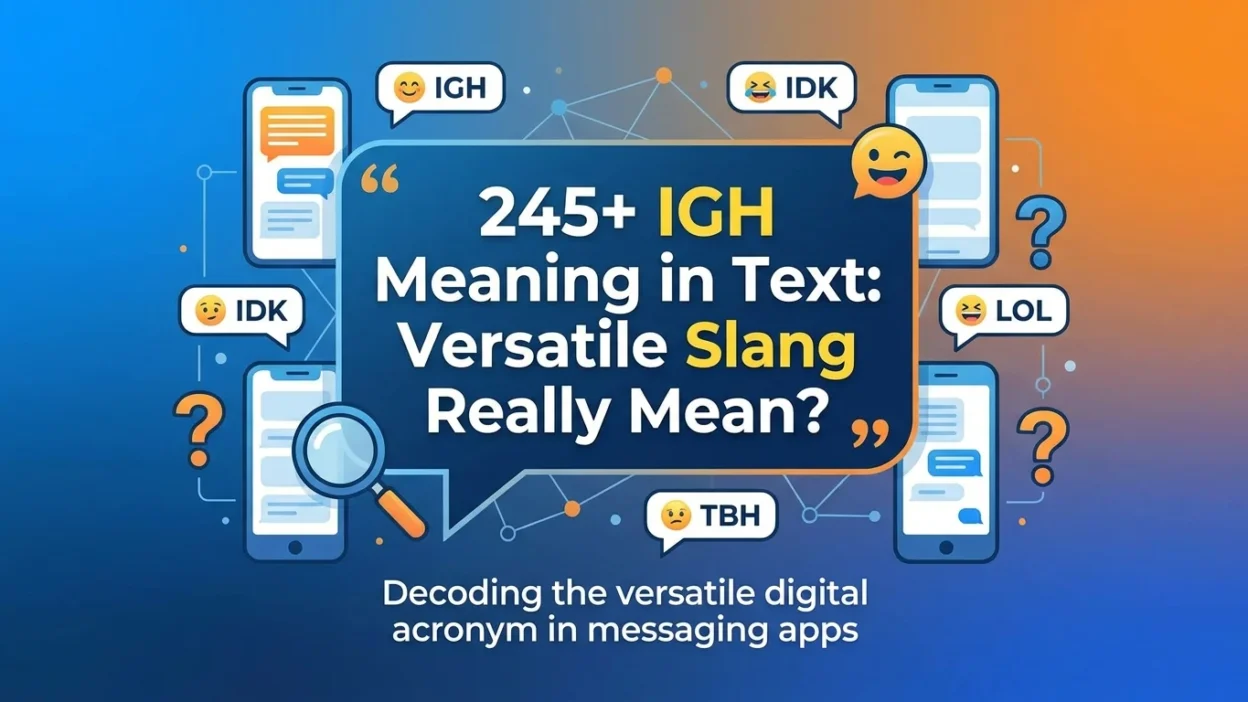
You’re scrolling through your messages, and suddenly you see it: “igh mean in text.” Maybe a friend sent it as a quick reply to your plans. Or perhaps you noticed it in a Snapchat conversation and found yourself pausing, wondering what those three letters actually mean. You’re not alone—this compact abbreviation has become surprisingly common in digital conversations, but its meaning isn’t always obvious.
The truth is, IGH doesn’t have one single definition. It’s a remarkably versatile piece of internet slang that shifts its meaning depending on who’s using it, where they’re using it, and what they’re talking about. This guide unpacks all the common interpretations of “igh meaning in text,” helping you decode exactly what someone means when they drop those three letters into a conversation. By the end, you’ll feel confident interpreting IGH in almost any context.
What Does IGH Most Commonly Mean?
Let’s start with the most frequent uses you’ll encounter in everyday digital conversations. The meaning of IGH often comes down to context, tone, and the platform you’re using.
IGH as “Alright” or “Okay”
The most common meaning of IGH is simply a casual way to say “alright,” “okay,” or “fine” . Think of it as the lazier, more relaxed cousin of “okay.” When someone types “IGH,” they’re usually acknowledging something you said or agreeing with a plan .
This usage is particularly popular because it’s quick and carries a casual, conversational tone. It’s the kind of response you might give when you’re half-paying attention or when you don’t feel like typing out a full word .
Examples of IGH meaning “Alright”:
- Your friend texts: “We’re meeting at 7 pm, is that good?” You reply: “IGH” — you’re agreeing to the plan .
- Someone asks: “Are you ready for dinner?” You respond: “Yeah, igh” — you’re confirming you’re prepared .
- A friend messages: “You tryna hop on after dinner?” You say: “Igh, send the addy and I’ll pull up” — you’re agreeing to join them .
IGH to Express Emotions
Beyond simple agreement, IGH can also convey various emotions. Depending on the context and your delivery, it can express frustration, excitement, or even mild exasperation .
Using IGH for Frustration or Resignation: When you’re annoyed or irritated, adding IGH to a message can emphasize those feelings. It’s similar to saying “ugh” but with a touch of reluctant acceptance .
- Example: “I didn’t know she was gonna be there, igh” — this shows frustration or irritation about an unexpected situation .
- Example: “Dude forgot my birthday again. IGH, why am I even surprised?” — this conveys weary resignation .
Interestingly, IGH can also function as an exaggerated written sigh. It’s the digital equivalent of rolling your eyes or letting out a long, exasperated breath . Some users describe it as the “miserable sibling of ‘ugh,’ albeit tempered with reluctant compliance” .
Using IGH for Excitement: On the flip side, IGH can express enthusiasm or excitement about something you’re looking forward to.
- Example: “IGH! Can’t wait for the weekend!” — this shows genuine excitement .
- Example: “IGH for the concert tonight!” — this conveys anticipation .
How IGH Differs from “Aight” and “Ight”
You might have noticed that “IGH” looks similar to “ight” and “aight.” That’s because they’re all variations of the same concept—they all mean “alright.”
The Relationship Between IGH and IGHT:
- “Ight” is a direct abbreviation of “alright” and is probably the most common variation you’ll see .
- “Aight” is another spelling variant that serves the same purpose .
- “IGH” functions similarly but can sometimes carry a slightly more resigned or frustrated tone .
Think of it this way:
- “Ight” = casual agreement (neutral to positive)
- “IGH” = casual agreement with a hint of reluctance, tiredness, or mild annoyance
All three are pronounced similarly—with a long “I” sound where the “gh” is silent .
Less Common Meanings of IGH
While “alright” is the dominant interpretation, IGH has a few other, less frequent meanings.
IGH as “I’m Going Home”
In some contexts, IGH can be shorthand for “I’m Going Home” . This is useful when you want to let someone know you’re about to leave or will be unavailable.
- Example: “Hey, sorry igh. I’ll text you when I’m free” — you’re letting them know you’re heading home .
- Example: “Igh, I’m heading home. I’ll text you later” — a casual way to exit a conversation .
IGH as “I Got High”
In some circles, IGH can mean “I Got High,” typically used to refer to feeling euphoric, either from cannabis use or just from excitement .
- Example: “IGH, the show’s new season is out today!” — expressing excitement .
- Example: “Igh, thinking about our date on Saturday!” — enthusiastic anticipation .
Other Professional and Formal Meanings
In more formal contexts, IGH can stand for various professional or organizational terms:
- In Good Hands — used in customer service or care contexts
- In God’s Hands — a religious or spiritual phrase
- Institute for Global Health — an actual organization
- Increased Glycated Hemoglobin — a medical term
These are niche uses that are unlikely to appear in casual texting.
The Emotional Range of IGH
One of the most interesting aspects of IGH is its emotional versatility. Depending on the context, it can convey a surprisingly wide range of feelings.
Reluctant Agreement: When you don’t really want to do something but agree anyway, IGH can convey that subtle reluctance. It’s like saying “Fine, I guess” without the extra words.
Weary Resignation: For many users, especially in Gen Z, IGH captures a sense of tired acceptance—the feeling of going along with something annoying because you don’t have the energy to argue .
Mild Annoyance: When something is mildly irritating, IGH can serve as a quick, low-effort expression of displeasure. It’s less aggressive than “ugh” but still conveys that you’re not thrilled .
Casual Affirmation: In its most neutral form, IGH is simply a chill way to say “okay” without sounding too formal or overly enthusiastic .
How to Use IGH in Your Messages
If you want to incorporate IGH into your own digital vocabulary, here are some practical tips.
Use IGH for Agreement: When someone proposes a plan and you’re on board, a simple “IGH” can serve as a quick confirmation. It’s especially useful for fast-paced group chats where brevity is valued.
Use IGH to Show You’re Feeling “Fine”: If someone asks how you’re doing and you’re not great but not terrible, “IGH” can be a concise way to say you’re getting by.
- Example: Friend asks: “Hey, you okay?” You reply: “I’m igh, just tired” .
Use IGH to Soften Criticism: When you need to deliver mild criticism or express frustration without being too harsh, adding IGH can temper the tone.
- Example: “Igh, I see where you’re coming from” — this acknowledges the other person’s perspective while still maintaining your position .
Etiquette Tips for Using IGH
While IGH is perfectly acceptable in casual conversations, there are a few situations where you should think twice before using it.
Know Your Audience: IGH is informal slang. Avoid using it in professional settings, with colleagues, or with people you don’t know well. It can come across as dismissive or unprofessional.
Avoid Overuse: Using IGH too frequently can make your messages seem lazy or disinterested. Like any slang, its value comes from appropriate use, not overuse.
Be Aware of Tone: Because IGH can convey reluctance or frustration, using it when you actually mean a cheerful “yes” might confuse the recipient. If you’re genuinely excited, consider using a more enthusiastic response.
Context Matters: On platforms like Snapchat, IGH is widely understood and perfectly natural . In a formal email to your boss, however, it’s entirely inappropriate.
Why IGH Has Become So Popular
The rise of IGH reflects broader trends in digital communication. As messaging becomes faster and more casual, users increasingly favor abbreviations that save time and keystrokes.
The Speed Factor: Typing “IGH” takes a fraction of a second compared to “alright” or “okay.” In fast-paced group chats, every millisecond counts .
The Tone Factor: “IGH” carries a specific, laid-back vibe that more formal responses lack. It signals that you’re part of the digital-native crowd and comfortable with internet slang .
The Versatility Factor: Because IGH can express agreement, frustration, excitement, or resignation, it’s a remarkably flexible tool for digital communication. One abbreviation can do the work of many.
Frequently Asked Questions
What does IGH mean in text?
IGH most commonly means “alright,” “okay,” or “fine.” It’s a casual way to acknowledge, agree, or express how you’re feeling. Depending on context, it can also convey frustration, excitement, or resignation .
What does IGH mean on Snapchat?
On Snapchat, IGH stands for “alright” and is widely used to indicate agreement, acknowledgment, or a general state of being okay. It’s a relaxed, informal way to respond to a message or plan .
Is IGH different from “ight”?
They’re variations of the same concept. Both mean “alright.” However, “IGHT” can sometimes carry a more reluctant or resigned tone, while “ight” might sound slightly more neutral .
What does IGH mean when you’re frustrated?
When used to show frustration, IGH conveys mild annoyance, exasperation, or resignation. It’s like saying “ugh” but with a sense of reluctant acceptance or weary acknowledgment of an annoying situation .
Can IGH mean “I’m Going Home”?
Yes, in some contexts, IGH is shorthand for “I’m Going Home.” It’s a way to let someone know you’re about to leave or will be unavailable .
Is IGH appropriate for professional settings?
No. IGH is informal slang and should be avoided in professional emails, messages to colleagues, or any formal communication. It’s best suited for casual conversations with friends and peers .
Why do people use IGH instead of saying “alright”?
People use IGH because it’s faster to type, saves keystrokes, and carries a casual, conversational tone that fits well with digital communication. It’s also part of internet slang culture, especially among younger generations .
Conclusion: Mastering the Versatility of IGH
The digital world is full of abbreviations, and IGH is one of the more versatile examples you’ll encounter. As we’ve explored, this three-letter acronym can express agreement, convey frustration, signal excitement, or even let someone know you’re heading home.
The most important lesson is simple: context is everything. The platform you’re using, the topic of conversation, your relationship with the sender, and even the emojis they use can all help you determine which meaning of IGH applies. Casual texting usually suggests “alright” or “okay.” Snapchat conversations often point to casual agreement. A message with a frustrated tone might mean mild annoyance or resignation.
If you’re using IGH yourself, clarity is key. Know your audience, use emojis or tone indicators when needed, and don’t be afraid to spell things out if there’s any risk of confusion. In professional settings, it’s almost always better to avoid abbreviations altogether.
Ultimately, understanding slang like IGH isn’t just about decoding messages—it’s about communicating more effectively in our increasingly digital world. The more confidently you can interpret and use these abbreviations, the smoother your online conversations will flow. So stay observant, stay curious, and when in doubt, simply ask. A quick “What do you mean by IGH?” is always better than a misunderstanding.

Amelia Brooks is a passionate writer specializing in text meanings, slang, and digital communication trends. She simplifies modern messaging to help readers understand every text with ease.