
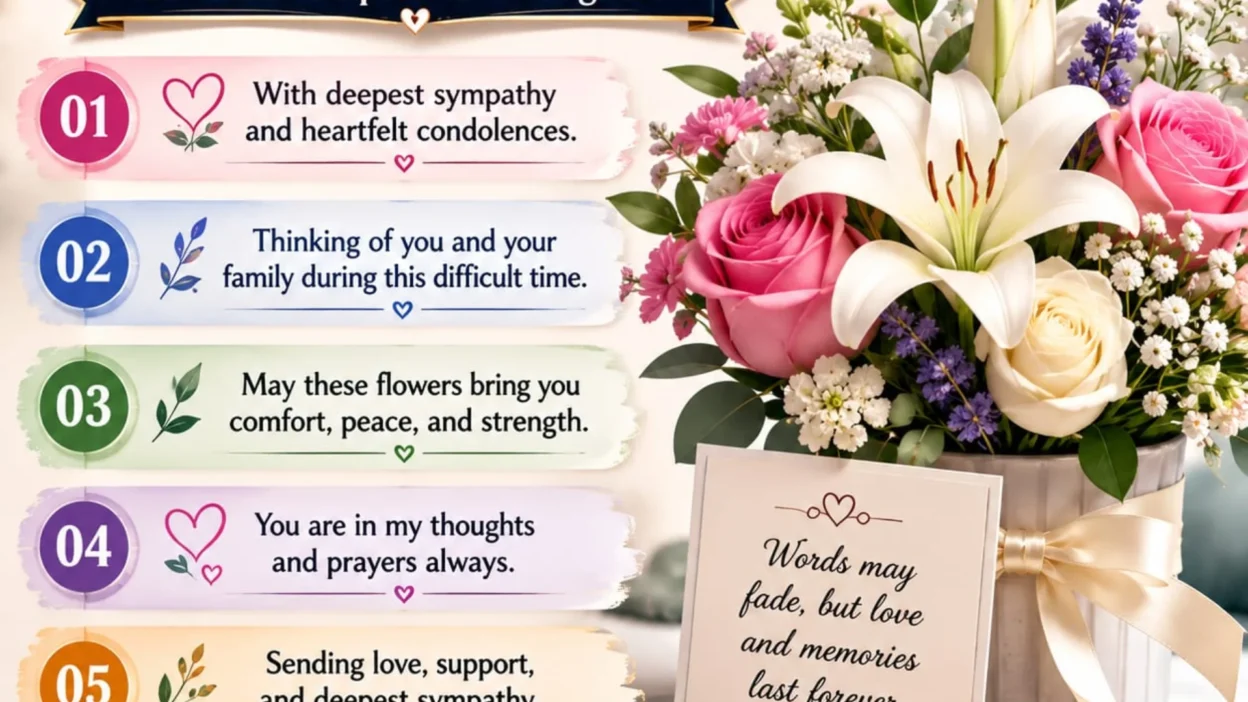
Sending flowers is one of the most meaningful ways to express condolences, but finding the right words to include on the card can feel surprisingly difficult . When you’re grieving alongside someone else, the pressure to say something perfect often makes the task even harder. The truth is, the best sympathy message for flowers doesn’t need to be long or eloquent—it simply needs to be sincere and from the heart .
This guide offers over 60 thoughtful sympathy message for flowers examples organized by relationship and situation. Whether you’re writing to a close friend, a colleague, a family member, or sending flowers for the loss of a pet, you’ll find inspiration here. Additionally, you’ll discover practical etiquette tips that ensure your message brings genuine comfort rather than adding to the burden of grief .
Why a Sympathy Message for Flowers Matters

Flowers themselves speak volumes—their beauty offers a moment of peace and reminds the recipient that they’re surrounded by care. However, the sympathy message for flowers you write on the card provides something that blooms alone cannot offer: a personal connection. It acknowledges the specific person who died and shows that you see the grieving individual’s pain .
Grieving can feel incredibly isolating, and a simple note that says “I see you, I’m here for you” can be a powerful anchor. Many people who are grieving keep small, sincere sympathy cards in a special box or on their nightstand, revisiting them on difficult days when they need to feel loved and remembered . A thoughtfully written sympathy message for flowers adds a personal touch that makes the entire gift feel uniquely meaningful.
Short Sympathy Messages for Flowers
Sometimes, a brief message is exactly what’s needed. These short but sincere phrases work well for professional relationships, acquaintances, or when you want to express support without writing a lengthy note .
Simple & Sincere
- “Thinking of you during this difficult time.”
- “With deepest sympathy for your loss.”
- “Wishing you peace and comfort.”
- “You are in my thoughts and prayers.”
- “With heartfelt condolences.”
- “Forever in our hearts.”
- “Gone but never forgotten.”
- “In loving memory.”
- “With love and fond memories.”
- “Rest in peace.”
Warm & Supportive
- “Sending love and strength.”
- “May loving memories bring you peace.”
- “Please accept my deepest sympathies. I’m here for you.”
- “Our hearts are with you.”
- “Thinking of you and wishing you moments of peace and comfort.”
- “I’m so sorry for your loss. I’m here for you, always.”
Sympathy Message for Flowers for a Close Friend

When a close friend is grieving, your sympathy message for flowers can reflect the depth of your bond. These messages often acknowledge the pain while offering unwavering support .
Thoughtful Messages for Friends
- “I am heartbroken over the loss of [Name]. They were such an incredible person and friend who brought so much joy into my life. I will always cherish our memories together.”
- “My heart aches for you during this difficult time. Please know that I am here for you and sending you all my love and support.”
- “I’m so sorry for your loss. I know how much [Name] meant to you, and I’m here for whatever you need.”
- “Your [family member] meant so much to me. Sending you all my love.”
- “I can’t imagine how hard this is. Thinking of you every day.”
- “They left such a beautiful legacy. I’ll never forget them.”
- “I know this hurts deeply. Let me bring over dinner this week.”
When You Have a Shared Memory
Including a specific memory can make your sympathy message for flowers especially meaningful .
- “I’ll never forget when [insert shared memory]. [Name] will be incredibly missed.”
- “My heart is heavy with sadness for your loss. I’ll always cherish the memories of [Name], especially the time when [shared memory].”
- “Your [name] had the best, most infectious laugh and will be greatly missed.”
Sympathy Message for Flowers for a Colleague
When sending flowers to a colleague or business associate, your sympathy message for flowers should strike a balance between professionalism and genuine care .
Professional Yet Caring Messages
- “I am so sorry for your loss. Please know that our entire team is here for you and sending our condolences during this difficult time. We are thinking of you and wishing you strength and comfort in the days ahead.”
- “I was deeply saddened to hear about the passing of [Name]. They were such a wonderful person who we cherished seeing every day in the office and will be greatly missed.”
- “My deepest sympathies go out to you for the loss of [Name]. They were a valued member of our team and a great person. Wishing you strength and comfort in the days ahead.”
- “Please accept my deepest condolences. I’m here to help with any work tasks you need taken off your plate.”
- “My thoughts are with you and your family during this sorrowful period.”
Sympathy Message for Flowers for a Family Member
Writing to a family member often means sharing a deeper personal connection. Your sympathy message for flowers can reflect shared history, love, and the collective grief of the family .
For a Parent
- “Mum/Dad, you were loved by all. You’ll be missed more than words can say.”
- “Thank you for everything, Mum/Dad — your love will stay with me forever.”
- “You gave me the best life. Rest peacefully.”
- “To the best Dad I could have asked for – there are no words to express how much I will miss you.”
- “Dear Dad, you will live in our hearts and minds forever. Miss you.”
- “Mum, you always inspired me to be the best I could be. There are no words to say how much I miss you.”
For a Sibling
- “You were my strength in good times and bad. Thank you for everything dear Brother.”
- “Dear Brother, you are loved dearly.”
- “Dear Sis, you were my best friend. I will miss you everyday.”
- “Cherishing all the love and memories forever.”
- “Miss you so much, love you forever.”
For a Grandparent
- “Grandma/Grandad, though we grieve you now, your memory will live on through us.”
- “Thank you for being there for me in darkness and in light. Miss you always.”
- “Nan, your love and compassion turned me into a better person and for this I am grateful.”
- “I will always carry in my heart fond memories of you dear Grandma.”
- “Dear Grandad, I will always hold you close to my heart.”
Sympathy Message for Flowers for the Loss of a Child
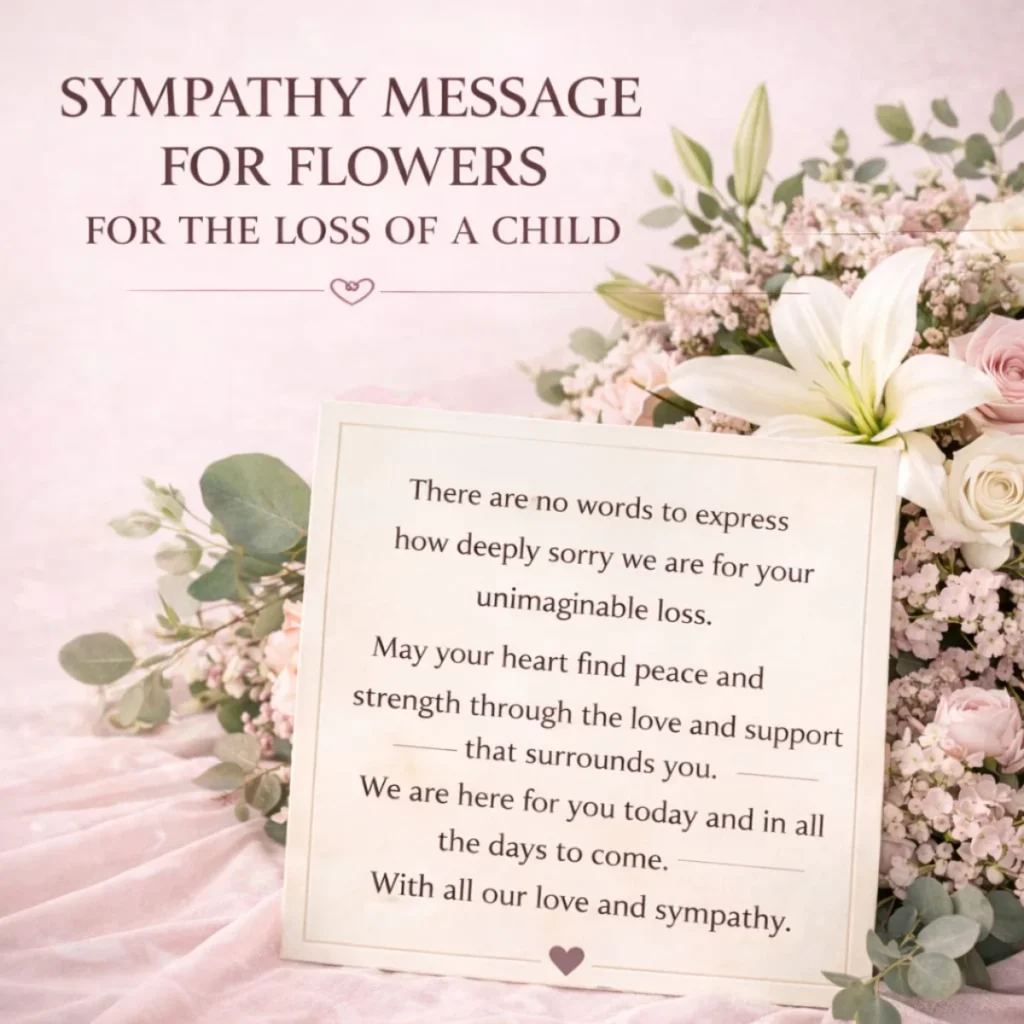
Losing a child is an unimaginable grief. Your sympathy message for flowers should be gentle, loving, and avoid any attempt to minimize the loss .
Messages of Comfort
- “There are no words to express the deep sorrow I feel for your loss. [Name] was a beautiful soul who brought light into this world. My heart is with you.”
- “I am so sorry for the loss of your precious [son/daughter]. Their memory will live on in the hearts of all who knew and loved them.”
- “Your child’s big heart and beautiful personality were infectious. My heart breaks for you and your family.”
- “How very quietly you tiptoed into our world, silently, only a moment you stayed. But what an imprint your footprints have left on our hearts.”
- “The love and joy that your child brought to us will never be forgotten.”
Sympathy Message for Flowers for Pet Loss
For many people, losing a pet means losing a family member. Your sympathy message for flowers can honor the special bond they shared .
Heartfelt Messages for Pet Loss
- “I am so sorry for the loss of your beloved [pet’s name]. They brought so much joy and love into our lives.”
- “Losing a pet is losing a family member. My heart goes out to you during this difficult time.”
- “Your [dog/cat/horse] brought so much joy to everyone who knew them. Sending you love.”
- “I know how much they meant to you. I’m here to listen whenever you need.”
- “They’ll be waiting at the bridge, safe and loved, until we see them again.”
Religious Sympathy Messages for Flowers
If the deceased or their family holds religious beliefs, a faith-based sympathy message for flowers can provide spiritual comfort .
Faith-Based Messages
- “May God bless you and keep you in His care.”
- “In God’s arms may you gently rest.”
- “A silent thought, a quiet prayer, for someone in God’s care.”
- “Heaven has gained another angel.”
- “During this time of grief, we pray that you find comfort and strength in your faith. May God bless and guide you through this difficult time.”
- “You are in my thoughts and prayers.”
What to Avoid in a Sympathy Message for Flowers
Knowing what not to say is just as important as knowing what to say. Certain phrases, though often well-intentioned, can actually add to a grieving person’s pain .
Hurtful Clichés to Avoid
What to Say InsteadWhat to Avoid“I’m so sorry for your loss.””Everything happens for a reason.””I’m here for you, no matter what.””You’ll get over it eventually.””Your loved one meant so much to me.””At least they lived a long life.””Sending you all my love and strength.””I know exactly how you feel.””I’ll never forget [deceased’s name].””You can always get another pet/child.””Your grief is valid, and I see you.””They’re in a better place now.”
Helpful phrases validate grief and offer support, while hurtful clichés often try to minimize or rush the grieving process . Even when you mean well, phrases that dismiss pain can make a grieving person feel alone and unheard.
Etiquette Tips for Sending a Sympathy Message with Flowers
Choosing the right sympathy message for flowers is just one part of the process. These etiquette tips will help ensure your gesture is as supportive as possible .
Timing Considerations
You don’t have to send flowers immediately after hearing about the loss. Many grieving people are overwhelmed with visitors and calls in the first few days. Waiting a week or two can actually be more helpful. Additionally, sending flowers months later, on the anniversary of the loss, can be a meaningful way to show you’re still thinking of them .
Who to Address
You can write to the deceased (“Rest in peace, Mum”) or to the family (“Thinking of you all”). Either approach is appropriate; just be consistent. Using the full name of the deceased is a good way to ensure clarity .
Group Messages
If multiple people are sending the flowers together, list everyone’s names or simply say “from all of us at [family/workplace/etc.]” .
Handwritten vs. Printed
A handwritten note feels far more personal than a printed one, even if the message is short. It shows you took the time to sit down and write specifically for the grieving person .
Pairing with Practical Support
Grieving people often struggle to find time for everyday tasks. Pairing your flowers with a practical gift, like a meal gift card, a cozy blanket, or a pre-made meal, can take a huge weight off their shoulders .
Following Up
Sending flowers and a sympathy message for flowers is a great first step, but don’t stop there. Follow up with a quick text or call a few weeks later, just to check in. Grief doesn’t end after the funeral, and many people feel forgotten in the months after a loss .
Frequently Asked Questions About Sympathy Messages for Flowers
What should I write in a sympathy message for flowers?
Keep your sympathy message for flowers short, sincere, and personal. Acknowledge the loss, express your condolences, and offer support. For example: “I am deeply sorry for your loss. My heart goes out to you and your family during such a difficult time.”
How do I write a short sympathy message for flowers?
Short sympathy messages for flowers can be as simple as “Thinking of you during this difficult time,” “With deepest sympathy,” or “Wishing you peace and comfort.” The most important thing is to be sincere and avoid trying to fix their grief—just acknowledge it .
What do you write on funeral flower cards?
Funeral flower cards usually include a short, respectful sympathy message for flowers such as “In loving memory,” “Forever in our hearts,” “Gone but never forgotten,” or a more personal note like “I’ll never forget [Name]’s kindness and the joy they brought into our lives” .
What are some sympathy messages for flowers for a friend?
For a friend, try: “I’m so sorry for your loss. I’m here for you, always,” or “Your mom/dad/sibling meant so much to me. Sending you all my love.” Including a shared memory can also make the message especially meaningful .
What are examples of sympathy messages for flowers for a family member?
For a parent, examples include “Mum/Dad, you were loved by all. You’ll be missed more than words can say” or “Thank you for everything — your love will stay with me forever.” For a sibling, “Dear Brother/Sister, you were my best friend. I will miss you everyday” .
What should I avoid writing in a sympathy message?
Avoid clichés like “Everything happens for a reason,” “You’ll get over it eventually,” or “At least they lived a long life.” These phrases often dismiss a person’s grief and can make them feel unheard .
How do I sign a sympathy card with flowers?
Sign with your full name if the recipient might not immediately recognize you. If it’s a close friend or family member, a first name is usually sufficient. For group messages, list everyone’s names or say “from all of us at [workplace/family]” .
What flowers are best for sending with a sympathy message?
Classic sympathy flowers include lilies, roses, chrysanthemums, and carnations. White and cream-colored flowers are traditional for sympathy arrangements. If you know the grieving person’s favorite flowers, sending those can be a deeply personal gesture .
Conclusion
Writing a sympathy message for flowers is an act of kindness that can provide real comfort to someone who is grieving. The words you choose don’t need to be elaborate or perfect—they just need to come from a place of genuine care. A short, heartfelt message that acknowledges the loss and offers support can make a grieving person feel seen, loved, and less alone.
Remember that your message is a companion to the flowers themselves. The beauty of the blooms offers a visual reminder of life and love, while your words add a personal touch that makes the gift feel uniquely meaningful. By avoiding hurtful clichés and focusing on validation and support, you can ensure that your sympathy message for flowers brings the comfort you intend. Your gesture, no matter how small, is a powerful way to show someone that they are not alone in their grief.

Amelia Brooks is a passionate writer specializing in text meanings, slang, and digital communication trends. She simplifies modern messaging to help readers understand every text with ease.