Have you ever stared at your phone screen, completely unsure how to express comfort after someone shares bad news? You are not alone. Texting has transformed how we communicate grief, yet many people still struggle with finding the right words. Sympathy message has become a critical skill in digital communication. After all, a thoughtful condolence text can provide immense emotional support during difficult times. Interestingly, the way we craft these messages has evolved dramatically over the past decade. This guide will teach you everything about sending the perfect sympathy message via text. You will learn proper etiquette, see real examples, and discover powerful alternatives. Consequently, you will never feel awkward or unsure when responding to someone’s loss again.
Definition & Core Meaning of Sympathy Message
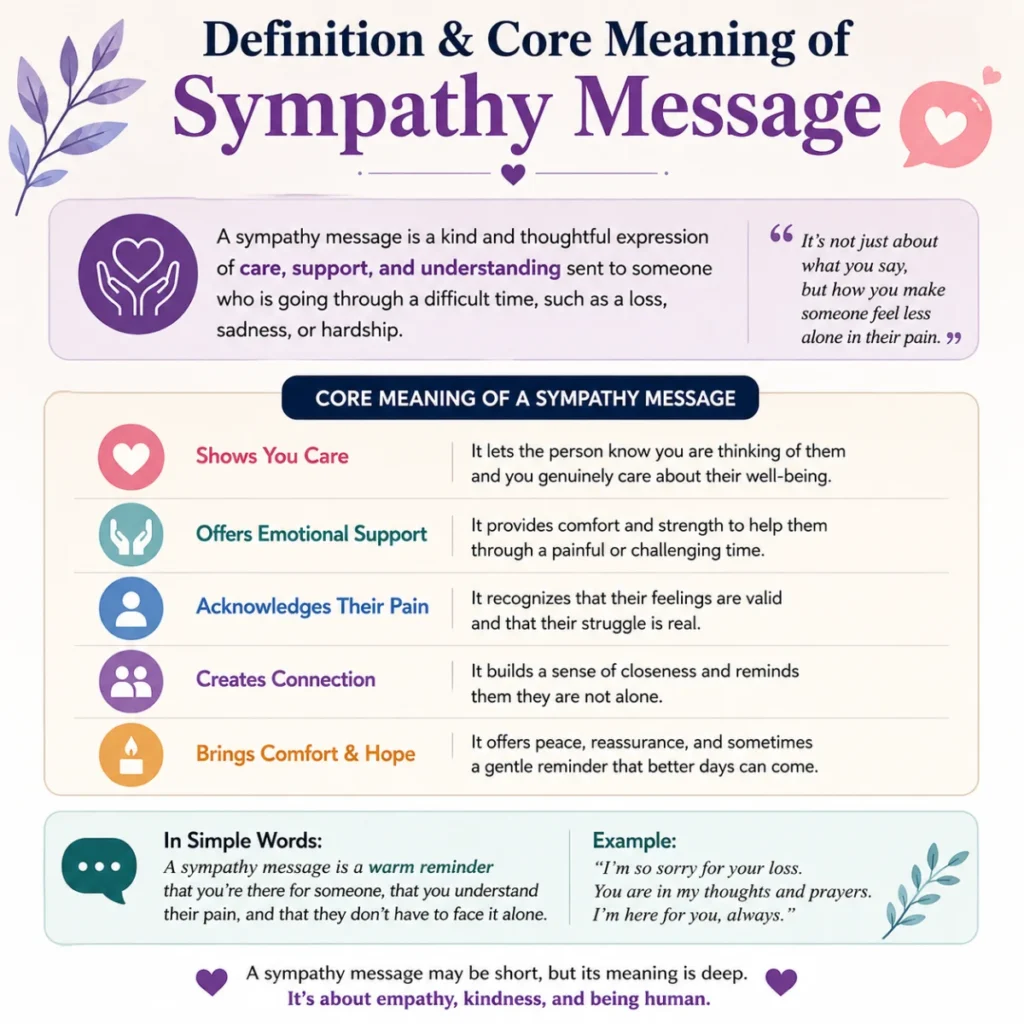
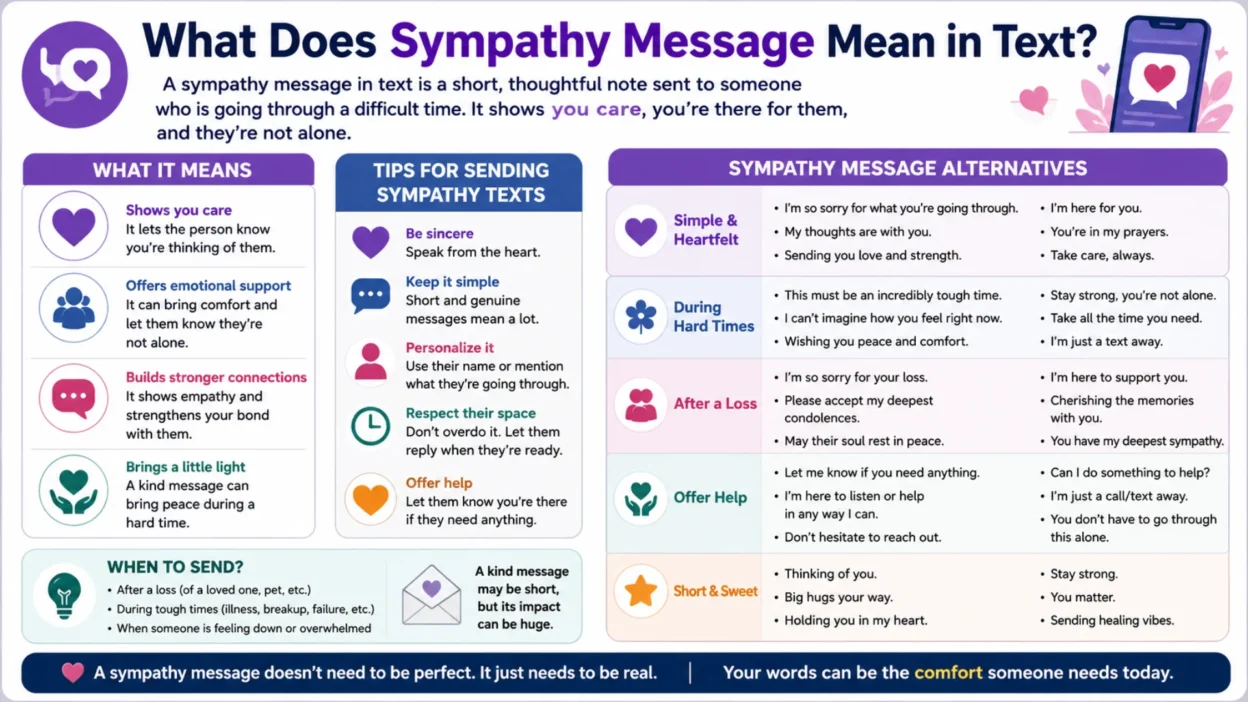
A sympathy message is a written expression of comfort, compassion, and support sent to someone experiencing grief, loss, or hardship. Specifically, it acknowledges another person’s pain without trying to fix it. Unlike advice or problem-solving texts, a sympathy message focuses purely on emotional validation.
Typically, these messages include three key components. First, they recognize the loss or difficulty directly. Second, they convey genuine care for the recipient’s well-being. Third, they offer support without making demands. For example, “I heard about your grandmother. I am deeply sorry for your loss” checks all these boxes.
Nevertheless, many people confuse sympathy message with empathy statements or apology texts. Sympathy expresses sorrow for someone. Empathy, however, involves feeling with that person. Therefore, a sympathy message maintains a gentle distance while still showing profound care.
Key Characteristics of an Effective Sympathy Message
- Brief but meaningful – 2 to 5 sentences typically suffice
- Personalized – Mentions the specific loss or struggle
- Action-oriented (rarely) – Offers concrete help sparingly
- Future-focused lightly – Acknowledges healing without pressure
- Avoids clichés – Steers clear of “everything happens for a reason”
Consequently, mastering this balance transforms an awkward text into genuine comfort.
History & Origin of Sympathy Message in Digital Communication
The sympathy message traces its roots to handwritten condolence letters popular in the Victorian era. During the 1800s, mourning etiquette demanded formal, often lengthy letters delivered by mail. These documents followed strict social rules about paper color, ink type, and phrasing.
Fast forward to the 1990s. Email emerged as a faster alternative. Suddenly, people could send a sympathy message within hours of hearing sad news. However, early email condolences still mimicked letter writing. They remained formal, structured, and relatively lengthy.
The true transformation began with SMS texting in the early 2000s. Character limits forced brevity. Consequently, the modern sympathy message was born. People learned to compress deep emotion into 160 characters. For instance, “So sorry for your loss ❤️” became acceptable shorthand.
Social media platforms like Facebook and Instagram introduced public sympathy message posting. Comment sections filled with “Sorry for your loss” and heart emojis. This shift raised new etiquette questions. Is a public sympathy message less genuine than a private one? Experts suggest both have their place depending on your relationship.
Today, messaging apps like WhatsApp, iMessage, and Telegram dominate. As a result, sympathy message culture continues evolving. Voice notes, GIFs, and even shared digital memorials now supplement traditional text. Interestingly, the core principles remain unchanged from Victorian times: acknowledge pain, show care, offer quiet support.
Real-World Examples of Sympathy Message in Conversations
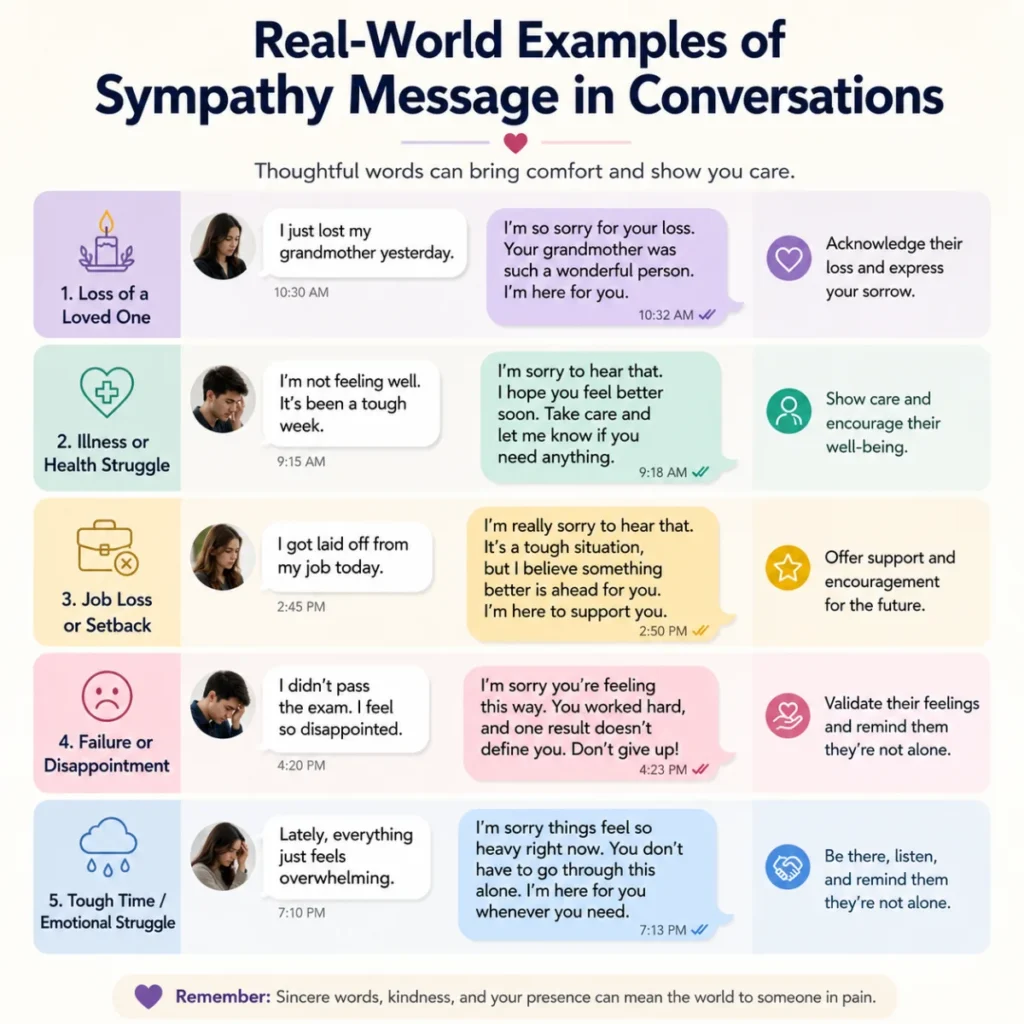
Below are four authentic scenarios demonstrating proper sympathy message usage. Each example reflects different relationships and levels of closeness.
Example 1: Close Friend – Pet Loss
Friend: “My dog Max passed away this morning. I am completely broken.”
You: “Oh no, Max was such a sweet boy. 💔 I am sending you so much love right now. He knew how much you adored him.”
Why it works: This sympathy message names the pet, acknowledges the bond, and avoids minimizing the loss.
Example 2: Coworker – Family Illness
Coworker: “My mom’s cancer treatments aren’t working. They are sending her home for hospice tomorrow.”
You: “I am so incredibly sorry to hear this. Please know you do not need to worry about the Johnson project. I have it covered for as long as you need.”
Why it works: The sympathy message combines emotional acknowledgment with specific, actionable help.
Example 3: Acquaintance – Job Loss
Acquaintance: “Got laid off today along with half my department.”
You: “That is incredibly stressful. I remember how hard you worked there. If you want me to review your resume or share any leads, just say the word.”
Why it works: This sympathy message validates the hardship while offering practical support without pressure.
Example 4: Family Member – Miscarriage
Sibling: “We lost the pregnancy at 10 weeks. I don’t even know what to say.”
You: “I am holding you both in my heart. There are no right words, but I am here. Want me to drop off dinner tomorrow night?”
Why it works: The sympathy message admits the limits of language while providing concrete comfort.
How Context Changes the Meaning of Sympathy Message
The same sympathy message can land completely differently depending on the platform and relationship context. Understanding these nuances prevents accidental hurt.
Texting (iMessage, WhatsApp, SMS)
In one-on-one texting, a sympathy message should feel personal and immediate. Brevity is acceptable but avoid sounding robotic. For instance, “Sorry” alone feels dismissive. However, “So sorry. Thinking of you.” works well. Texting allows for back-and-forth clarification. Consequently, you can follow up hours later with a longer message.
Social Media (Facebook, Instagram, Twitter)
Public sympathy message posts require extra caution. Someone’s loved one may not want their grief displayed publicly. Before commenting, check if the person shared the news themselves. If they did, a short public sympathy message like “Sending love your way 💕” is fine. Nevertheless, save detailed condolences for private direct messages.
Gaming Platforms (Discord, Twitch, Xbox Live)
Gaming communities have unique norms for a sympathy message. Casual language and humor are common, but grief demands respect. A good gaming sympathy message might be: “Dude, that sucks so much. Take all the time you need. We will hold your spot in the clan.” Avoid excessive slang or inside jokes initially.
Dating Apps (Tinder, Bumble, Hinge)
A sympathy message on a dating app is tricky. You likely have minimal history with the person. Therefore, keep it brief and low-pressure. Example: “I am sorry you are dealing with that. No pressure to reply quickly.” Do not over-invest emotionally. Avoid offering to meet up as comfort unless you have already dated for weeks.
Professional Messaging (Slack, Teams, Email)
Workplace sympathy message etiquette demands professionalism. Acknowledge the loss without prying for details. Use phrases like “I was saddened to hear about your loss. Please let me know if deadlines need adjusting.” Never use emojis in professional sympathy message contexts unless the workplace culture is exceptionally casual.
Tone Nuances: Is Sympathy Message Rude or Friendly?
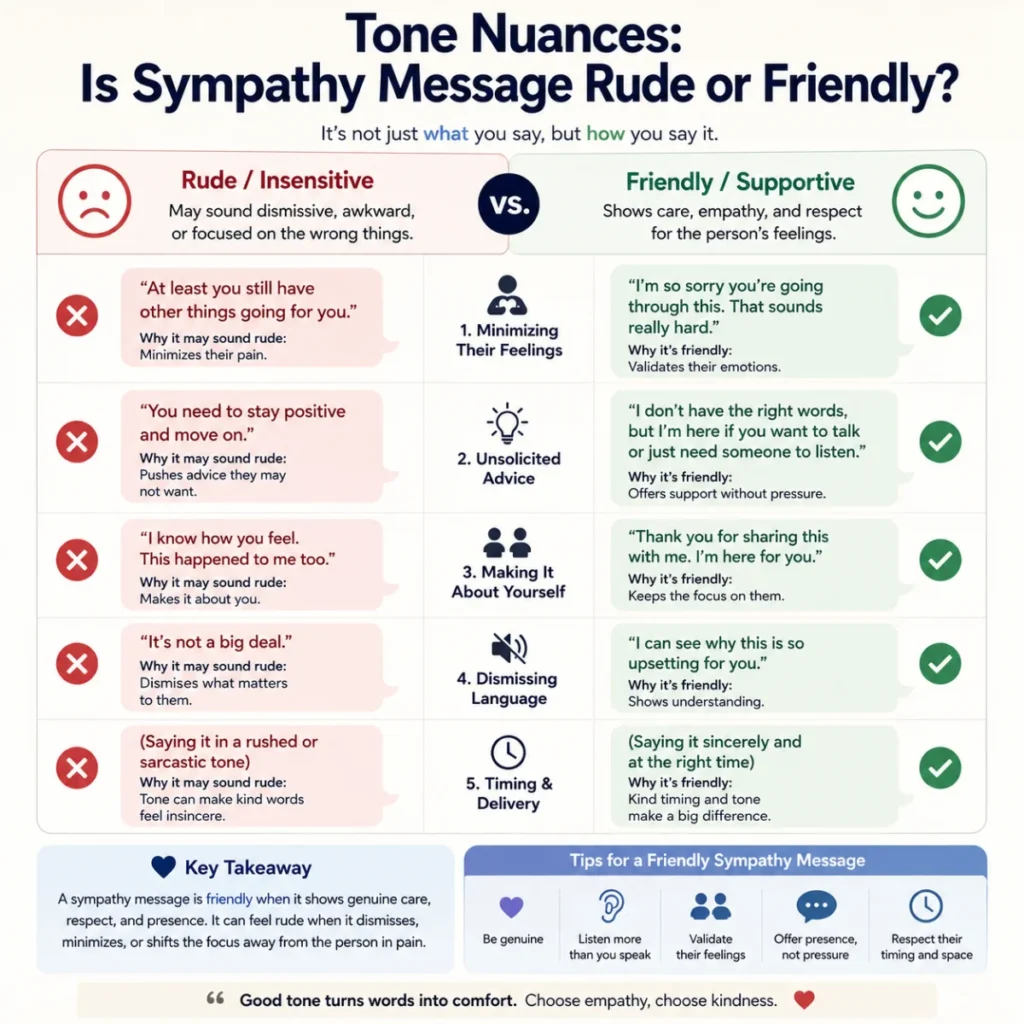
A sympathy message sits on a spectrum from deeply warm to coldly formal. The difference often lies in specific word choices and punctuation. Let us break down what makes a feel rude versus friendly.
Signs of a Rude or Insensitive Sympathy Message
- One-word replies – “Sorry.” (without follow-up)
- Comparisons – “I know exactly how you feel. My cat died last year.”
- Unsolicited advice – “You should try grief counseling.”
- Clichés about fate – “Everything happens for a reason.”
- Changing the subject – “Anyway, did you see the game last night?”
These approaches dismiss the recipient’s unique pain. Consequently, they damage relationships rather than healing them.
Signs of a Friendly, Empathetic Sympathy Message
- Personal acknowledgment – “I remember how close you were with your aunt.”
- Open-ended support – “I am here if you want to talk or just sit in silence.”
- Gentle permission – “No need to respond to this text at all.”
- Specific, small offers – “Can I send coffee your way tomorrow?”
- Emotion labeling – “This sounds incredibly painful.”
Friendly examples prioritize the recipient’s comfort over the sender’s need to “fix” things. As a result, they build trust and demonstrate true emotional intelligence.
The Role of Punctuation and Emojis
Punctuation changes tone dramatically. A ending with a period can feel final or cold. Compare “Sorry for your loss.” versus “Sorry for your loss 💙” – the heart softens everything. Similarly, exclamation marks rarely belong in condolence texts. They can seem overly cheerful or jarring.
Sympathy Message vs Similar Slang Terms
Many people confuse with related texting concepts. The table below clarifies key differences.
TermCore DefinitionWhen to UseExampleSympathy MessageExpressing sorrow for someone else’s painDeath, illness, job loss, breakup“I am so sorry about your father’s passing.”Condolence NoteMore formal than a text; often handwrittenFunerals, memorial servicesFormal letter on cardstockEmpathy StatementCommunicating shared feeling; deeper than sympathyClose relationships, shared trauma“I feel your grief because I lost my mom too.”Check-in TextAsking about current well-being without assuming bad newsOngoing illness, chronic stress“How are you holding up today?”Supportive MessageBroader category including encouragement, not just griefAny hardship, including financial or academic struggles“You’ve got this. One day at a time.”Consolation TextAttempting to reduce disappointment rather than griefLosing a game, failing a test, minor setbacks“That really stinks. Next time will be better.”
Notice that sympathy message specifically addresses profound loss. It does not trivialize pain with “look on the bright side” language. Furthermore, it never demands emotional labor from the grieving person.
What Does “If Sympathy Message Sympathy Message” Mean?
You may occasionally see the phrase “if ” in online forums or texting guides. This construction typically refers to conditional or hypothetical condolence scenarios. Specifically, it describes situations where someone debates whether or not to send a .
For example: “If sentiment is genuine, then sending that sympathy message makes sense.” Alternatively, “If timing feels wrong, delay sending it.”
In practice, people rarely type this exact phrase in casual conversation. Instead, it appears in etiquette articles discussing decision-making frameworks. The repetition emphasizes the conditional nature of the choice.
Key takeaway: When unsure whether to send a sympathy message, consider these three factors:
- Your relationship closeness
- How you learned the news
- Whether someone closer to the griever has already reached out
If all three align positively, send that without overthinking.
How to Respond to a Sympathy Message
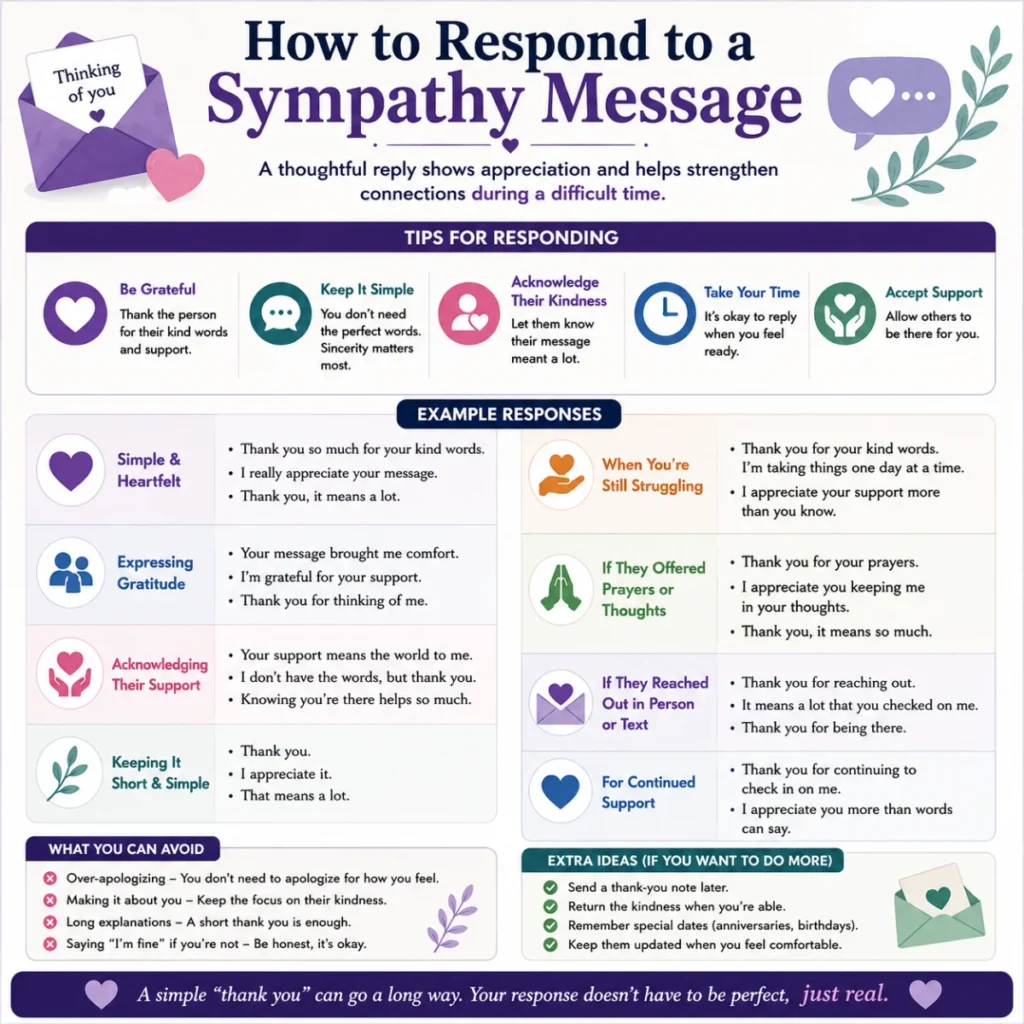
Receiving a sympathy message can feel awkward. You may not know how to acknowledge someone’s kindness while grieving. Below are three common scenarios with ideal responses.
Scenario 1: You Want to Keep It Brief (Overwhelmed with Grief)
They sent: “Thinking of you during this impossible time.”
Your reply: “Thank you. That means a lot.”
Why it works: This response acknowledges the without forcing you to manage their emotions. Short is perfectly acceptable here.
Scenario 2: You Feel Like Explaining Briefly
They sent: “I am so sorry about your diagnosis. I am here for appointments if you need rides.”
Your reply: “I really appreciate that offer. I may take you up on it next week. Thank you for understanding.”
Why it works: You accept specific help from the while setting boundaries around timing.
Scenario 3: You Do Not Know the Person Well
They sent: “Sorry to hear about your loss from the team email.”
Your reply: “Thank you for reaching out. I am taking things day by day.”
Why it works: This response politely closes the loop on the without encouraging further conversation. It is gracious yet neutral.
What to Avoid When Responding
- ❌ Over-explaining your grief (you owe no one details)
- ❌ Apologizing for their discomfort (“Sorry to make you sad”)
- ❌ Immediately changing the subject (“Anyway, how is work?”)
- ❌ Ignoring the sympathy message completely (seen as rude)
Professional Use: Can You Say Sympathy Message at Work?
Workplace communication requires extra caution around sympathy message phrasing. Yes, you can absolutely acknowledge a coworker’s loss professionally. However, following specific guidelines prevents accidental harm.
Appropriate Professional Sympathy Message Scenarios
- Coworker’s immediate family member dies
- Coworker suffers a serious health crisis
- Coworker experiences a miscarriage or stillbirth
- Coworker’s long-term pet dies (if they were openly devoted to that pet)
Inappropriate Professional Sympathy Message Scenarios
- Coworker’s distant relative (great-aunt, cousin twice removed) dies
- Coworker goes through a casual breakup
- Coworker misses a promotion
- Coworker’s friend dies (unless you also know that friend personally)
Professional Sympathy Message Template
Subject: Thinking of you
Body: “Hi [Name], I was saddened to hear about your [loss/situation]. Please know there is no pressure to respond. Take whatever time you need. If you want me to handle [specific task] while you are away, just let me know.”
Why this works: It keeps the brief, offers concrete help, and removes reply pressure.
Platforms and Their Risk Levels
PlatformAppropriate?Best PracticeWork EmailYesKeep formal, no emojisSlack (public channel)NoToo performativeSlack (direct message)YesBrief, empatheticTeam meetingNoPuts them on the spotCompany-wide memoOnly for executivesMust be approved by HR
Common Misconceptions About
Several myths prevent people from sending helpful sympathy message texts. Let us debunk the most harmful ones.
Misconception 1: “You must send a handwritten card instead of a text.”
Reality: Experts now agree that a timely via text beats a late card. Grieving people often feel isolated in the first 48 hours. A quick text shows immediate support. Cards arriving weeks later can feel like an afterthought. Therefore, send the text first. Mail a card later if appropriate.
Misconception 2: “Mentioning the specific loss makes things worse.”
Reality: The opposite is true. A vague like “Sorry you are going through this” feels dismissive. In contrast, naming the loss (“Sorry about your father”) proves you are paying attention. It validates their specific pain. Obviously, only name the loss if you are certain of the details.
Misconception 3: “You should only send one sympathy message and then stay silent.”
Reality: Grief lasts far longer than society acknowledges. A single followed by weeks of silence can feel like abandonment. Consider sending a second message after 10-14 days. For instance: “Still thinking of you. How are you eating this week?” This follow-up shows sustained care.
Misconception 4: “Emojis are always inappropriate in a .”
Reality: While excessive emojis are tacky, a single well-chosen symbol can soften text. The 🫂 (hugging face) and 💙 (blue heart for calm solidarity) work well. Avoid 😂, 😍, or 🎉 obviously. Use emojis only with people you know reasonably well.
5 Polite Alternatives to Sympathy Message
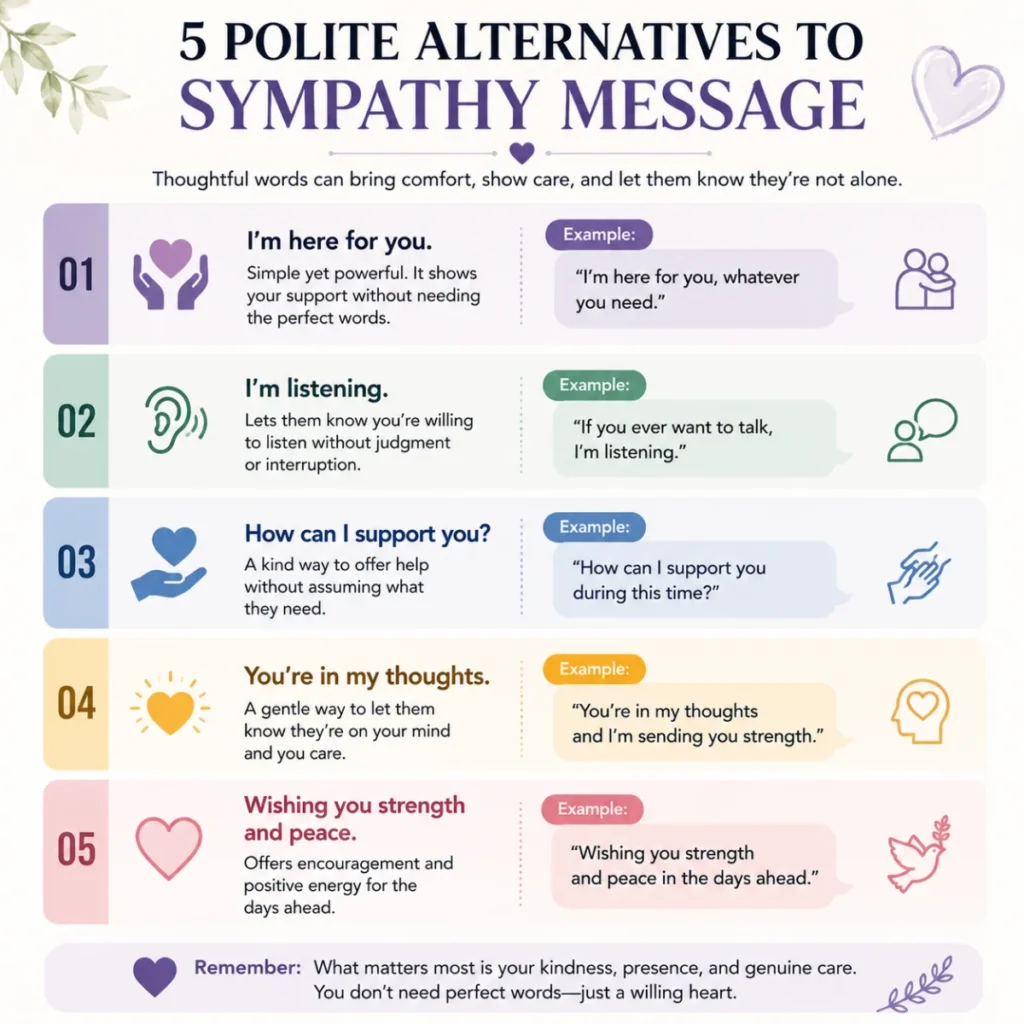
Sometimes you want to express comfort without using the exact phrase “sympathy message.” These alternatives offer variety while preserving emotional depth.
Alternative PhraseBest Used ForExample Sentence“Thinking of you”Any loss or hardship; very versatile“Thinking of you during this difficult time.”“Sending comfort”Illness, chronic pain, mental health struggles“Sending comfort your way as you recover.”“You are in my heart”Deep, personal losses (child loss, spouse death)“You are in my heart today and always.”“Holding space for you”Traumatic or complicated grief“Holding space for you and all you are feeling.”“With you in spirit”Distance prevents physical presence“Wish I could be there. With you in spirit.”
Each alternative carries slightly different emotional weight. “Thinking of you” is safest for acquaintances. “Holding space for you” works best for emotionally intelligent close friends. Match the alternative to your relationship depth.
Frequently Asked Questions About Sympathy Message
1. How long should I wait before sending a sympathy message text?
Send it as soon as you hear the news, ideally within 24 hours. Waiting more than three days can seem like you forgot. However, a late sympathy message is always better than none. Simply acknowledge the delay: “I just learned about your loss. I am so sorry I did not know sooner.”
2. Can I send a sympathy message via group chat?
Generally, no. Group chats dilute the personal nature of a . The grieving person may feel put on display. Send a private message instead. The only exception is if the group consists exclusively of very close mutual friends who all want to support the person together.
3. Should I include a question in my ?
Yes, but make it low-pressure. Yes/no questions work best. For example: “Can I drop off groceries tomorrow?” versus “What do you need?” The latter forces the grieving person to manage logistics. Consequently, stick to specific, easy-to-answer questions.
4. Is it rude to send a sympathy message on a holiday?
It depends on the timing. If the death or bad news occurred on or just before a holiday, sending a sympathy message is appropriate. However, avoid mentioning the holiday itself (“Hope you still enjoy Christmas”). Focus entirely on the loss. Alternatively, wait until the holiday passes if the news is several weeks old.
5. How do I end a sympathy message conversation?
Let the grieving person lead. After your initial sympathy message, they may or may not reply. If they reply briefly (“Thanks”), do not demand further engagement. Send one final acknowledgment: “Of course. No need to respond again. I will check in next week unless you reach out first.” This gives them control.
Conclusion
Mastering the sympathy message transforms you into a truly supportive friend, coworker, and family member. You have learned that effective condolence texts balance brevity with genuine emotion. They name the specific loss, avoid harmful clichés, and remove pressure to respond. Furthermore, you discovered how context changes everything – a on LinkedIn differs wildly from one on Discord.
The best you can send is the one you send today. Do not wait for perfect words. Do not overthink punctuation. Just write from a place of honest care. Consequently, your message will land as intended: a warm, comforting presence in someone’s darkest moment.
Remember the golden rule of digital condolences: It is far better to send an imperfect than to send nothing at all. Silence, after all, speaks louder than any text – and rarely says anything kind.

Amelia Brooks is a passionate writer specializing in text meanings, slang, and digital communication trends. She simplifies modern messaging to help readers understand every text with ease.